Rail overview
Rail as a national and regional connector
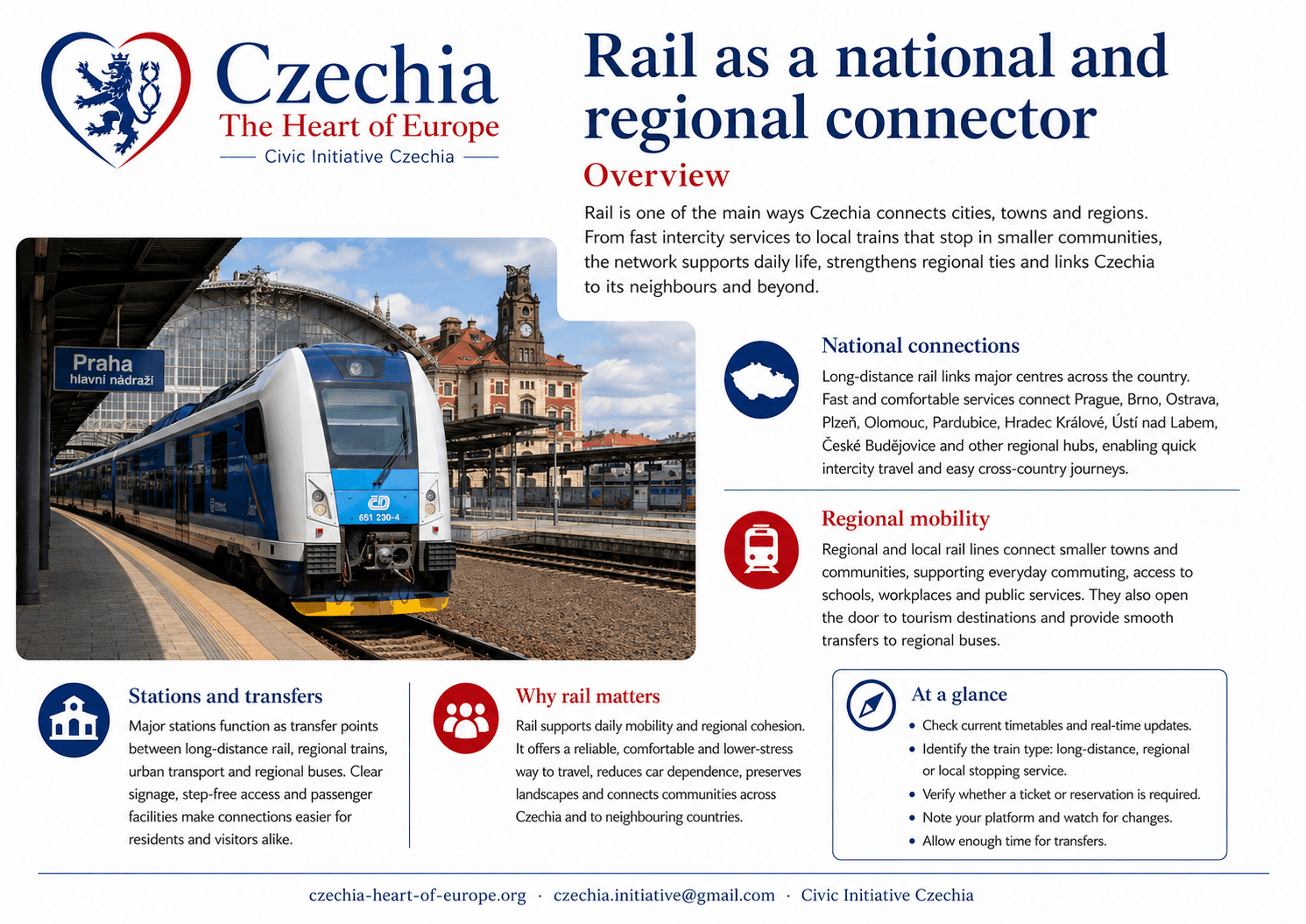
Rail in Czechia connects major cities, smaller towns, border regions, spa places,
industrial centres, university cities and international routes. A train journey may
be local, regional, long-distance or cross-border, and the right ticket depends on
the route, operator, tariff and service type.
Czech rail travel is used for commuting, study, tourism, business, family visits,
airport access in some routes, and international movement. The same station can serve
several operators, train categories and platforms, so the practical reading begins with
the route, train number, departure board and ticket conditions.
Local and regional
Daily movement
Regional trains connect towns, suburbs, schools, workplaces, services and transfer hubs.
Long-distance
City-to-city travel
Express and long-distance trains connect Prague, Brno, Ostrava, Plzeň, Olomouc and other centres.
International
Cross-border rail
International services connect Czechia with neighbouring countries and wider European routes.
Train types
Regional, long-distance and international rail
Regional trains are often used for commuting, school, local services and short journeys between
towns. Long-distance trains connect major centres and usually have clearer onboard services,
longer routes and more reservation options. International trains add border, operator and
reservation conditions.
Regional trains
Local access and transfers
Useful for towns, suburbs, landscapes and connections into larger transport hubs.
Long-distance trains
City-to-city routes
Often used between major Czech cities and for longer domestic journeys.
International trains
Cross-border conditions
Check reservation, train-bound ticket rules, refund conditions and station names carefully.
Stations
Stations, platforms and train information
Czech train stations range from major city hubs to small regional stops. Larger stations may
have ticket counters, machines, shops, toilets, waiting areas, lockers, information boards,
lifts or underpasses. Smaller stops may have only a shelter, timetable, platform and basic signage.
Departure boards usually show train category, number, destination, departure time, platform,
delay and intermediate information. Platform numbers can change, especially during disruption
or construction, so check the board shortly before departure.
Station name
Use the exact station
Large cities can have several stations. Confirm the full station name before buying or boarding.
Platform
Watch final updates
Track and platform details may appear shortly before departure and can change during disruption.
Train number
Match route and service
The train number helps separate similar departures, split services and routes with the same destination.
Tickets
Tickets, operators and reservations
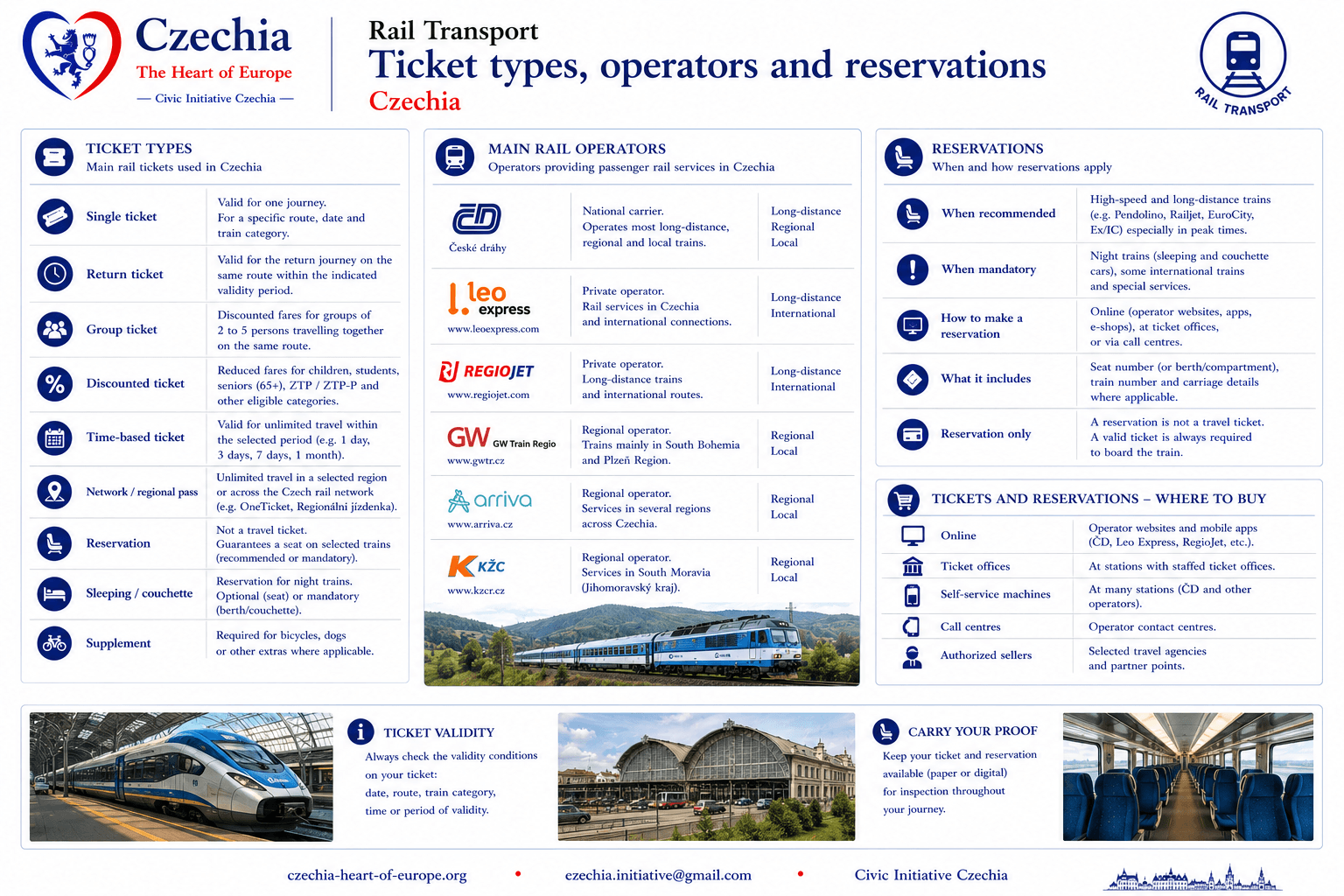
Rail tickets may be bought through an operator e-shop or app, ticket counter, ticket machine,
integrated regional system, international platform or authorized seller. The ticket may be valid
for a specific train, a route, a time window, a region, a day product, a group, a bicycle, a dog
or a reserved seat.
Several operators can run on the same rail network. A ticket bought from one operator or tariff
may have limits on other operators, train categories or routes. Before buying, check whether the
ticket is flexible, train-bound, operator-bound, region-bound or reservation-linked.
Route
Confirm the exact departure station, arrival station, date and direction.
Operator
Check which operator runs the selected train and whether the ticket is accepted on that service.
Ticket type
Separate one-way, return, regional, day, group, international, bike, dog and discounted tickets.
Reservation
Some trains have optional reservations; some international or long-distance services may require them.
Proof
Keep the ticket, QR code, reservation, discount entitlement or identity proof ready until the journey is finished.
Ticket rule: for rail travel, the cheapest or fastest-looking result is not always the simplest one.
Check operator, validity, reservation, transfer and refund conditions before purchase.
Belongings
Luggage, bicycles, dogs and large items
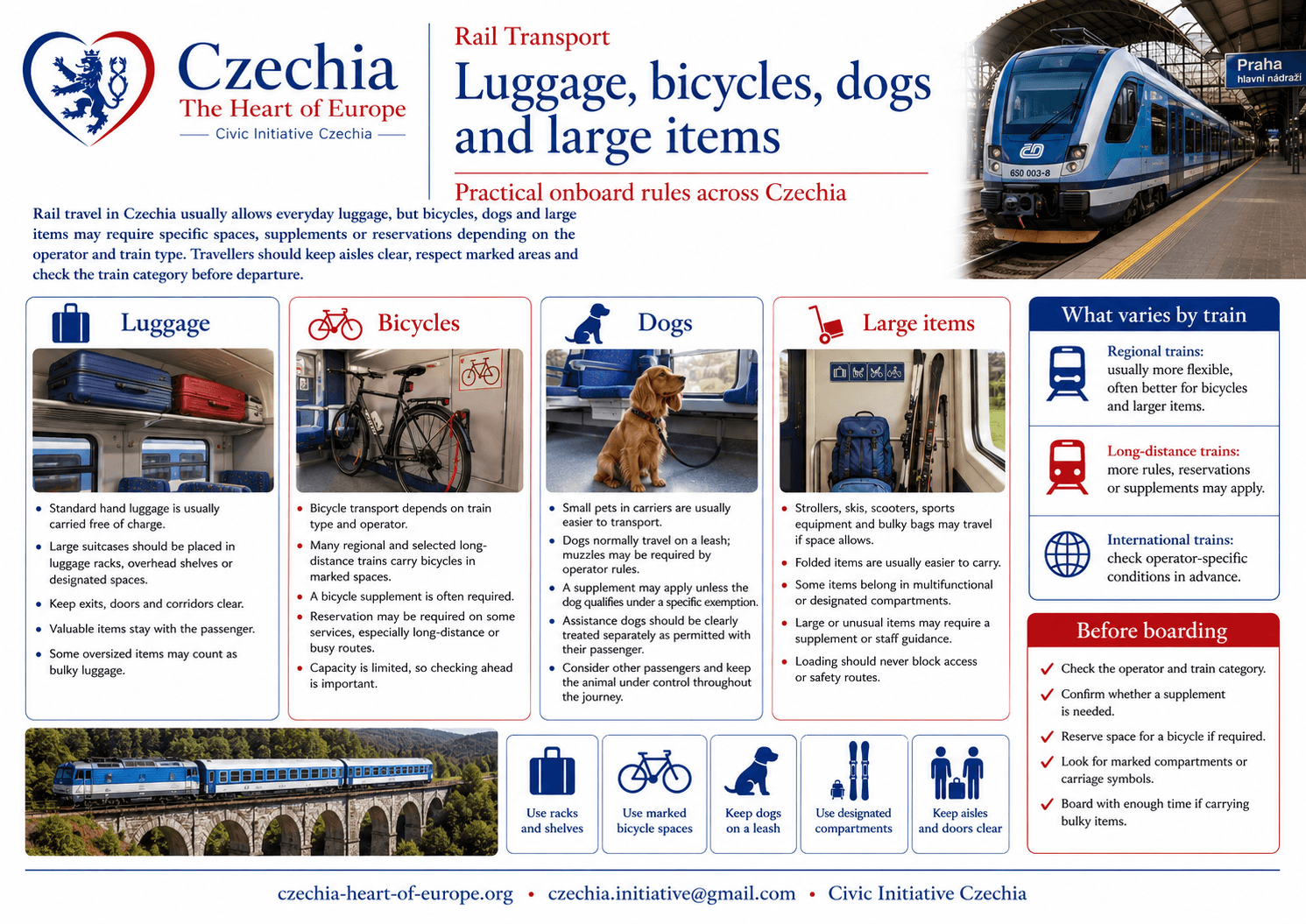
Ordinary luggage usually travels with the passenger, but it should not block doors, corridors,
priority spaces or evacuation movement. Larger bags, sports equipment, bicycles and dogs may
need a specific ticket, reservation, marked space or operator permission.
Bicycle rules are especially route-specific. Some trains allow bikes in marked areas, some
require a reservation, and some have limited capacity. Dogs may require a ticket, leash, muzzle
or carrier depending on the operator and train type.
Luggage
Keep passages clear
Place luggage above, below or beside you without blocking doors, aisles or priority areas.
Bicycles
Capacity and reservation
Check whether the train accepts bikes and whether a reservation or bike ticket is required.
Dogs and animals
Operator conditions apply
Check carrier, muzzle, leash and ticket rules before boarding.
Accessibility
Assistance, low-floor access and station barriers
Rail accessibility depends on the station, platform, train type, door height, lift availability,
assistance rules and current operation. Larger stations may have barrier-free access, lifts or
assistance points. Smaller stops can be more limited.
Travellers using wheelchairs, mobility aids, strollers, assistance dogs or calm-travel planning
should check the station and selected train before departure. During construction or replacement
transport, the accessible path may change.
Station access
Lifts, ramps and underpasses
Check station equipment and lift status when barrier-free access is essential.
Train access
Door height and assistance
Some trains are easier to board than others. Assistance may require advance request.
Calm travel
Less pressure, clearer route
Reserve seats, avoid tight transfers and save platform, carriage and destination details offline.
Disruptions
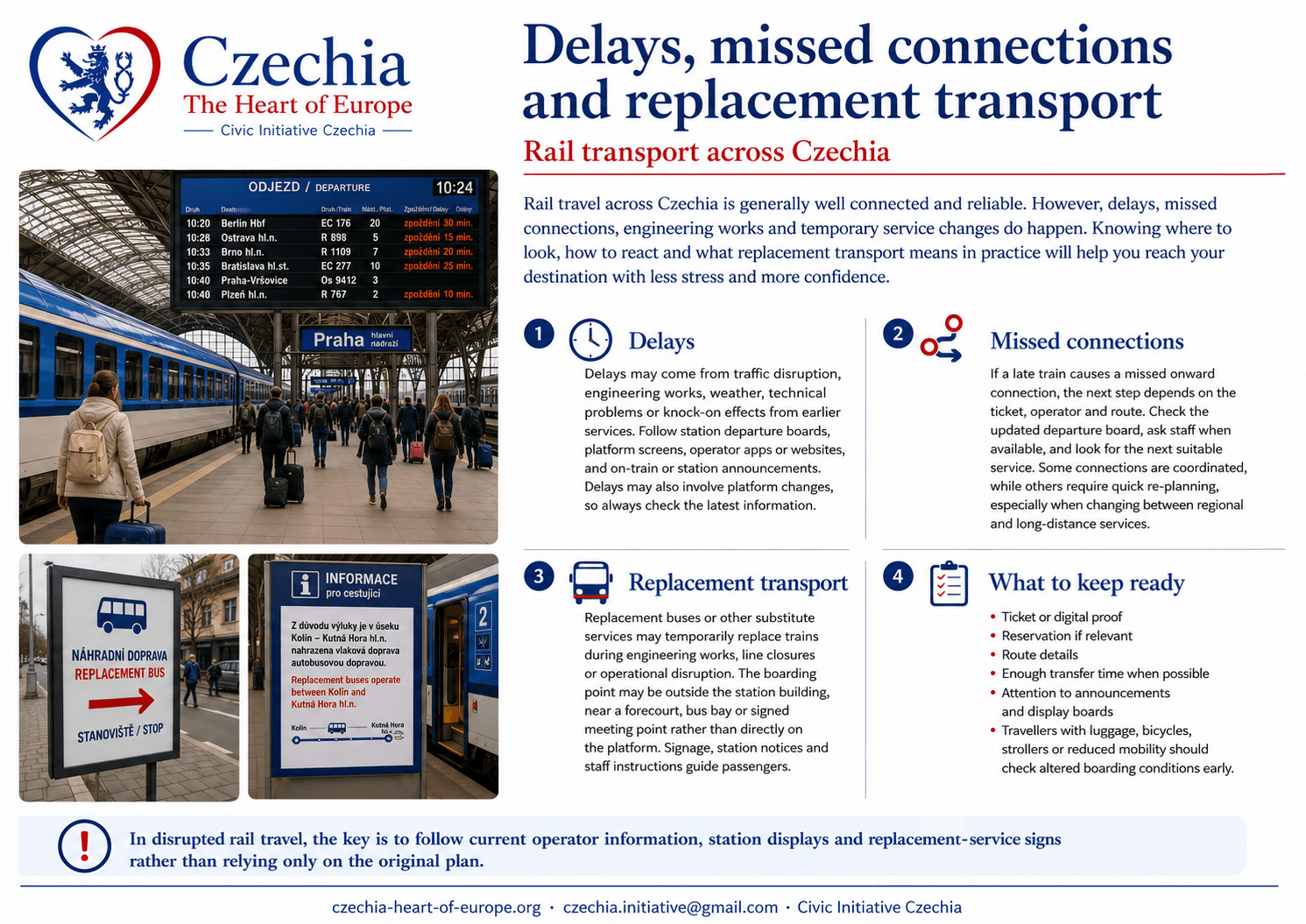
Delays, missed connections and replacement transport
Rail disruptions can come from construction, technical issues, weather, operational problems,
police activity, accidents or cross-border delays. Replacement buses may use different stops
from the station entrance, and journey time can increase.
For important journeys, check the route shortly before departure. During disruption, look for
official station displays, operator updates, staff instructions and current timetable tools.
Delay
Watch the train number
Destination names can repeat. The train number helps follow the correct delayed service.
Replacement bus
Find the correct stop
Replacement transport can depart outside the station building or from a temporary stop.
Missed connection
Ask the operator
Connection, refund and compensation rules depend on ticket type, route and operator conditions.
Practical situations
Rail FAQ
Can I buy a rail ticket at the station?
Many larger stations have ticket counters or machines, but smaller stops may not. Buying through the operator app or e-shop is often safer when the route, operator and ticket conditions are clear.
Do I always need a seat reservation?
Many domestic trains allow travel without a seat reservation, but reservations can be useful on long-distance routes. Some international or specific services may require them.
Can I use one ticket on any train?
Check the ticket conditions. Some tickets are flexible, some are train-bound, some are operator-bound, and some belong to an integrated regional tariff.
Can I take a bicycle on the train?
Often yes, but conditions vary by train and operator. Check whether the train accepts bicycles and whether a bike ticket or reservation is required.
What should I do if the platform changes?
Follow the current station display, train number and staff announcements. Leave enough time for stairs, lifts, underpasses and luggage.
What happens during replacement bus service?
Replacement buses can depart from a temporary stop near the station or nearby road. Check the operator notice and station signs before the original train time.
Is rail travel accessible?
Some stations and trains are accessible, while others have barriers. Check station equipment, train type and assistance rules before travelling.
Official references
Primary rail references
Use official sources for current timetables, station information, tickets,
restrictions, infrastructure updates and passenger conditions.
Transport pages
Continue by transport topic
Transport overview
Transport in Czechia
Country-level orientation to public transport, rail, roads, airports, regional mobility and safety.
Public transport
City and local systems
Metro, trams, buses, trolleybuses, tickets, validation, inspections and passenger rules.
Roads & driving
Road movement and vehicle use
Roads, driving, parking, tolls, winter conditions and vehicle use.
Airports
Air travel and arrivals
Airports, arrivals, transfers, airport-city links and passenger orientation.
Regional mobility
Movement beyond major cities
Regional buses, local connections, towns, castles, spa places and nature access.
Accessible mobility
Barrier-free and inclusive movement
Low-floor services, station access, mobility support, strollers and calm travel needs.
Cycling & walking
Soft mobility and public-space movement
Walking, cycling, shared mobility, bikes on trains and public-space safety.
Foreigners & newcomers
First transport orientation
Tickets, validation, inspections, useful words and common first-arrival mistakes.
Freight & logistics
Goods movement and corridors
Road freight, rail freight, logistics hubs, industry links and European corridors.
Safety & disruptions
Delays, closures and incidents
Replacement transport, weather disruption, lost property, emergency numbers and safety notices.