Overview
Accessible mobility as a whole-journey question
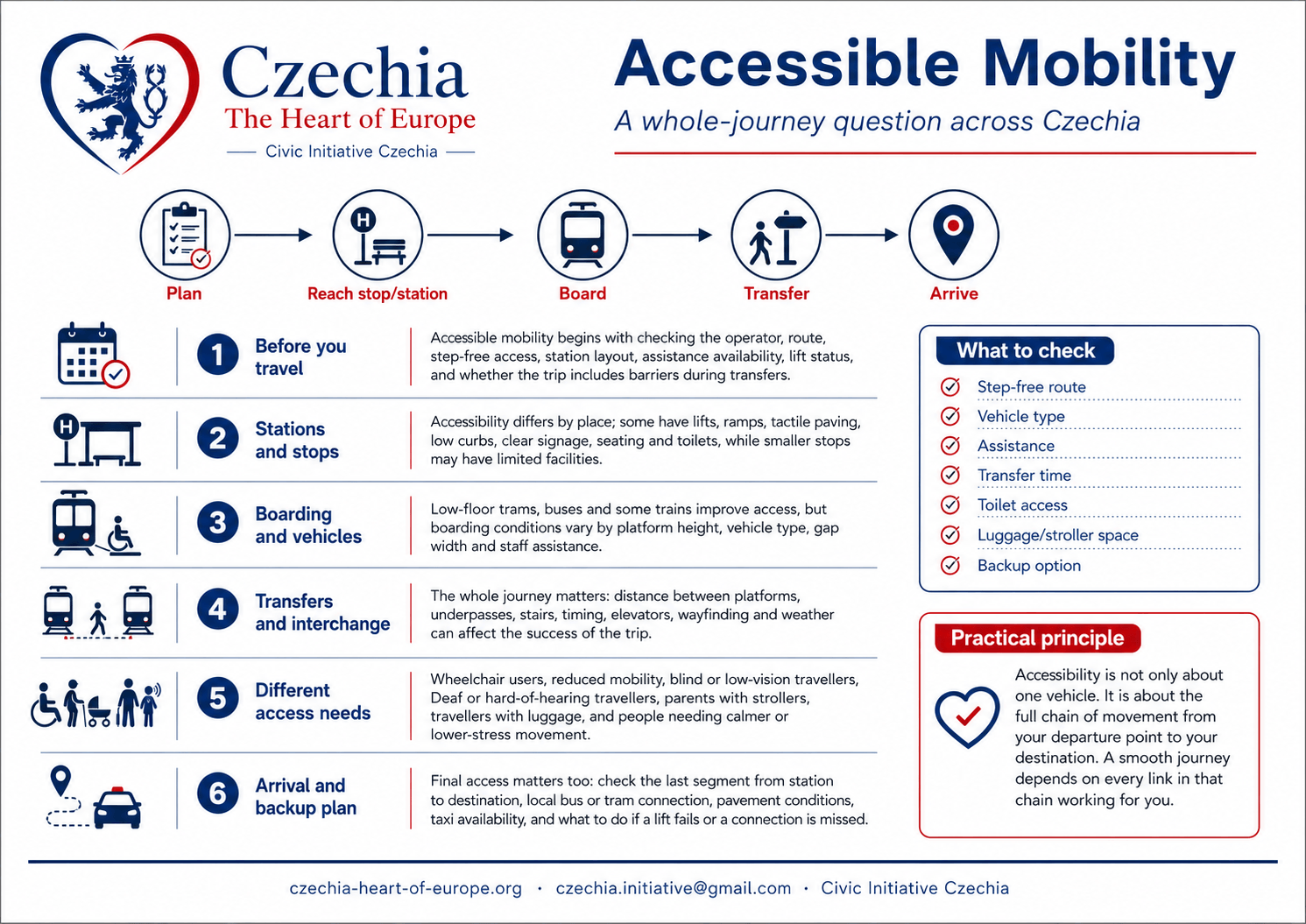
Accessible mobility in Czechia depends on the full journey: departure point, station or stop,
vehicle type, platform access, ticket method, transfer, arrival point, final path and backup
option. One accessible vehicle does not guarantee that the whole journey is accessible.
The practical question is the complete chain. Can the traveller reach the platform, board the
vehicle, travel with enough space, transfer without pressure, leave at the destination, and reach
the final address, office, school, hotel, hospital, museum, castle, station or appointment?
Physical access
Steps, lifts, ramps and surfaces
Accessibility depends on platform height, lifts, stairs, kerbs, cobbles, slopes, doors and stop surfaces.
Service access
Information and assistance
Clear instructions, staff help, assistance requests, apps and live updates can decide the practical journey.
Cognitive access
Calm, clarity and pressure reduction
Noise, crowding, unclear transfers, delays and sudden changes affect many travellers beyond physical mobility.
Traveller needs
Accessible mobility serves different situations
Accessible mobility concerns wheelchair users, people with reduced mobility, blind or visually
impaired travellers, deaf or hard-of-hearing travellers, older people, pregnant travellers,
children, families with strollers, people with temporary injuries, people with luggage, assistance
dog users and travellers with sensory, cognitive or fatigue-related needs.
Many people need accessibility only in certain conditions: during heat, illness, surgery recovery,
after a long flight, with children, with heavy luggage, during a crowded event, after dark or when
a transfer becomes unclear.
Mobility
Wheelchairs, aids and reduced movement
Access depends on station design, vehicle type, staff support, lifts and the final path.
Family movement
Strollers, children and fatigue
Families need safe boarding, enough space, toilets, lifts, calmer transfers and clear meeting points.
Sensory and cognitive needs
Noise, crowds and sudden changes
Clear instructions, fewer transfers, screenshots, quiet timing and backup options reduce pressure.
Planning
Plan access step by step
Accessible travel should be planned as a sequence, not as a single ticket purchase. A route can
look correct in a timetable while the station access, lift, replacement bus, cobbled street,
steep final path or transfer time makes the journey difficult.
Start point
Check whether the departure stop or station is physically reachable from the street or building entrance.
Vehicle
Confirm low-floor service, boarding height, space, assistance rules or marked accessible connection where available.
Transfer
Avoid tight transfers when lifts, long corridors, crowds, children, luggage or sensory fatigue are involved.
Arrival
Check whether the arrival platform, stop or terminal has a usable exit and safe onward path.
Final path
Confirm the final walk, surface, slope, lighting, crossing, cobbles, stairs, taxi option or building access.
Access rule: the final path matters as much as the vehicle.
A low-floor bus, accessible train or lift-equipped station still needs a usable destination path.
Public transport
Low-floor services, stops and city movement
City transport accessibility depends on the mode, line, vehicle, platform, stop surface, lift
availability and current operation. Metro, trams, buses and trolleybuses can have different access
conditions even within the same city.
Many systems mark low-floor connections or barrier-free access in timetables and apps. Those markings
should be checked close to departure, especially during construction, vehicle substitution or service changes.
Vehicles
Low-floor connections
Marked low-floor vehicles can support wheelchair users, strollers, luggage and reduced mobility.
Stops
Kerbs, platforms and crossings
Stop design affects boarding, waiting, street crossing and the distance to the final destination.
Operation
Current service matters
Vehicle changes, lift outages, closures and replacement transport can change the accessible route.
Rail and regional travel
Trains, regional buses and assistance limits
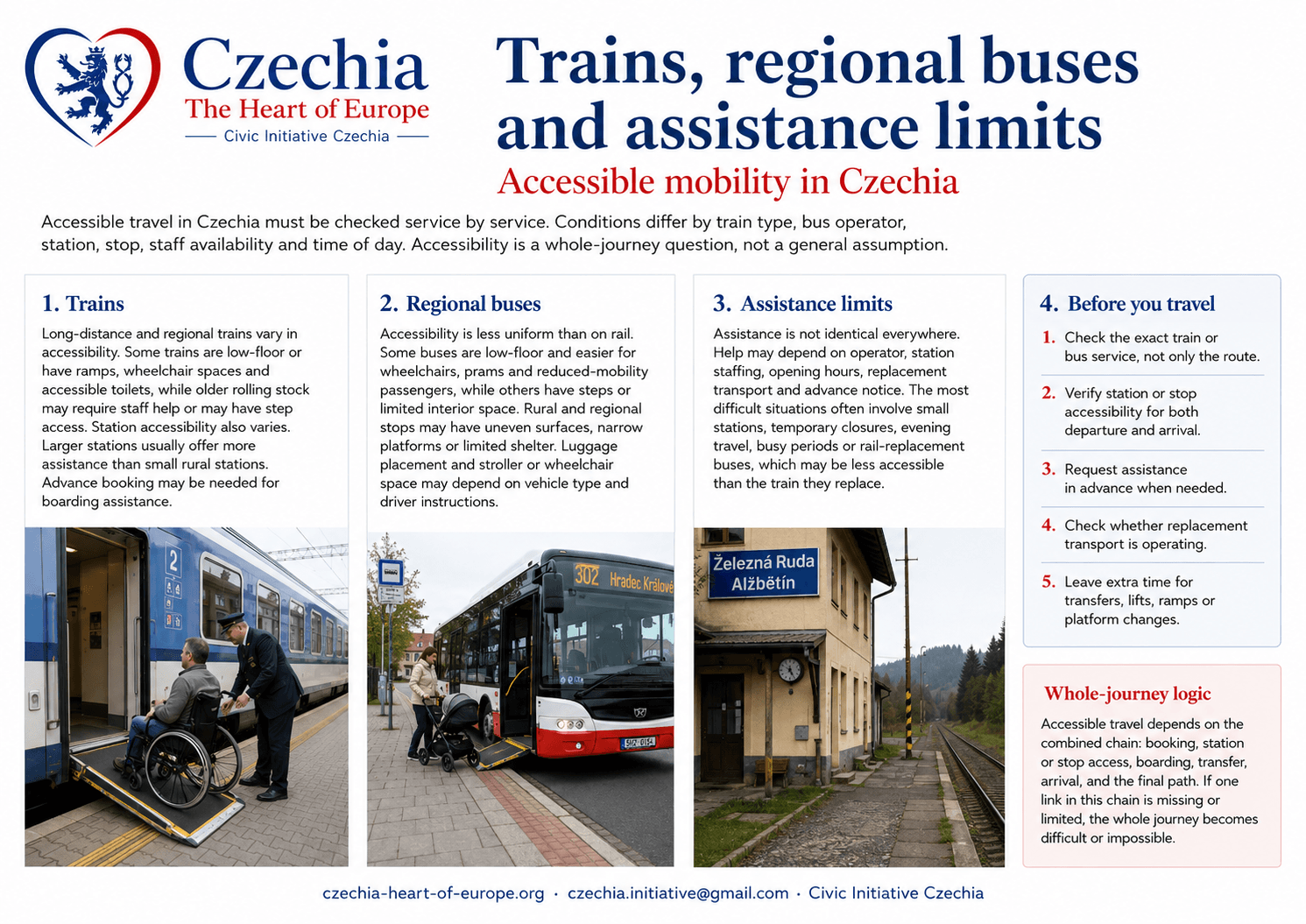
Rail and regional travel require special attention because stations, platforms, vehicle types and
assistance rules vary widely. A major station may have lifts and staffed support, while a smaller
regional stop may have limited equipment, uneven surfaces or no staff.
Regional buses can also differ. Some vehicles and stops are accessible; others may depend on vehicle
allocation, stop design, luggage, driver support and the final walking path.
Rail stations
Platform access
Check lifts, ramps, underpasses, platform height and assistance rules before departure.
Regional buses
Vehicle and stop reality
Accessibility depends on vehicle type, stop surface, kerb height and current service.
Replacement transport
Backup required
Rail replacement buses may have different access conditions from the train they replace.
Airports
Airport assistance and terminal movement
Airport accessibility includes more than reaching the terminal. It involves airline assistance,
baggage movement, security, passport control, lifts, toilets, waiting areas, transfer points,
public transport stops, taxi pick-up, car rental and onward travel after landing.
Travellers needing airport assistance should check airline and airport procedures before travel.
Assistance may need to be requested in advance through the airline, booking channel or airport process.
Assistance
Request before travel
Check airline and airport procedures for reduced mobility or specific assistance needs.
Terminal path
From aircraft to exit
Plan baggage, toilets, charging, lifts, meeting point and ground transfer as one sequence.
Onward travel
Airport to destination
Check public transport, taxi, rideshare, hotel transfer or rental-car access before leaving the terminal.
Families and strollers
Children, strollers and family movement
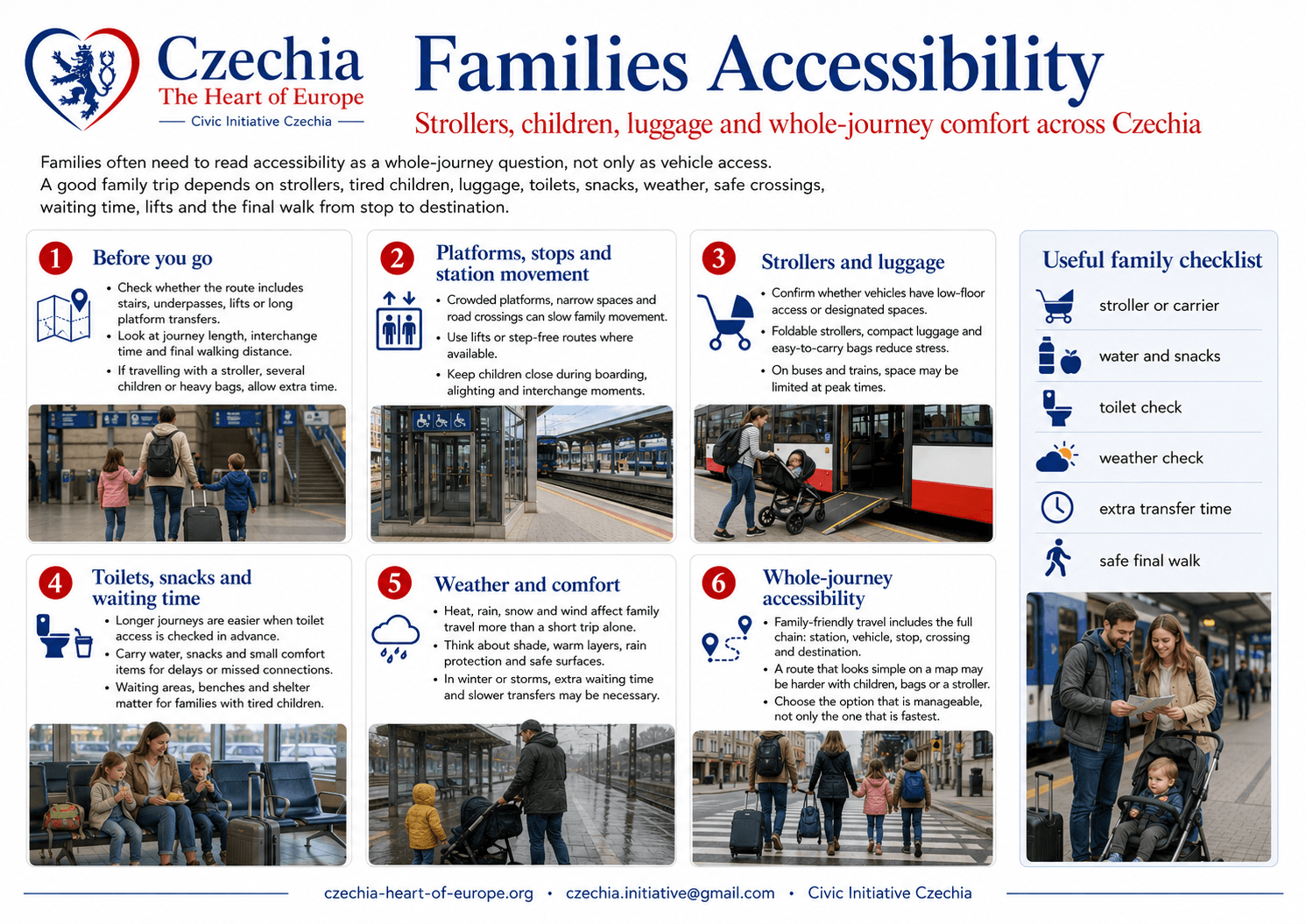
Families need practical accessibility even when no disability is involved. Strollers, tired children,
luggage, toilets, snacks, weather, crowded platforms, stairs, lifts, road crossings and waiting time
shape the journey.
The easiest route with children is often the route with fewer transfers, clearer platforms, lifts,
toilets and realistic walking distances. A slightly longer route can be better when it reduces
stress, stairs or crowding.
Strollers
Doors, lifts and space
Check low-floor access, priority areas, lifts and platform gaps before choosing a route.
Children
Safety before speed
Use visible meeting points, avoid platform edges and plan toilets, food and rest.
Families
Fewer transfers help
Simple routes often work better than fast routes with stairs, crowds or tight changes.
Calm travel
Sensory, cognitive and fatigue-sensitive travel
Accessible mobility also includes people who are overloaded by noise, crowds, sudden changes,
unclear signage, time pressure, unfamiliar language, long queues, flashing displays, announcements,
conflict, delays or physical fatigue.
Calm travel planning helps autistic travellers, people with dementia, people recovering from illness
or surgery, older travellers, children, people with anxiety, people with migraines, and anyone under
cognitive or sensory pressure.
Reduce transfers
Prefer simpler routes when stress, fatigue, luggage, children or cognitive load are high.
Save offline
Keep screenshots of ticket, destination, platform, address, map and emergency contact.
Choose timing
Travel outside peak hours when possible and allow extra time for delays or recovery.
Use anchors
Choose clear meeting points, visible landmarks and simple written instructions.
Plan exit
Know where to stop, sit, ask for help, leave the platform or change route if overloaded.
Disruptions
Closures, replacement transport and broken access chains
Disruption can break an accessible journey even when the original route was suitable. Lift outages,
platform changes, construction, replacement buses, vehicle substitutions, crowding, roadworks and
weather can change access conditions at short notice.
Replacement transport deserves special care. A train replacement bus, changed stop, temporary platform
or diverted route may be less accessible than the original service.
Lift outage
Station access changes
Check lift status and alternate exits when step-free access is essential.
Replacement bus
Access may differ
Replacement buses may have different boarding, luggage and wheelchair conditions.
Weather
Surfaces and fatigue
Snow, ice, heat, rain and wind affect walking, waiting, strollers, mobility aids and sensory load.
Disruption rule: when access matters, check live service conditions close to departure.
A route that worked yesterday may be difficult today because of lift, platform, vehicle or road changes.
Practical situations
Accessible mobility FAQ
Is a marked accessible route always fully accessible?
Not always. The marking may apply to one part of the journey. Check station access, vehicle, transfer, lift status, arrival stop and final path.
Are low-floor vehicles enough?
They help, but the stop surface, kerb height, platform gap, crowding, driver support and final destination path still matter.
Should assistance be requested in advance?
For rail, air travel or specific mobility needs, advance request is often safer. Check the operator, station, airport or airline procedure before travel.
What is the best route with a stroller?
Usually the route with fewer stairs, fewer transfers, lifts, low-floor vehicles, safe platforms and realistic walking time.
How can sensory overload be reduced?
Avoid peak hours where possible, use fewer transfers, save route details offline, choose clear meeting points and plan a calm exit option.
What should I check during disruption?
Check lift status, platform changes, replacement bus location, vehicle type, final walking path and whether staff assistance remains available.
Can luggage make a journey inaccessible?
Yes. Heavy luggage can make stairs, tight transfers, buses, cobbles, long walks and crowded platforms difficult even for travellers without mobility limitations.
Official references
Primary accessible mobility references
Use official sources for current accessibility information, low-floor services,
assistance rules, station access, airport assistance, public transport updates and live disruptions.
Transport pages
Continue by transport topic
Transport overview
Transport in Czechia
Country-level orientation to public transport, rail, roads, airports, regional mobility and safety.
Public transport
City and local systems
Metro, trams, buses, trolleybuses, tickets, validation, inspections and passenger rules.
Rail
National, regional and international rail
Trains, stations, tickets, operators, reservations and rail travel.
Roads & driving
Road movement and vehicle use
Roads, driving, parking, tolls, winter conditions and vehicle use.
Airports
Air travel and arrivals
Airports, arrivals, transfers, airport-city links and passenger orientation.
Regional mobility
Movement beyond major cities
Regional buses, local connections, towns, castles, spa places and nature access.
Cycling & walking
Soft mobility and public-space movement
Walking, cycling, shared mobility, bikes on trains and public-space safety.
Foreigners & newcomers
First transport orientation
Tickets, validation, inspections, useful words and common first-arrival mistakes.
Freight & logistics
Goods movement and corridors
Road freight, rail freight, logistics hubs, industry links and European corridors.
Safety & disruptions
Delays, closures and incidents
Replacement transport, weather disruption, lost property, emergency numbers and safety notices.