Overview
Airports as arrival points and transport gateways
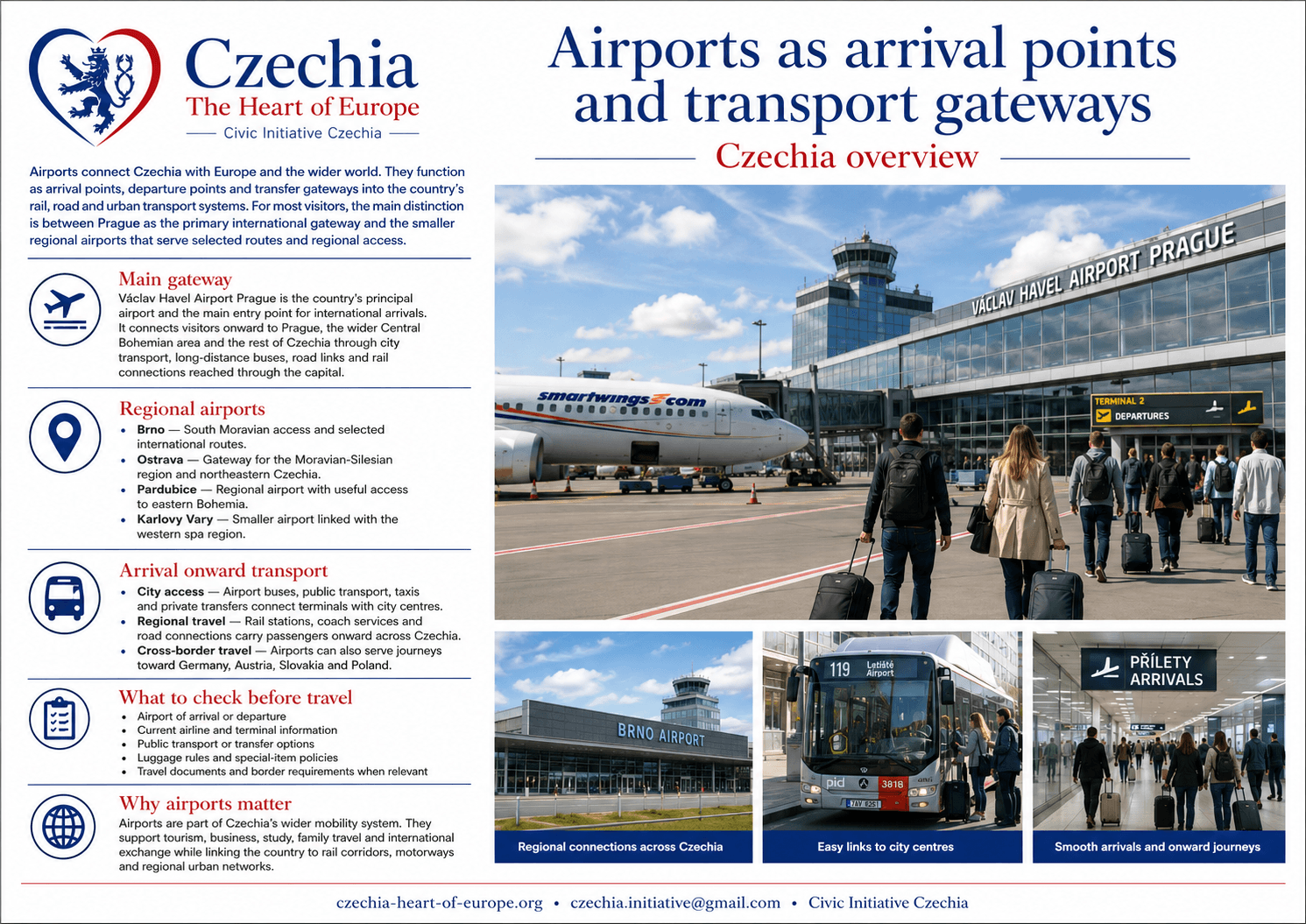
Airports in Czechia connect international arrivals, domestic travel needs, airport-city transfers,
business travel, tourism, regional mobility and onward journeys by public transport, taxi, rental car,
coach or rail connection from nearby transport hubs.
For many visitors, the airport is the first practical point of contact with Czechia. The important
sequence is simple: land, follow passport or arrival procedures where required, collect baggage,
choose a safe transfer, keep documents and payment access ready, and check onward transport before
leaving the terminal.
Main gateway
Prague Airport
The main international arrival point, with public transport, taxi, car-rental and airport service connections.
Regional airports
Regional access
Regional airports can serve seasonal, charter, business, local or specific international connections.
Onward travel
Airport to destination
The airport journey usually continues by public transport, taxi, rideshare, shuttle, coach or rental car.
Arrival sequence
From aircraft to onward journey
Airport arrival is easier when each stage is kept separate: passport or identity control where it applies,
baggage claim, customs channel if relevant, terminal exit, ticket or transfer choice, and the final route
to the accommodation, station, meeting point or next city.
Documents
Keep passport, ID, boarding pass, visa or residence documents accessible until arrival procedures are complete.
Baggage
Check the baggage belt, damaged baggage counter, oversized baggage area and airline or handling-agent instructions.
Exit
Before leaving the terminal, confirm the transfer method, payment option, destination address and travel time.
Connection
For onward rail or bus journeys, leave time for ticket purchase, city transfer and station orientation.
Backup
Save address, phone number, booking reference and emergency contact offline in case mobile data is not active.
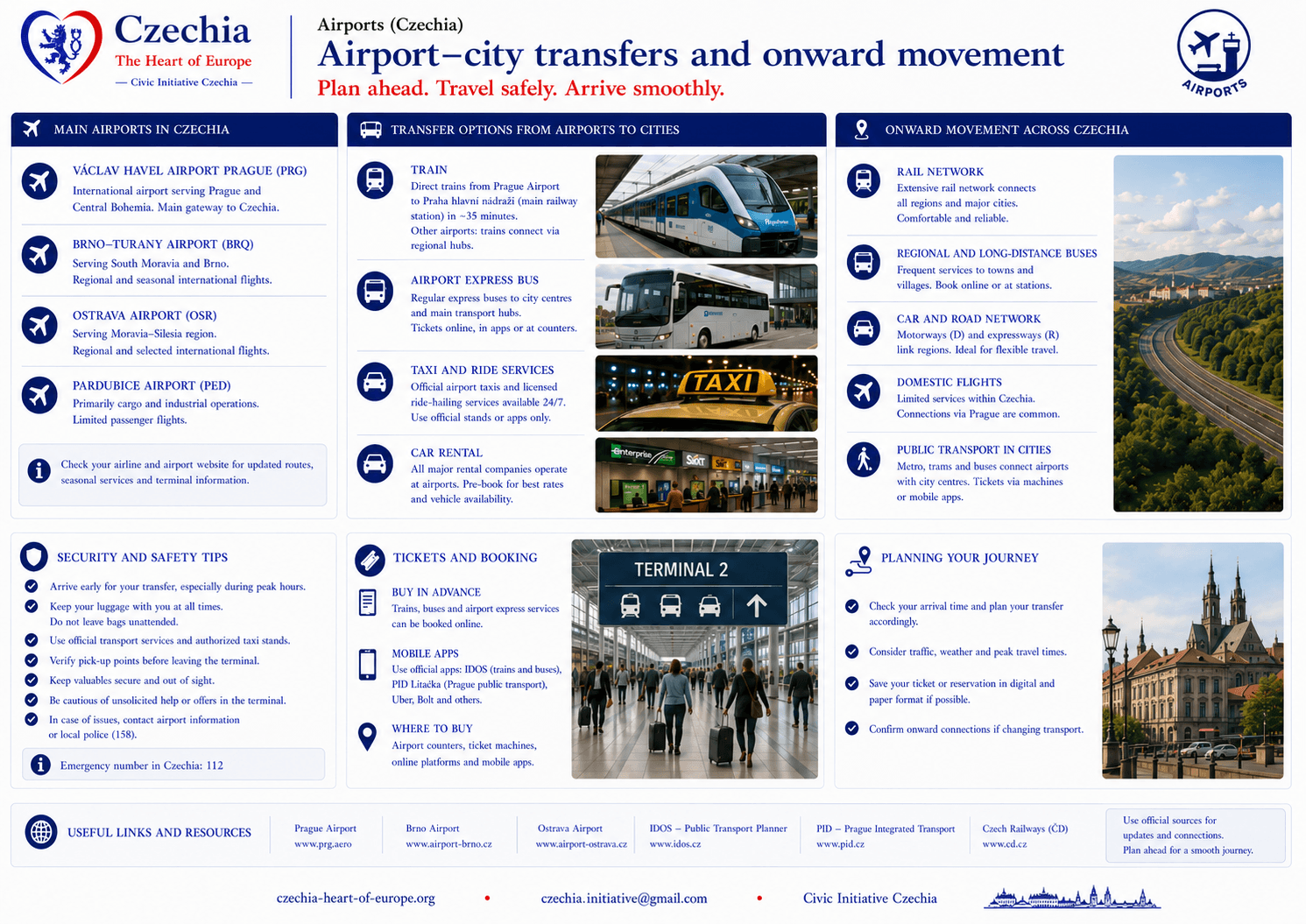
Transfers
Airport-city transfers and onward movement
Airport transfers can involve city public transport, airport buses, taxis, rideshare apps, hotel transfers,
coaches, rental cars or a combination with rail from a main station. The best option depends on arrival time,
luggage, children, mobility needs, destination, budget and fatigue.
Before choosing a transfer, check whether the destination is in the city centre, an outer district, another
town, a hotel outside the centre, a railway station, a bus terminal, a university residence or a private address.
Public transport
Tickets before travel
Check ticket type, validation or app activation before boarding airport public transport.
Taxi and rideshare
Use official pick-up points
Confirm the vehicle, driver, destination and price method before leaving the airport area.
Rental car
Check contract before driving
Review damage, insurance, fuel policy, motorway vignette status and cross-border permission.
Main gateway
Prague Airport orientation
Prague Airport is the main air gateway for Czechia and the most common first arrival point for
international visitors. Practical orientation includes terminal, airline, baggage, arrival hall,
public transport stops, taxi or rideshare pick-up, car rental, charging areas, toilets, information
points and onward travel to Prague or other Czech regions.
A Prague arrival does not always mean the final destination is Prague. Many travellers continue to
Brno, Plzeň, České Budějovice, Karlovy Vary, Liberec, Olomouc, Ostrava, spa towns, mountain regions
or neighbouring countries.
Terminal
Airline and arrival hall
Check terminal, baggage area, meeting point and exit before moving toward transport.
City connection
Airport to Prague
Use current airport or transport-operator information for public transport and taxi options.
Further travel
Beyond Prague
Allow time for transfers to railway stations, coach terminals, car rental or regional connections.
Regional airports
Regional airports and local access
Czechia also has regional airports that may serve scheduled, seasonal, charter, cargo, business,
training, emergency or local aviation functions. Their passenger role can vary by season and route,
so travellers should check the airport’s own website before planning around a regional arrival or departure.
Regional airport access may rely more on private car, taxi, shuttle, local bus, coach or pre-arranged
transfer than on high-frequency public transport. Check arrival time, onward journey and late-evening options
before departure.
Route availability
Season and airline matter
Regional routes can change by season, airline, charter programme or local demand.
Ground transport
Plan before arrival
Local transfers may require taxi, car rental, shuttle, local bus or pre-arranged pick-up.
Timing
Late arrivals need care
Check whether public transport, taxi availability or accommodation check-in works after landing.
Departures
Departures, check-in and security timing
Departure planning begins before the terminal. Confirm the airport, terminal, airline, baggage allowance,
check-in method, security restrictions, travel documents, arrival time at the airport and the transport
connection to the airport.
Delays often come from underestimating transfer time, baggage drop, document checks, security queues,
terminal changes, oversized baggage, family logistics or rental-car return. For early flights, check
night and morning transport options carefully.
Airport
Confirm the correct airport and terminal before arranging transport.
Airline
Check check-in, baggage, boarding pass, document and boarding-gate instructions.
Transport
Allow time for road traffic, ticket purchase, public transport changes, taxi pick-up or rental-car return.
Security
Prepare liquids, electronics, children’s items, medicines and restricted objects before screening.
Gate
Follow airport displays and airline updates; gates and boarding times can change.
Departure rule: the flight time is not the airport arrival time.
Plan the transport, check-in, security and gate sequence as one chain.
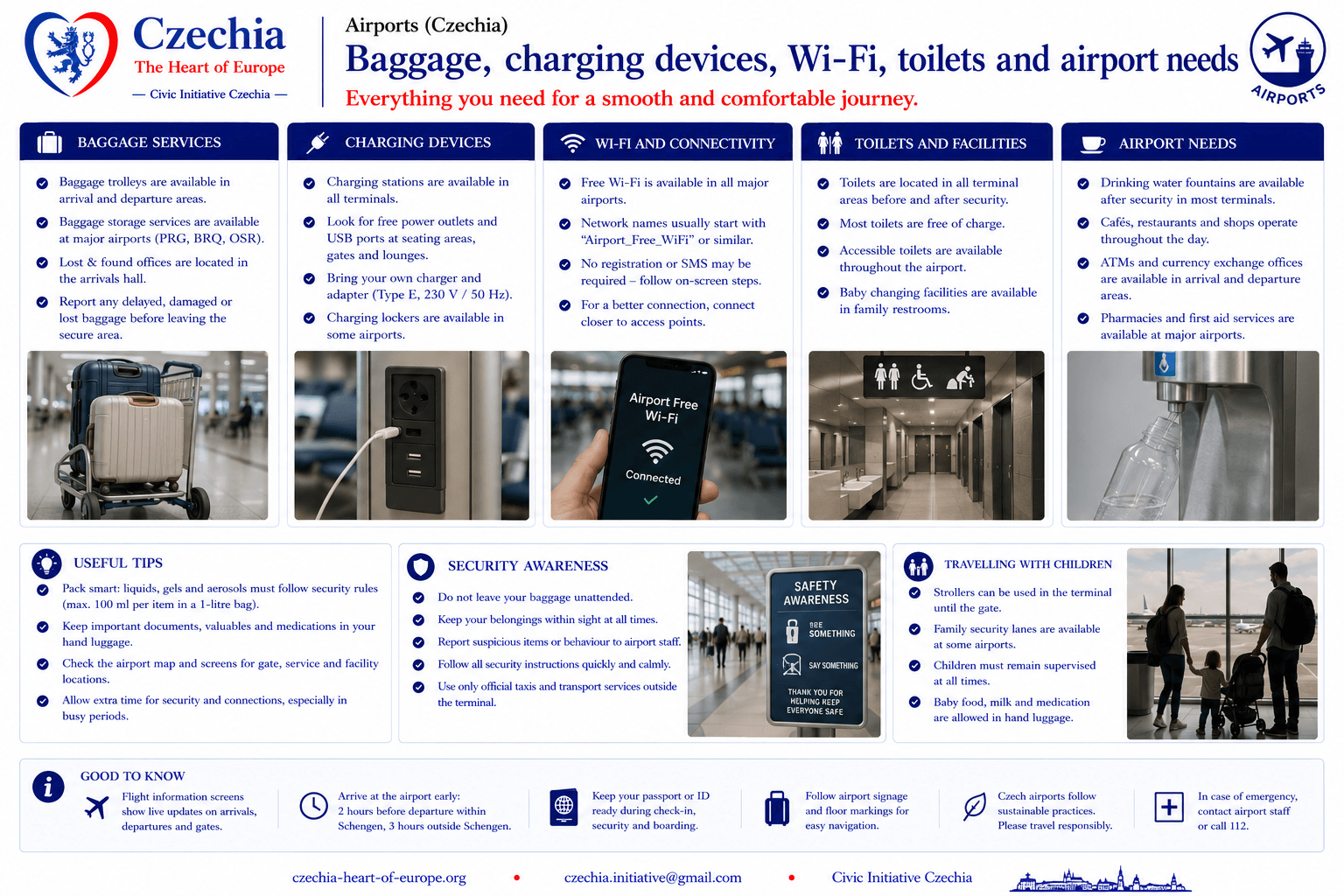
Baggage and services
Baggage, charging, toilets and airport needs
Airports are practical waiting environments as much as transport nodes. Travellers often need toilets,
water, food, seating, charging, Wi-Fi, pharmacy access, baggage services, information points, family
areas, quiet corners, currency or card payment options.
Keep essential items in hand luggage: documents, medication, chargers, glasses, phone, wallet, child needs,
mobility aids, keys and the address of the first destination. Checked baggage can be delayed, damaged or routed
differently from the passenger.
Baggage
Essentials stay with you
Keep documents, medicines, chargers, valuables and urgent child or health needs in cabin baggage.
Charging
Power before onward travel
Charge phone and power bank before leaving the terminal for maps, tickets, calls and bookings.
Waiting
Toilets, water and rest
Use the terminal to reset before continuing by bus, train, taxi, car or regional connection.
Accessibility
Assistance, families and calmer airport movement
Airport accessibility involves more than wheelchair movement. It includes assistance requests,
elevators, accessible toilets, clear meeting points, stroller handling, assistance dogs, sensory
pressure, dementia, fatigue, language stress and the movement between terminal, baggage area and transfer point.
Travellers needing assistance should check airport and airline procedures before travel. Assistance may
need to be requested in advance through the airline, travel agency or airport process, depending on the journey.
Reduced mobility
Request early
Check airline and airport assistance procedures before departure.
Families
Strollers, children and waiting
Prepare documents, snacks, toilets, stroller rules and meeting points before entering queues.
Calm travel
Reduce pressure
Save instructions offline, avoid tight transfers and use clear meeting points after arrival.
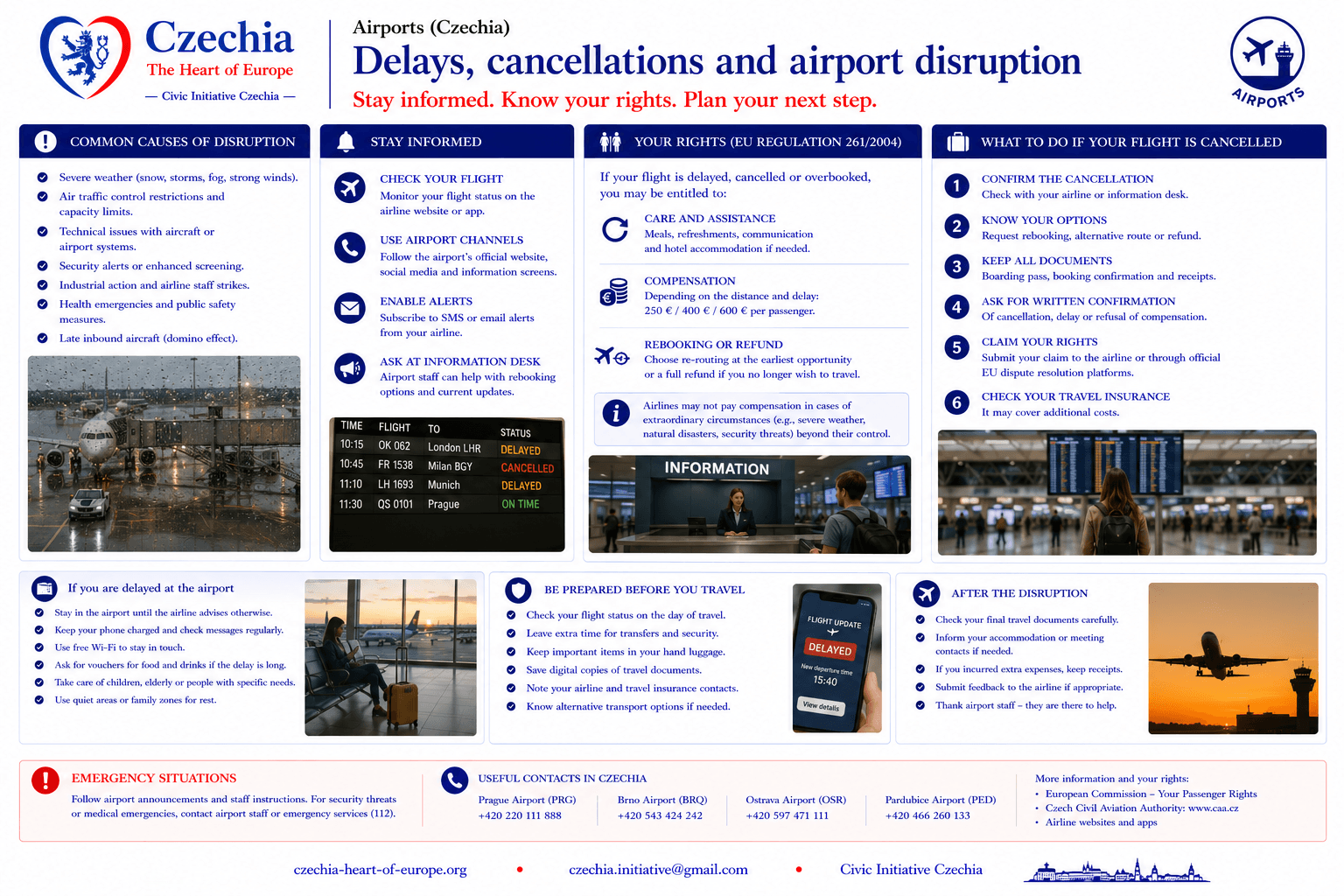
Delays and safety
Delays, cancellations and airport disruption
Airport disruption can come from weather, technical issues, air-traffic restrictions, strikes, security
events, baggage problems, missed connections or late aircraft. During disruption, follow official airport
displays, airline messages and staff instructions.
Keep documents, phone power, ticket references, accommodation contact, payment access and onward-transport
options available. When travelling with children, older people, medication or mobility needs, plan a calmer
fallback before fatigue becomes the main problem.
Flight change
Airline first
Rebooking, baggage and passenger-rights handling usually begin with the airline or booking channel.
Ground transfer
Recheck transport
Late arrivals can change taxi, public transport, hotel check-in and rental-car plans.
Waiting safely
Power, water, documents
Keep phone charged, documents accessible and urgent health or family needs close.
Practical situations
Airports FAQ
Which airport should I check first?
Check the exact airport and terminal on the airline booking, boarding pass or airport display. Do this before arranging public transport, taxi, rental-car return or hotel transfer.
How should I get from the airport to Prague or another city?
Choose according to luggage, time of arrival, destination, mobility needs and budget. Use official airport and transport information for current public transport, taxi, rideshare, coach and car-rental options.
Are taxis and rideshare safe to use from the airport?
Use official pick-up points, airport guidance or app-based confirmation. Check the vehicle, driver, destination and price method before leaving the terminal area.
What should stay in hand luggage?
Keep passport or ID, medication, phone, charger, payment card, glasses, child essentials, urgent documents, accommodation address and key contacts with you.
What if my baggage is delayed or damaged?
Follow the airport, airline or handling-agent instructions before leaving the baggage area. Keep baggage tags, boarding pass and photos or records where relevant.
Do regional airports work like Prague Airport?
Not always. Regional airports may have fewer connections, different transfer options and seasonal routes. Check the specific airport before planning a journey around it.
How do I plan an early morning flight?
Check night or early public transport, taxi availability, rental-car return, accommodation distance, baggage drop and terminal opening details before the travel day.
How should assistance be arranged?
Check airline and airport procedures before travel. Assistance for reduced mobility or specific needs may need advance request through the airline, booking channel or airport process.
Official references
Primary airport references
Use official sources for current airport information, arrivals, departures, ground transport,
charging areas, passenger services, assistance and transport links.
Transport pages
Continue by transport topic
Transport overview
Transport in Czechia
Country-level orientation to public transport, rail, roads, airports, regional mobility and safety.
Public transport
City and local systems
Metro, trams, buses, trolleybuses, tickets, validation, inspections and passenger rules.
Rail
National, regional and international rail
Trains, stations, tickets, operators, reservations and rail travel.
Roads & driving
Road movement and vehicle use
Roads, driving, parking, tolls, winter conditions and vehicle use.
Regional mobility
Movement beyond major cities
Regional buses, local connections, towns, castles, spa places and nature access.
Accessible mobility
Barrier-free and inclusive movement
Low-floor services, station access, mobility support, strollers and calm travel needs.
Cycling & walking
Soft mobility and public-space movement
Walking, cycling, shared mobility, bikes on trains and public-space safety.
Foreigners & newcomers
First transport orientation
Tickets, validation, inspections, useful words and common first-arrival mistakes.
Freight & logistics
Goods movement and corridors
Road freight, rail freight, logistics hubs, industry links and European corridors.
Safety & disruptions
Delays, closures and incidents
Replacement transport, weather disruption, lost property, emergency numbers and safety notices.