Overview
Public transport as everyday movement
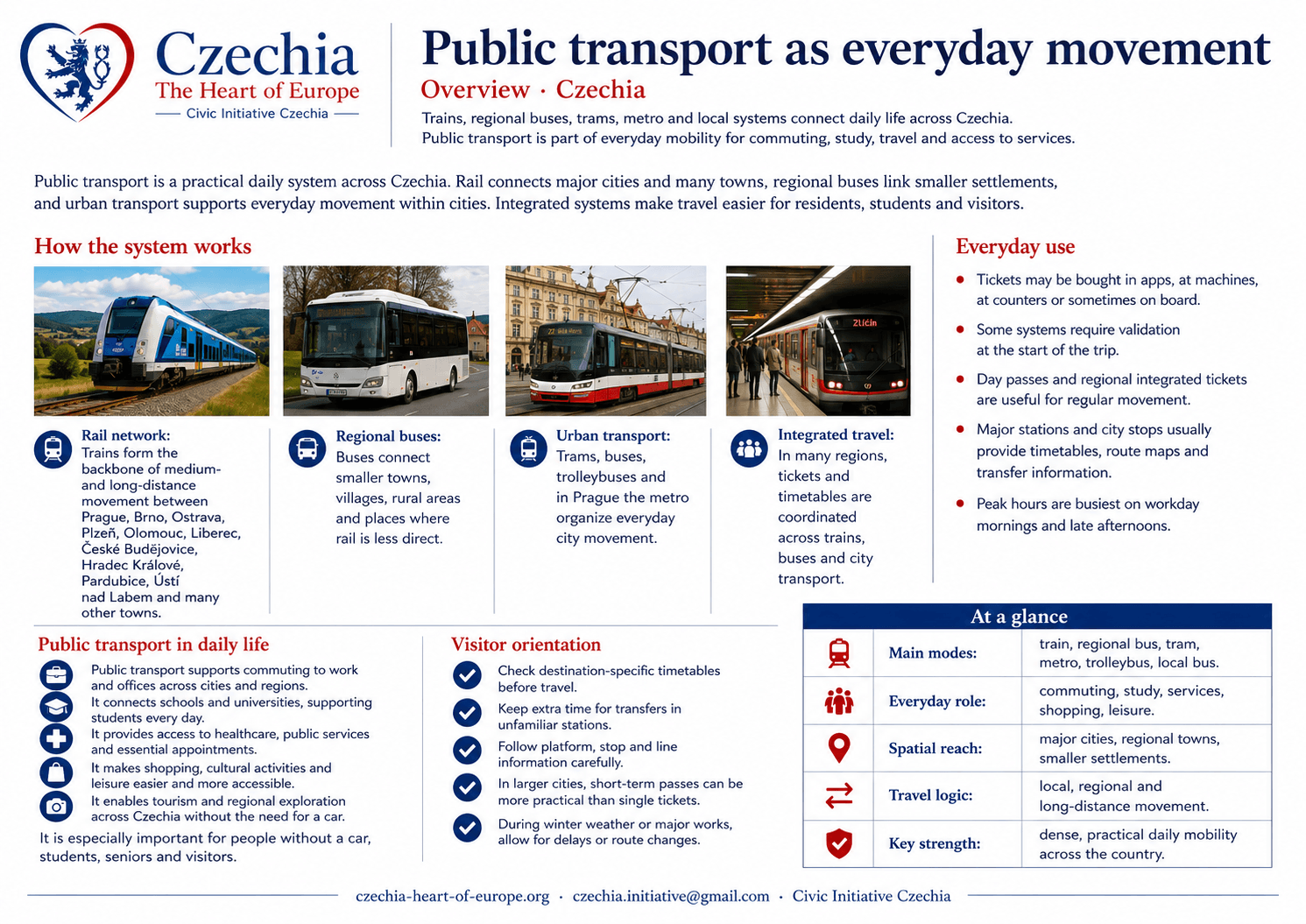
Public transport in Czechia is mainly organized through city, regional and integrated transport systems.
In daily use, this means metro, trams, buses, trolleybuses and local lines that connect homes, stations,
schools, offices, hospitals, shops and public spaces.
Each city or region has its own operator, tariff and passenger rules. Prague uses the PID system, other
regions use their own integrated systems, and smaller towns may use local urban transport. Timetables,
ticket validity and zone rules should always be checked for the place where the journey starts.
Network
How local public transport is organized
Public transport usually works as a network of lines, stops, interchanges and zones. A single journey
may combine several modes, such as tram and metro in Prague, bus and train in a regional system, or
local bus and city transport in smaller towns.
City transport
Metro, trams, buses and trolleybuses
Urban systems serve local movement inside a city and its immediate surroundings.
Integrated systems
One tariff across several modes
Integrated systems can combine local buses, city transport and selected regional rail or bus services.
Stops and transfers
Direction matters
Check the line number, final destination, platform, stop side and zone before boarding.
Tickets
Tickets, validation and time validity
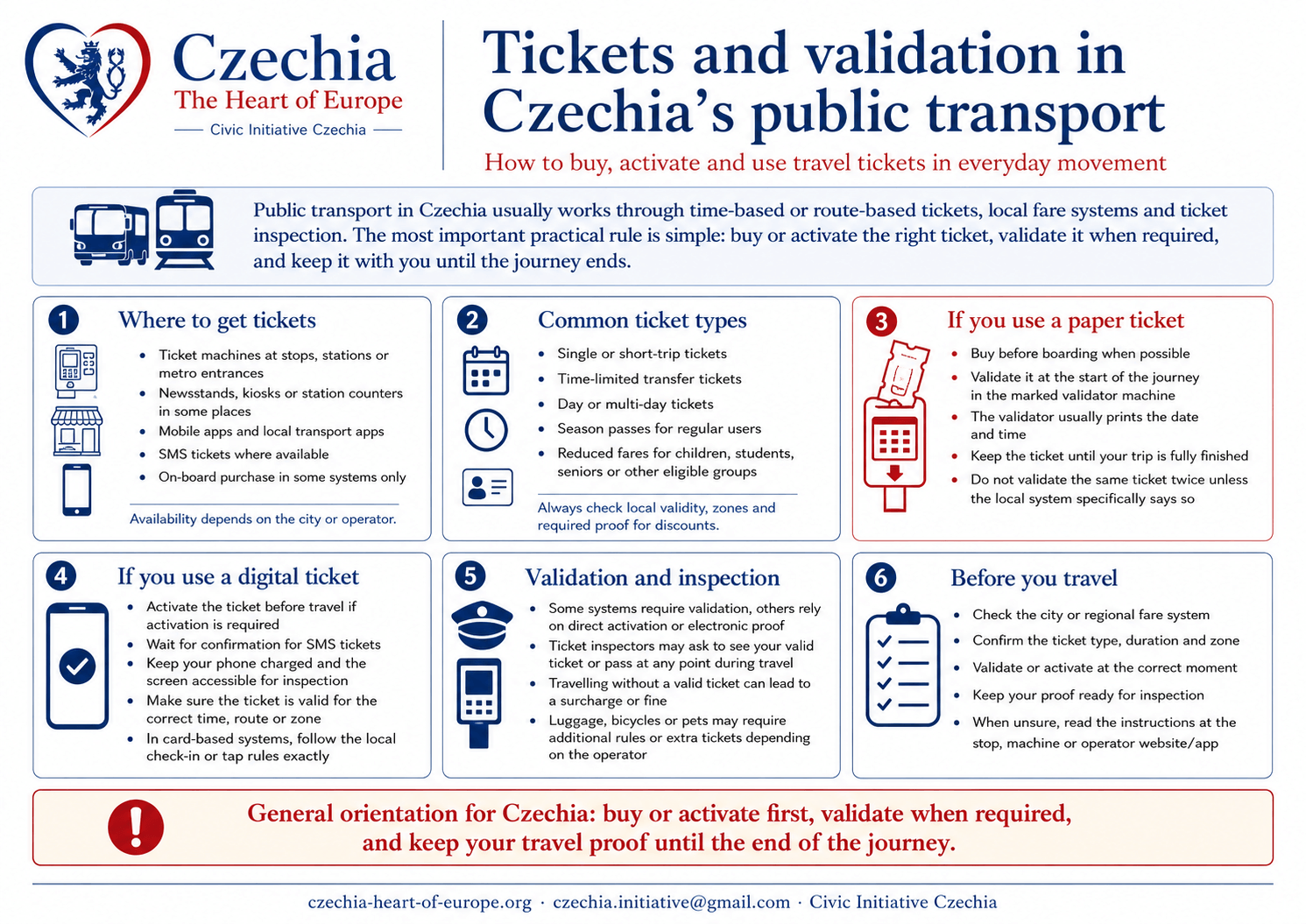
Public transport tickets are usually defined by time, zone, route or local tariff. A ticket may be valid
for one trip, a time period, a day, several days or a longer pass. In integrated systems, one ticket can
cover transfers between several modes if the trip stays within the ticket’s time and zone validity.
Paper tickets often need validation before or at the start of the trip. App tickets usually need purchase
and activation before boarding or before entering a paid transport area. Contactless payment terminals,
SMS tickets and ticket machines exist in some systems, but availability and rules differ by city and region.
Choose
Check the correct city, region, zone, duration and passenger category before buying.
Buy
Use the local app, ticket machine, contactless terminal, counter, seller or other official channel available in that system.
Validate
Paper tickets usually need validation once. App tickets may need activation before boarding or before entering the paid area.
Keep
Keep the ticket, pass, QR code, receipt or proof of entitlement ready until the end of the journey.
Important: An unvalidated, unactivated, expired or wrong-zone ticket can be treated as invalid.
Local rules decide how validation works, where the paid area begins and what proof is required during inspection.
Journey
Stops, boarding and transfers
Public transport information is usually organized by line number, direction, stop name and departure time.
The same stop name can sometimes have several platforms or stop positions, especially near stations,
terminals, hospitals, schools and large intersections.
Before boarding
Check line and direction
Use the final destination, route display and stop timetable to confirm that the vehicle goes the right way.
At the stop
Watch platforms and stop sides
Large interchanges can have several platforms for the same line or direction.
Transfers
Follow time and zone validity
A transfer is usually allowed only while the ticket remains valid for the route, time and zones used.
Inspection
Ticket checks and passenger obligations
Many Czech public-transport systems use proof-of-payment rules. Passengers are expected to have a valid
ticket or pass and present it when an authorized inspector asks for it. Inspectors may work in uniform or
plain clothes depending on the operator and must identify themselves according to local transport rules.
During inspection, passengers may be asked to show a ticket, QR code, pass, entitlement document or identity
document if a fine or surcharge process applies. Penalty amounts and appeal rules are set by the local tariff
and transport conditions.
Valid proof
Ticket, pass or entitlement
Reduced fares, student fares, age-based fares or free travel may require proof, not only the ticket itself.
Common problems
Expired or unactivated tickets
Wrong zone, late activation, forgotten validation or expired time validity can lead to a surcharge.
Accessibility
Low-floor vehicles, lifts and accessible routes
Accessibility depends on the city, line, vehicle type, stop design and current operation. Many systems mark
low-floor connections, barrier-free metro access, lifts or accessible stations in timetables and apps.
Travellers using wheelchairs, strollers, mobility aids or other assistance should check the current route,
platform access and service status before travelling, especially when lifts, replacement buses or construction
works are involved.
Vehicles
Low-floor services
Low-floor trams, buses and trolleybuses may be marked in timetables or apps.
Stations
Lifts and ramps
Metro and rail-linked stops may have lifts, ramps or accessible entrances, but outages can change the route.
Planning
Check before departure
Use current operator information for lift closures, route changes and replacement transport.
Luggage and animals
Strollers, bikes, luggage and dogs
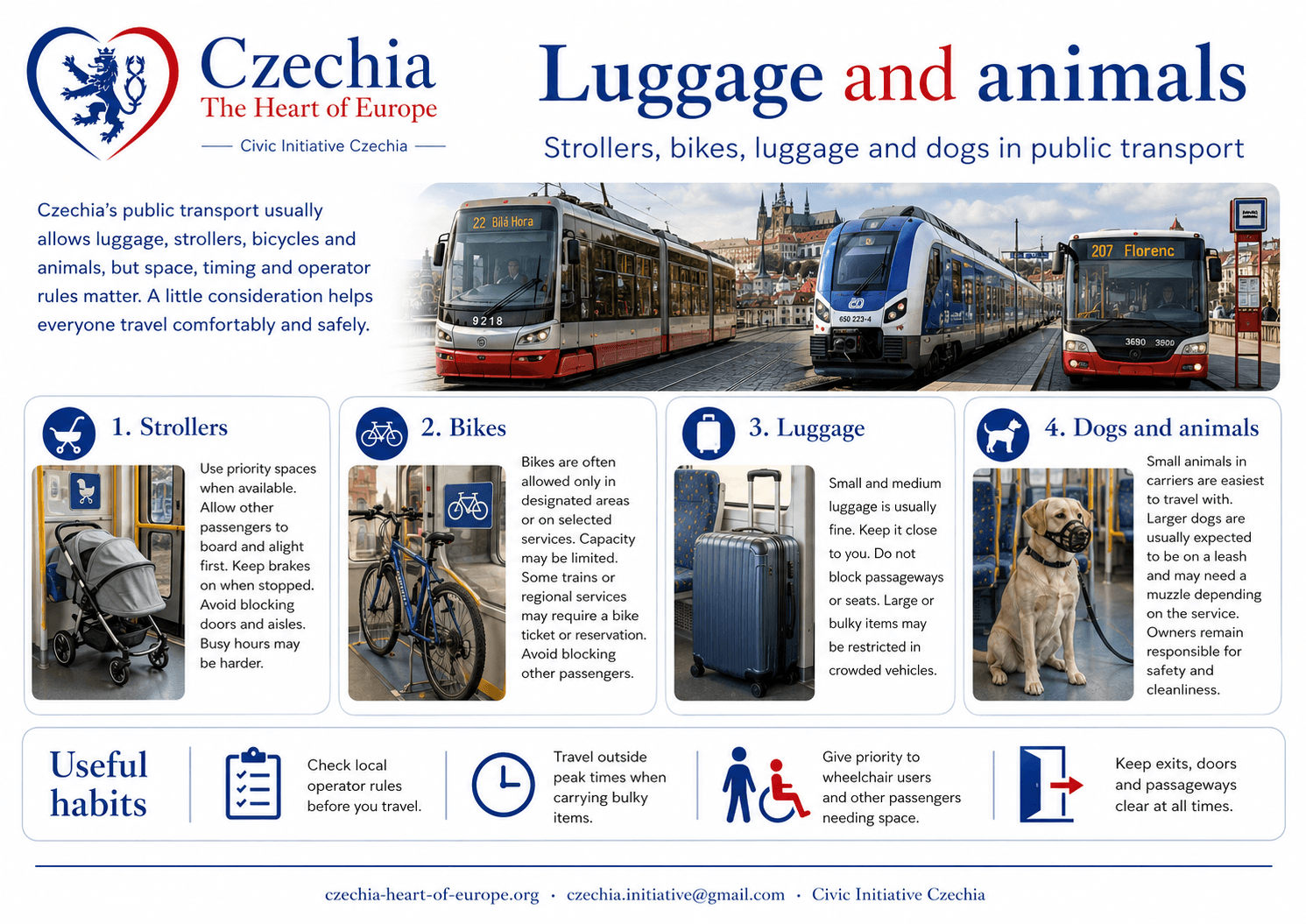
Public transport rules can differ for luggage, bicycles, strollers, sports equipment and dogs. Some items
may travel free, some may need a ticket, and some may be restricted during peak hours or on specific modes.
Dogs may need a leash, muzzle or ticket depending on the system. Bikes may be allowed only on selected lines,
vehicles, time windows or marked spaces. Large luggage should be placed so that it does not block doors,
aisles or emergency movement.
Disruptions
Closures, diversions and replacement transport
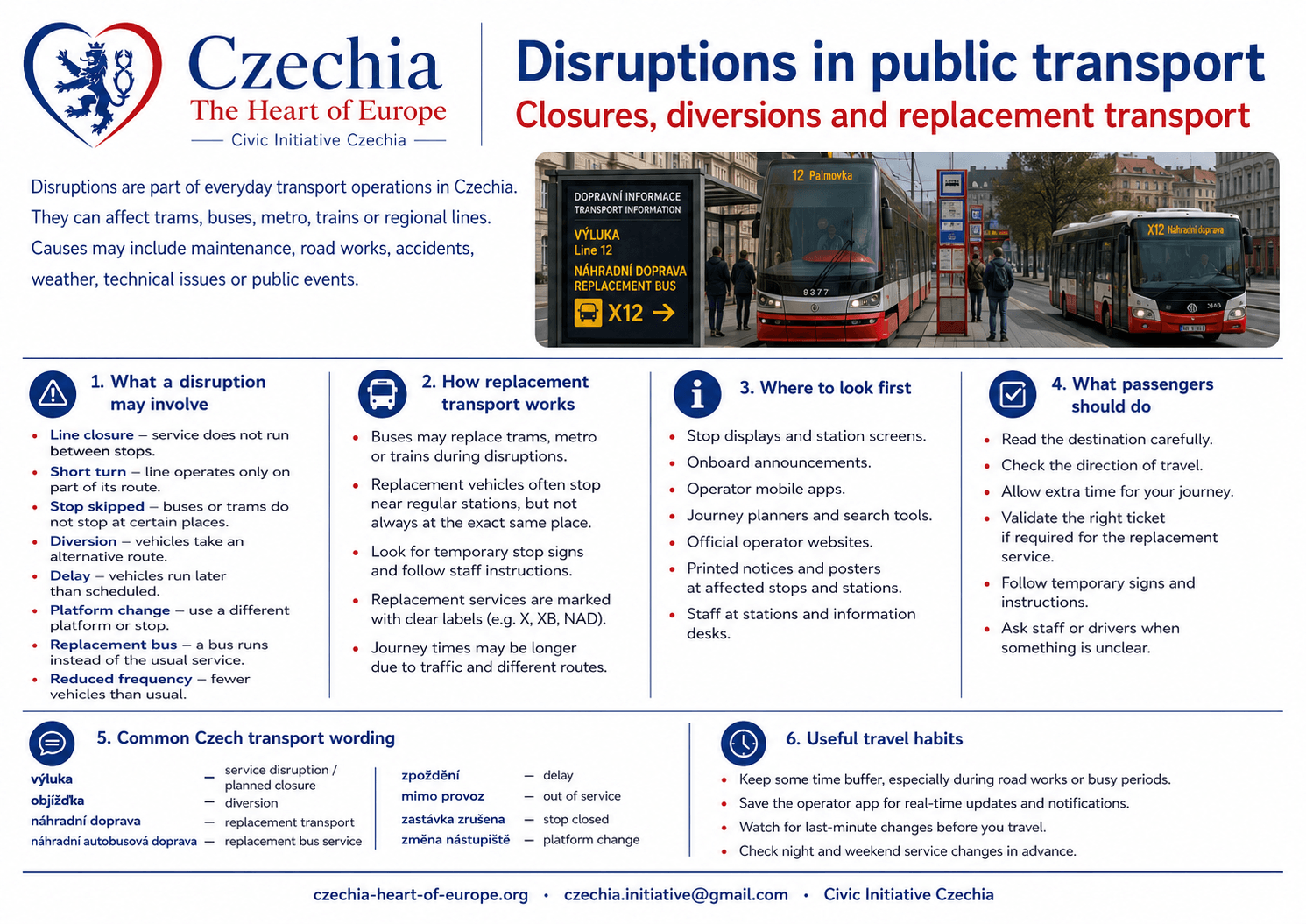
Public transport can change because of construction, accidents, weather, events, police activity or technical
problems. Temporary routes, replacement buses, changed platforms or skipped stops may appear at short notice.
Use official operator pages, apps and stop notices for current information. If a journey is important, check
the route shortly before departure and leave extra time for transfers.
Planned works
Closures and diversions
Construction and track work often come with replacement buses or changed stop positions.
Immediate disruption
Accidents or technical problems
Apps, platform displays and operator updates usually give the fastest practical guidance.
Events
Crowds and service changes
Sports, festivals, demonstrations and major events can affect stops, lines and waiting times.
Official references
Primary public-transport references
Use the relevant local operator or integrated transport system for current fares, disruption notices,
accessibility information, ticket rules and passenger conditions.
Transport pages
Continue by transport topic
Transport overview
Transport in Czechia
Country-level orientation to public transport, rail, roads, airports, regional mobility and safety.
Rail
National, regional and international rail
Trains, stations, tickets, operators, reservations and rail travel.
Roads & driving
Road movement and vehicle use
Roads, driving, parking, tolls, winter conditions and vehicle use.
Airports
Air travel and arrivals
Airports, arrivals, transfers, airport-city links and passenger orientation.
Regional mobility
Movement beyond major cities
Regional buses, local connections, towns, castles, spa places and nature access.
Accessible mobility
Barrier-free and inclusive movement
Low-floor services, station access, mobility support, strollers and calm travel needs.
Cycling & walking
Soft mobility and public-space movement
Walking, cycling, shared mobility, bikes on trains and public-space safety.
Foreigners & newcomers
First transport orientation
Tickets, validation, inspections, useful words and common first-arrival mistakes.
Freight & logistics
Goods movement and corridors
Road freight, rail freight, logistics hubs, industry links and European corridors.
Safety & disruptions
Delays, closures and incidents
Replacement transport, weather disruption, lost property, emergency numbers and safety notices.