Regions of Czechia hero image

About Czechia · Regions

Regions of Czechia

Czechia is divided into fourteen modern regions, including Prague. These regions organise public administration, services, development, transport, tourism, education, business orientation and regional identity.

14 regionsincluding Prague
Since 2000modern regional structure
3 landsolder historical layer
Public lifeservices, transport, development

Modern territorial structure

The regions are the contemporary territorial structure of Czechia.

The fourteen regions of Czechia help explain the country as it works today. They show where public services are delivered, how regional development is organised, how transport and education are planned, how tourism and business orientation are communicated, and how local identities connect with the state as a whole.
Timeline

The regional structure connects local life with national administration.

  1. Historical layerBohemia, Moravia and Czech Silesia remain the older cultural-historical lands of the country.
  2. 2000The modern regional structure takes practical form as the fourteen regions become the core territorial framework for regional administration.
  3. TodayThe regions structure public services, regional development, transport, cultural policy, tourism, education, statistics and international cooperation.

Regional map

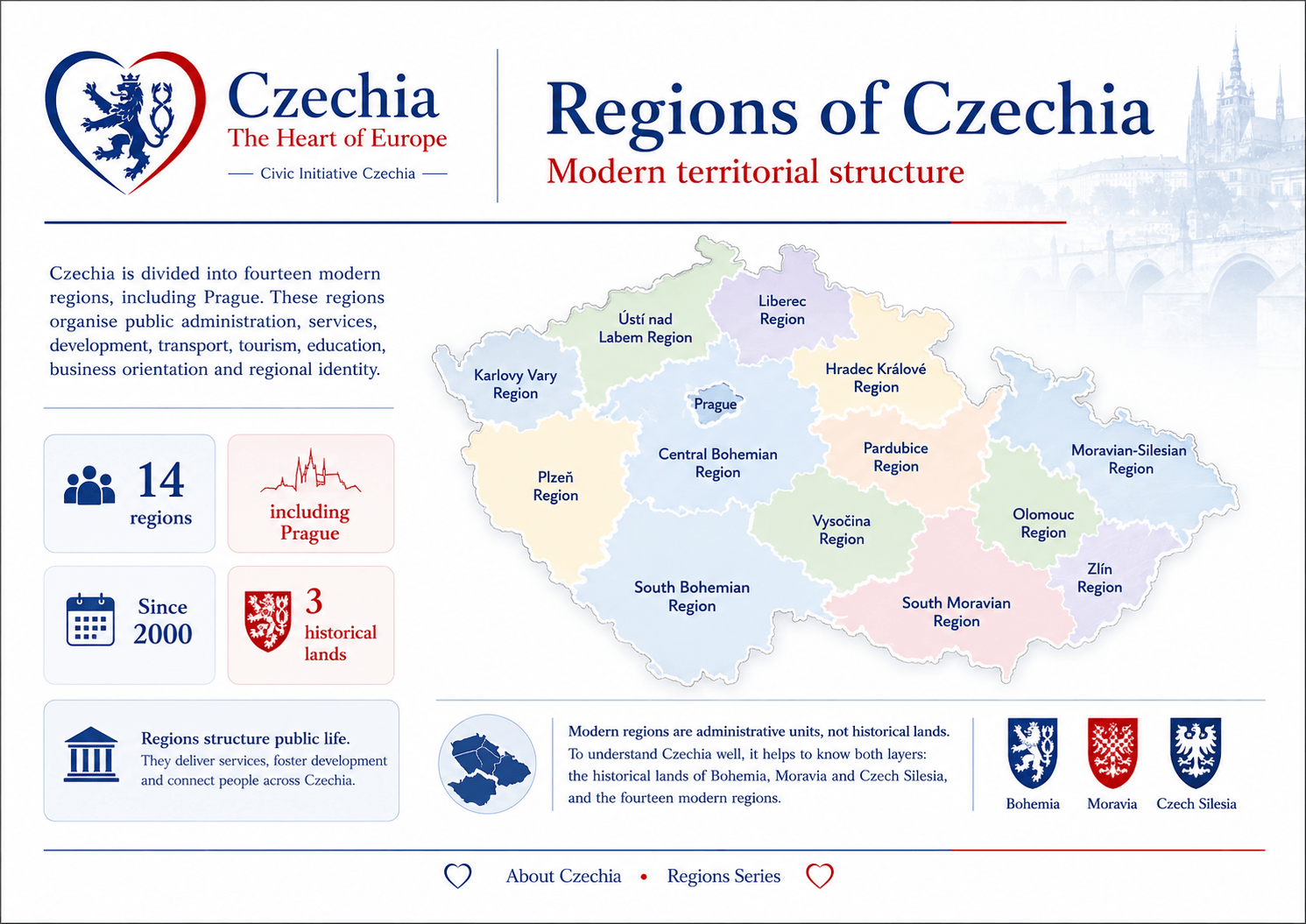
Fourteen regions, including Prague.

The regional map is the modern territorial layer of Czechia. It sits beside the historical-land layer of Bohemia, Moravia and Czech Silesia. Together, these layers explain how Czechia is both remembered and administered.

RegionsAdministrative units used for contemporary public life, development and services.
Historical landsBohemia, Moravia and Czech Silesia as the older identity layer.
PragueThe capital city is also one of the fourteen regions.
regions of Czechia infographic

Administrative map

Regional capitals help explain how the country is administered.

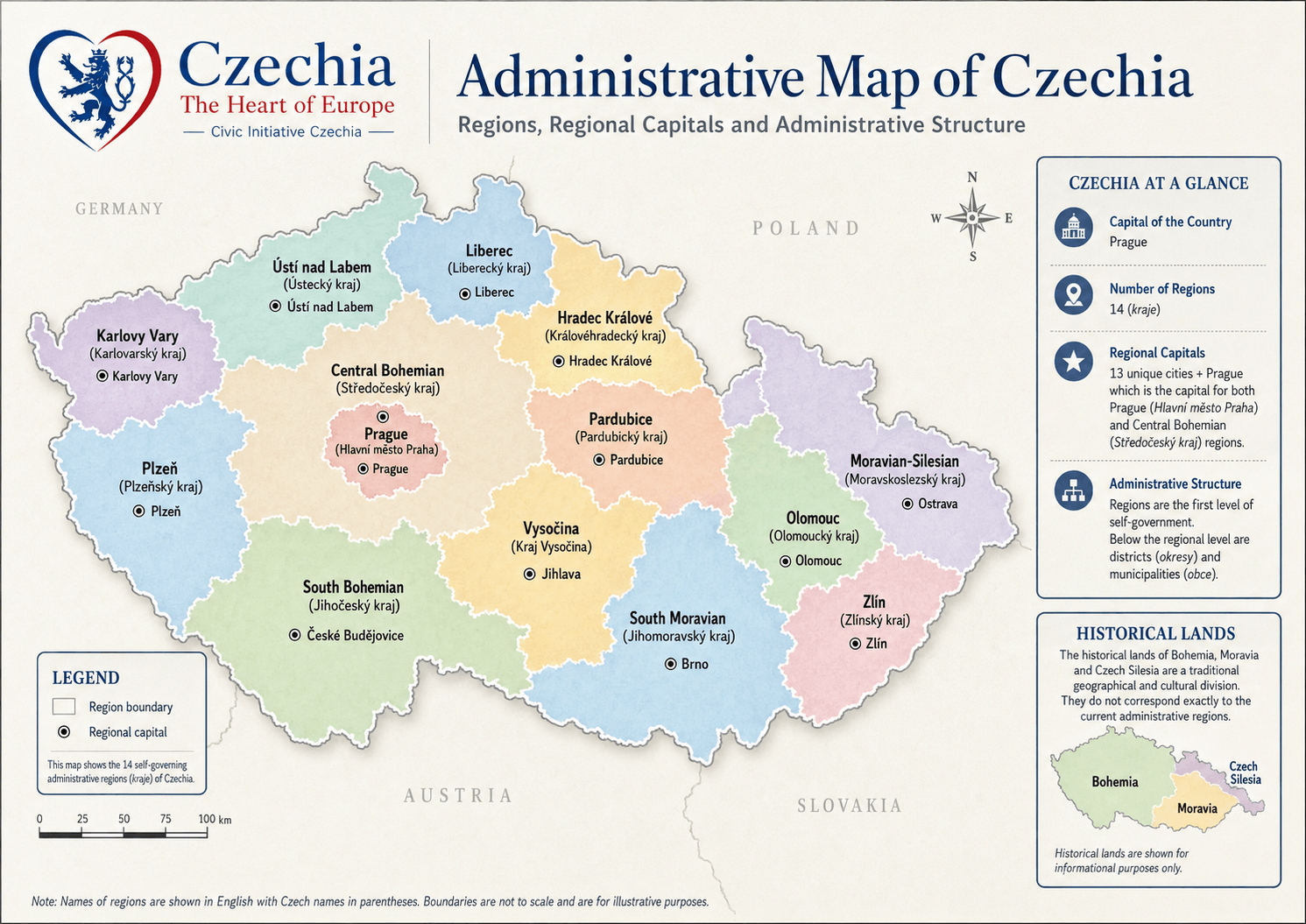
The administrative map shows the fourteen regions together with their regional capitals and neighbouring countries. It clarifies that Prague is both the capital of the country and one of the fourteen regions, while the Central Bohemian Region is administered from Prague although Prague itself is a separate region.

14 regionsThe first level of regional self-government in Czechia.
Regional capitalsThirteen regional capitals plus Prague, which serves as both capital city and region.
Administrative layerRegions are different from the historical lands of Bohemia, Moravia and Czech Silesia.
Administrative map of Czechia showing regions and regional capitals

The fourteen regions

Each region gives Czechia a different public and geographic role.

Capital city and region Prague

The national capital, seat of central institutions, major university city, cultural centre, transport hub and principal international arrival point.

Ring around Prague Central Bohemian Region

A region surrounding the capital, marked by commuter towns, castles, river valleys, industry, research sites, logistics and rural landscapes.

Ponds, forests and heritage South Bohemian Region

A region known for České Budějovice, Český Krumlov, pond landscapes, forests, rural heritage and the northern edge of Šumava.

Western gateway Plzeň Region

A western region with Plzeň as its centre, strong industrial traditions, beer culture, border routes and links toward Bavaria.

Spa triangle Karlovy Vary Region

A western border region known for mineral springs, the spa triangle, film culture, mountain landscapes and international spa heritage.

Elbe corridor Ústí nad Labem Region

A northwestern region shaped by the Elbe corridor, Bohemian Switzerland, industrial transformation and a strong borderland memory.

Mountain and glass region Liberec Region

A northern region with Liberec, Ještěd, the Jizera Mountains, glassmaking, textile memory and mountain towns.

Eastern Bohemia and Krkonoše access Hradec Králové Region

An eastern Bohemian region connected with Hradec Králové, Krkonoše access, Sněžka, river landscapes and modern architecture.

Transport routes and lowlands Pardubice Region

A region of Elbe lowlands, transport routes, horses, industry, eastern Bohemian towns and the transition toward Moravia.

Highland bridge Vysočina Region

A highland region between Bohemia and Moravia, important for watersheds, forests, rural continuity, historic towns and UNESCO heritage.

Brno, wine and research South Moravian Region

A Moravian region with Brno, wine country, the Moravian Karst, universities, research capacity and links toward Vienna and Bratislava.

Haná and Jeseníky Olomouc Region

A central and northern Moravian region with historic Olomouc, Haná, Jeseníky, university tradition and rich cultural memory.

Bata modernity and traditions Zlín Region

An eastern Moravian region associated with Zlín, Bata heritage, Wallachia, Slovácko, the White Carpathians and living traditions.

Ostrava and transformation Moravian-Silesian Region

A northeastern region shaped by Ostrava, Czech Silesia, industrial transformation, the Beskids and cross-border links with Poland and Slovakia.

How regions function

Regions connect public life, services and regional development.

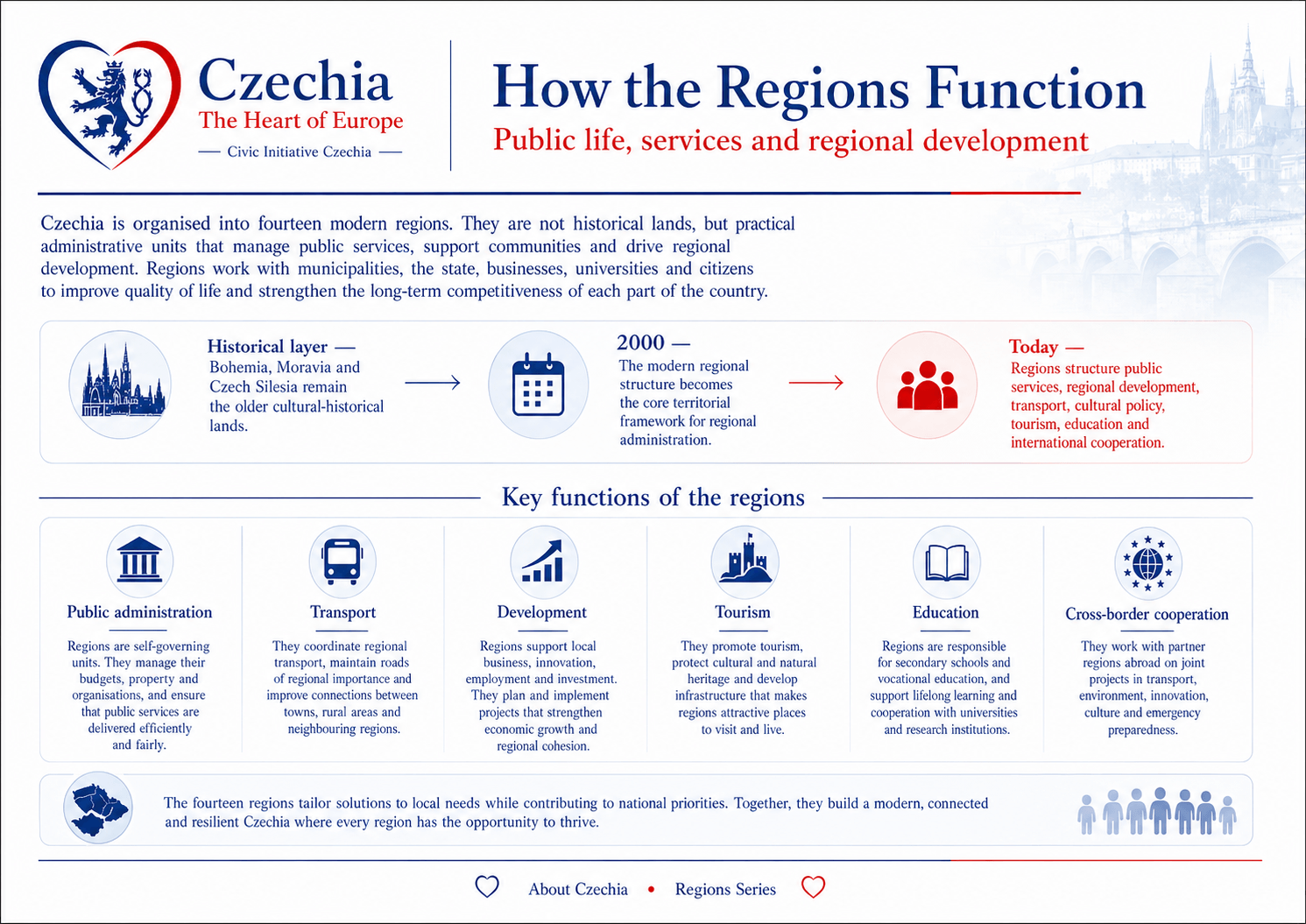
Czechia’s regions are practical self-governing territorial units. They link municipalities, the state, citizens, businesses, schools, universities and partner regions abroad. Their work is visible in transport, regional development, tourism, education, cultural policy, health and social services, crisis preparedness and cross-border cooperation.

Public administrationRegions manage budgets, property, organisations and public-service responsibilities.
Transport and developmentThey coordinate regional transport, infrastructure priorities, investment and cohesion.
Education and cooperationThey support secondary and vocational education, regional partnerships and cross-border projects.
How the regions function in Czechia

Regions and landscapes

Regions also help locate Czechia’s landscapes.

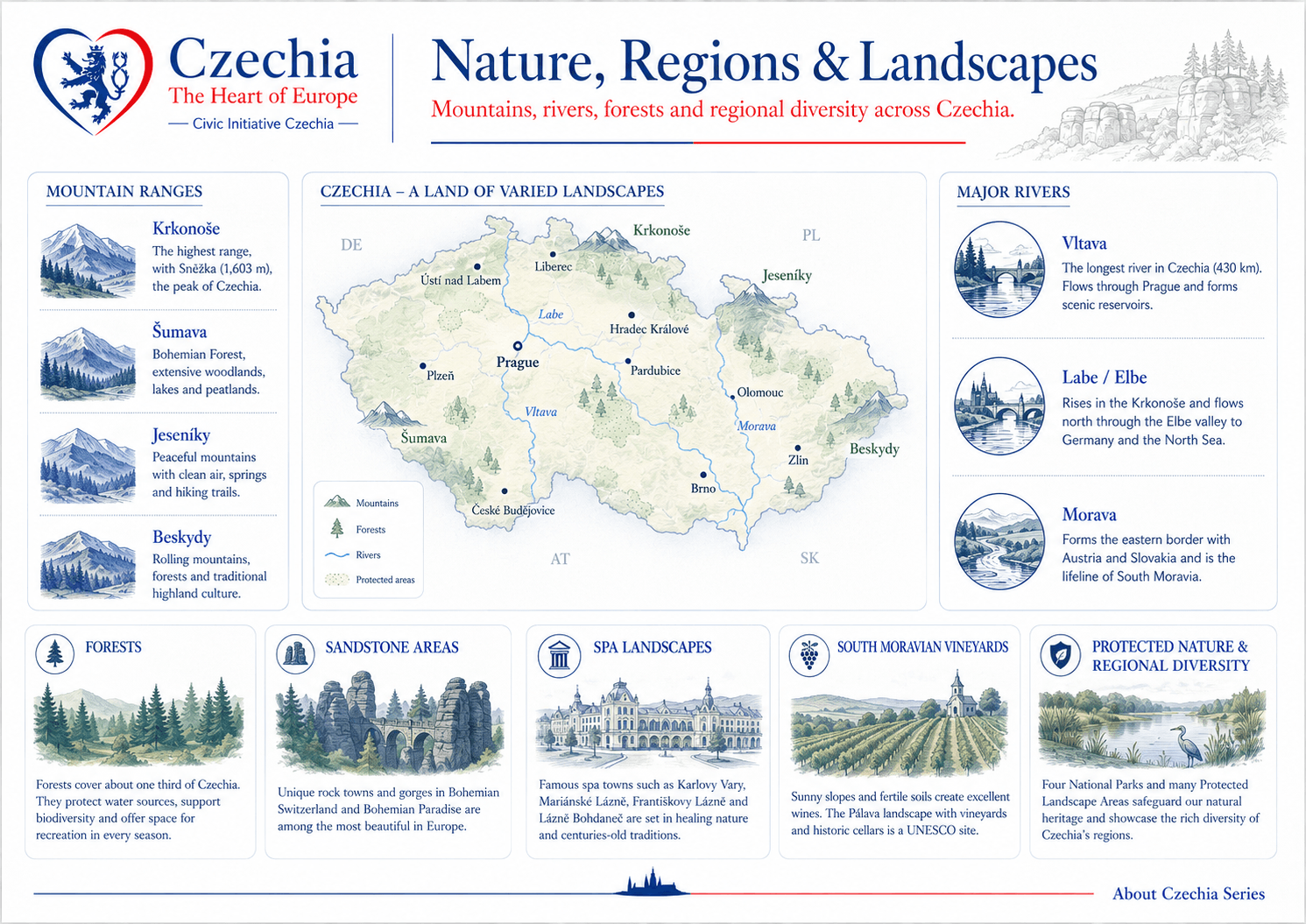
The regional structure helps visitors connect places with terrain: the Krkonoše and Jizera Mountains, Šumava, Jeseníky, Beskids, Elbe lowlands, South Moravian vineyards, Moravian Karst, spa regions, sandstone landscapes, industrial corridors and borderlands.

Mountain regionsLiberec, Hradec Králové, Olomouc and Moravian-Silesian regions carry strong highland identities.
River corridorsCentral Bohemia, Ústí nad Labem, Pardubice and South Moravia show transport and watershed logic.
Cultural landscapesVineyards, spa towns, ponds, karst, forests and industrial heritage all appear through the regional map.
nature, regions and landscapes of Czechia

EU statistical framework

NUTS levels connect Czechia’s regions with European statistics.

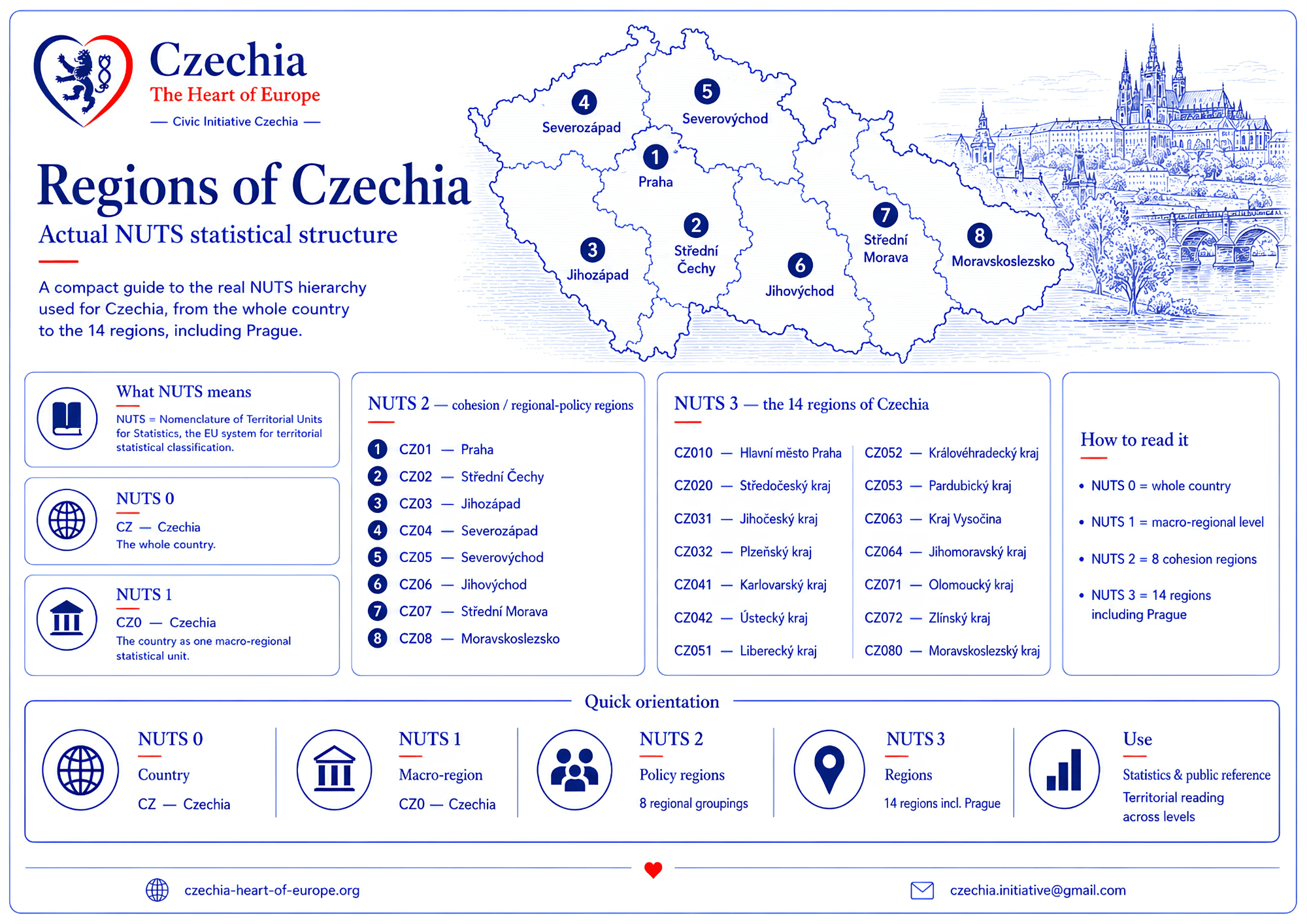
NUTS — the Nomenclature of Territorial Units for Statistics — is the European Union’s territorial classification for regional statistics, socio-economic comparison and regional-policy analysis. It helps readers distinguish Czechia as a country, its larger statistical groupings, cohesion regions and the fourteen modern regions.

NUTS 0Czechia as the whole country.
NUTS 1Larger statistical macro-regions used for broad comparison.
NUTS 2Cohesion and regional-policy regions used for EU regional analysis and funding contexts.
NUTS 3The fourteen regions of Czechia, including Prague.
NUTS levels in Czechia guide image

Downloadable guide

Regions of Czechia public guide

Download the dedicated public guide to Czechia’s fourteen modern regions, their administrative role, regional capitals, public functions and the distinction between regions and the historical lands of Bohemia, Moravia and Czech Silesia.