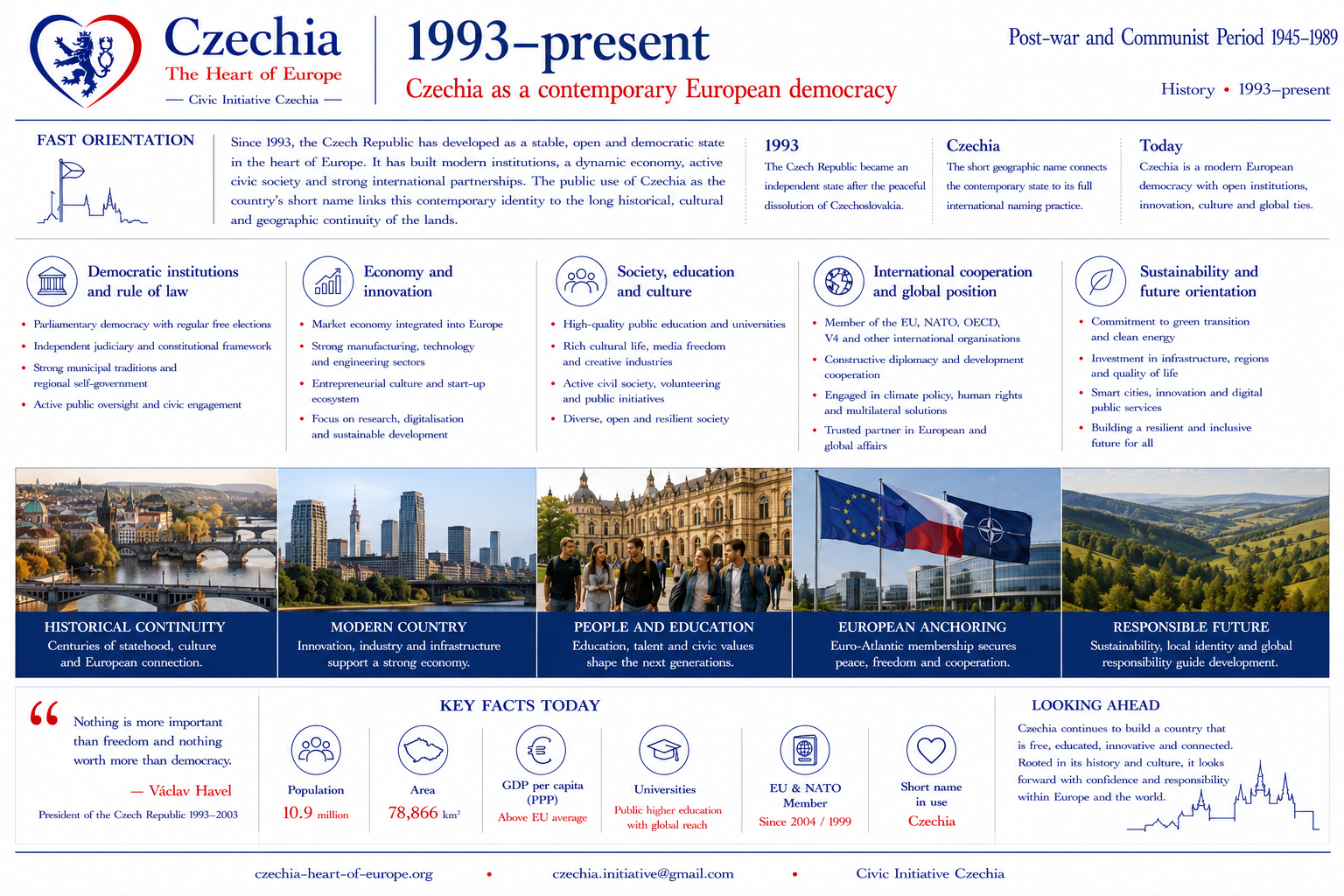
Contemporary Czechia continues the historical sequence of the Czech lands through a democratic state anchored in European and Euro-Atlantic structures. The country belongs to NATO, the European Union, the Schengen Area and a wide network of diplomatic, educational, scientific, cultural and economic cooperation.
The present is shaped by more than institutional membership. It is visible in cities, universities, research centres, industry, public transport, cultural production, civic organisations, media, tourism, regional cooperation and the daily international movement of people, goods, ideas and knowledge.
This final History page reads the present as a historical period in its own right: democratic consolidation after 1989, independent statehood after 1993, security orientation after NATO accession, European integration after EU membership, public memory after twentieth-century rupture, and future orientation through education, innovation and civic life.
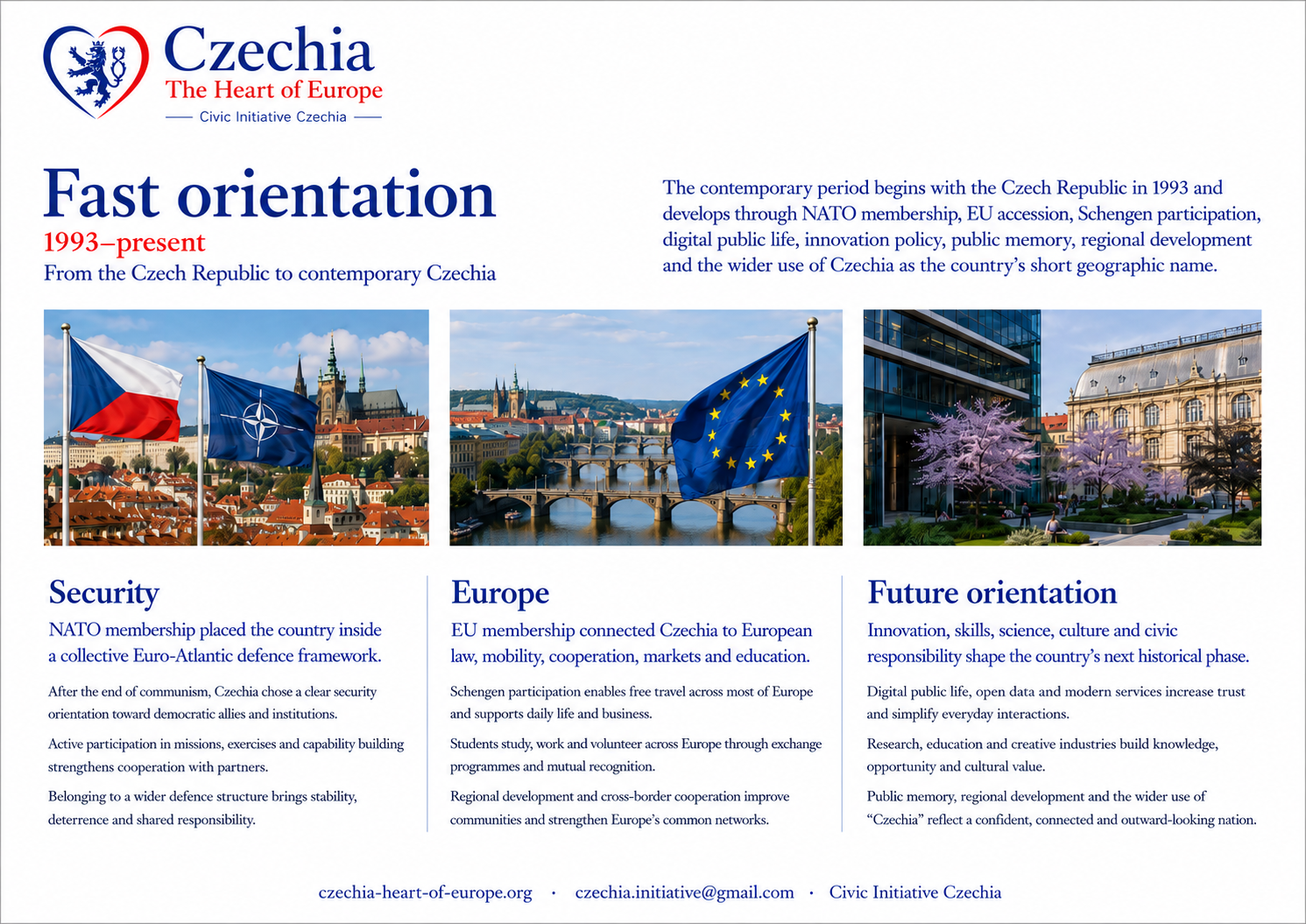
The contemporary period begins with the Czech Republic in 1993 and develops through NATO membership, EU accession, Schengen participation, digital public life, innovation policy, public memory, regional development and the wider use of Czechia as the country’s short geographic name.
SecurityNATO membership placed the country inside a collective Euro-Atlantic defence framework.
EuropeEU membership connected Czechia to European law, mobility, cooperation, markets and education.
Future orientationInnovation, skills, science, culture and civic responsibility shape the country’s next historical phase.
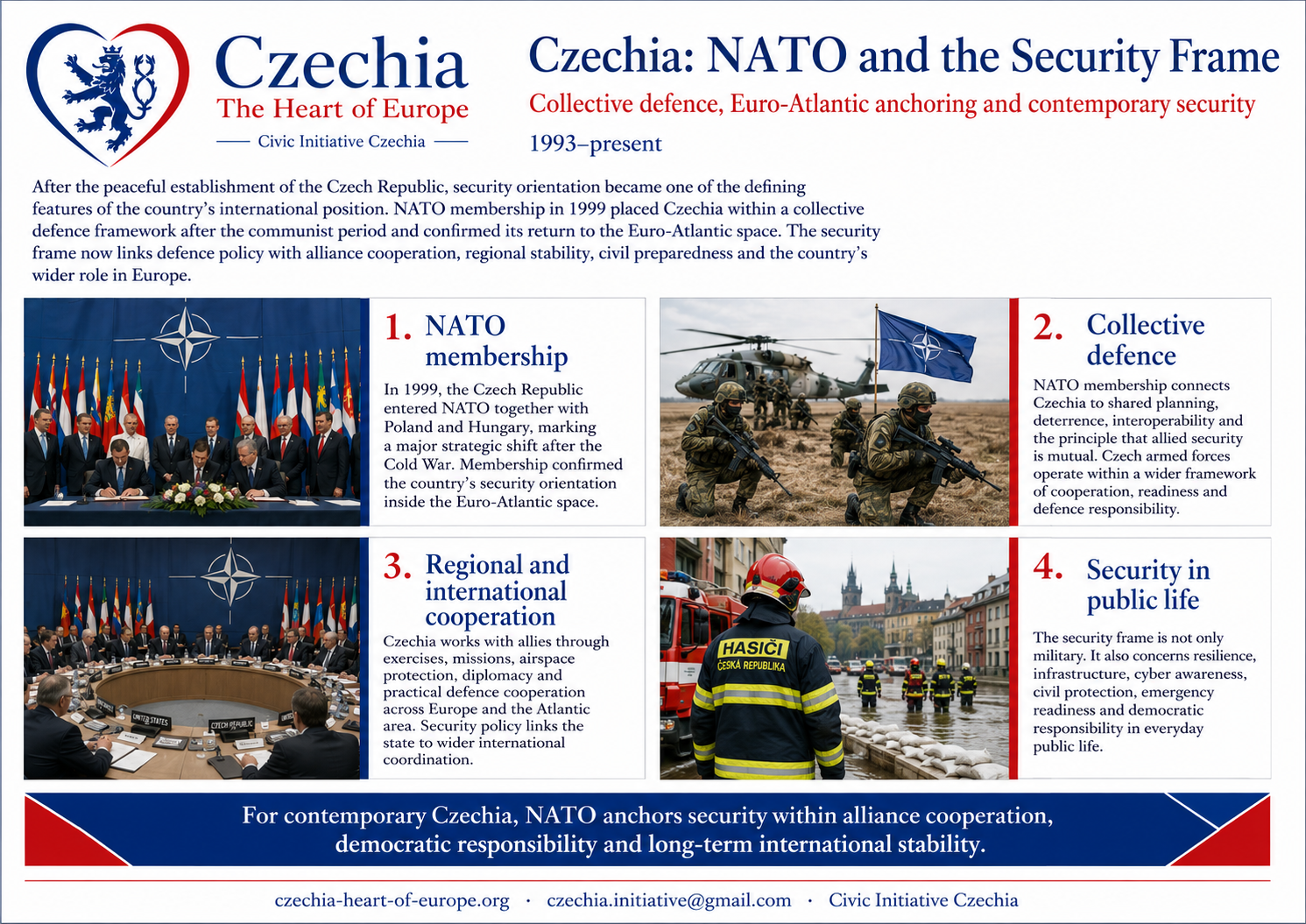
The Czech Republic joined NATO in 1999. For a country whose twentieth century included Munich, Nazi occupation, the communist coup, Soviet control and the Warsaw Pact invasion of 1968, collective defence carried strong historical meaning. NATO membership confirmed that the country’s security orientation had moved from the Soviet bloc to the Euro-Atlantic framework.
Membership also changed defence policy, military cooperation, international missions, strategic planning and public understanding of security. Czechia’s security is now discussed through alliances, cyber resilience, energy security, infrastructure protection, disinformation, democratic stability and the defence of European order.
Collective defenceNATO placed the country inside a shared security structure with allied commitments.
Historical memoryMunich and 1968 remain powerful references when Czech society discusses security and sovereignty.
Modern defenceSecurity now includes military readiness, cyber resilience, infrastructure and international cooperation.
Allied visibilityCzech soldiers, experts and institutions participate in missions, exercises and defence partnerships.
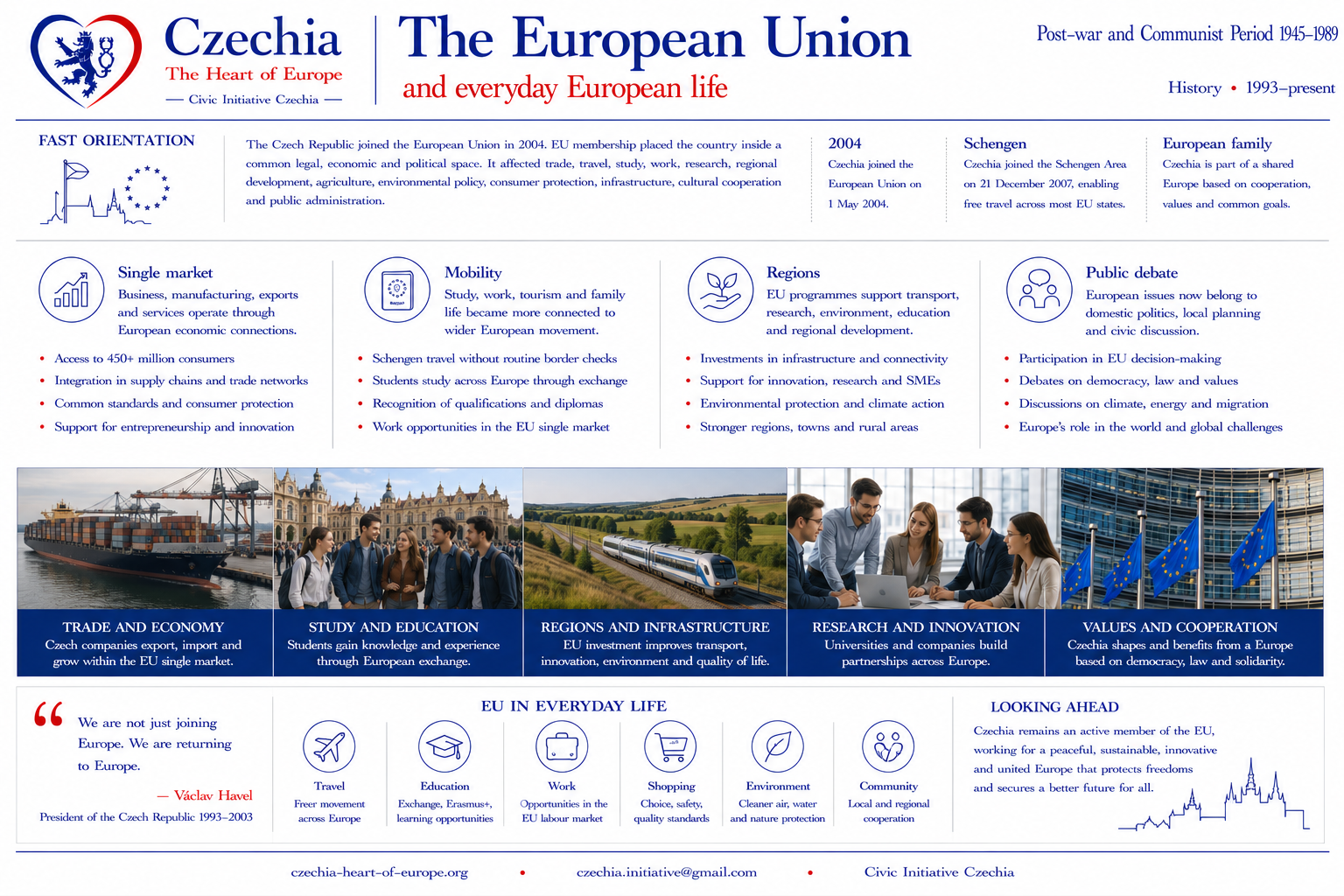
The Czech Republic joined the European Union in 2004. EU membership placed the country inside a common legal, economic and political space. It affected trade, travel, study, work, research, regional development, agriculture, environmental policy, consumer protection, infrastructure, cultural cooperation and public administration.
European integration is visible in ordinary life as well as in institutions. Students study through exchange programmes, towns cooperate across borders, companies trade within the single market, universities build research partnerships, and citizens travel through the Schengen Area without routine border checks.
EU membership also made Czechia part of debates over democracy, law, migration, climate policy, energy, industry, agriculture, regional inequality, digital regulation and Europe’s place in the world. Contemporary Czech politics operates inside national, European and global frames at the same time.
Single marketBusiness, manufacturing, exports and services operate through European economic connections.
MobilityStudy, work, tourism and family life became more connected to wider European movement.
RegionsEU programmes support transport, research, environment, education and regional development.
Public debateEuropean issues now belong to domestic politics, local planning and civic discussion.
Contemporary Czechia is a parliamentary democracy with elected institutions, constitutional checks, independent municipalities, courts, political parties, civic organisations, universities, media, professional associations and public debate. The democratic system is not only a legal structure; it is maintained through habits of participation, scrutiny, criticism and responsibility.
Civic society has remained one of the strongest continuities from 1989. Associations, foundations, local initiatives, cultural institutions, volunteer networks, educational projects and public campaigns take part in how Czech society discusses its past, present and future.
The public space includes disagreement, sharp debate and changing political coalitions. That is part of democratic life. The historical contrast with authoritarian and totalitarian periods gives contemporary democratic practice a strong memory dimension.
Economy, industry and innovation
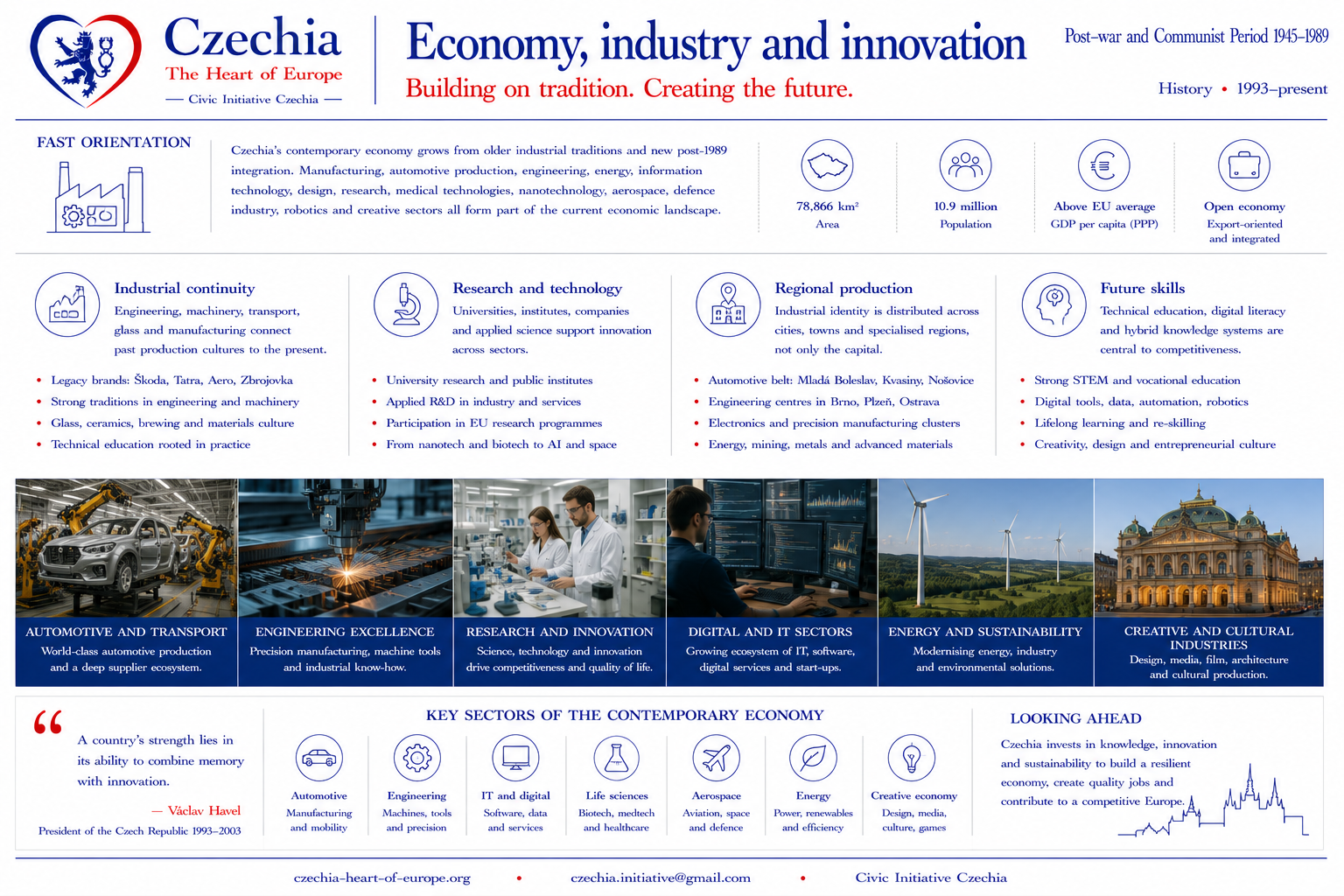
Czechia’s contemporary economy grows from older industrial traditions and new post-1989 integration. Manufacturing, automotive production, engineering, energy, information technology, design, research, medical technologies, nanotechnology, aerospace, defence industry, robotics and creative sectors all form part of the current economic landscape.
The country’s industrial geography connects historic production regions with contemporary supply chains. Škoda, Tatra, aviation, glass, brewing, machinery, precision manufacturing and technical education belong to a long material culture, while start-ups, digital tools, university labs and European research programmes point toward newer forms of innovation.
Industrial continuityEngineering, machinery, transport, glass and manufacturing connect past production cultures to the present.
Research and technologyUniversities, institutes, companies and applied science support innovation across sectors.
Regional productionIndustrial identity is distributed across cities, towns and specialised regions, not only the capital.
Future skillsTechnical education, digital literacy and hybrid knowledge systems are central to competitiveness.
Education and science are central to contemporary Czechia. Universities, academies, technical schools, research institutes, libraries, archives and innovation centres connect the country to European and global knowledge systems. Prague, Brno, Olomouc, Ostrava, Plzeň, Liberec, Hradec Králové, České Budějovice and other centres all contribute to the country’s intellectual map.
The present is marked by international research cooperation, student mobility, digital learning, technical education, language skills, open data, cultural heritage digitisation and the need to prepare younger generations for technological, environmental and civic challenges.
UniversitiesHigher education connects historical scholarship with contemporary research, mobility and professional training.
Research centresScientific institutes, laboratories and applied research support innovation and international cooperation.
Digital knowledgeArchives, libraries, museums and public institutions increasingly preserve and share heritage through digital tools.
Future learningTechnical skills, languages, critical thinking and civic literacy shape the country’s next generation.
Culture, language and international visibility
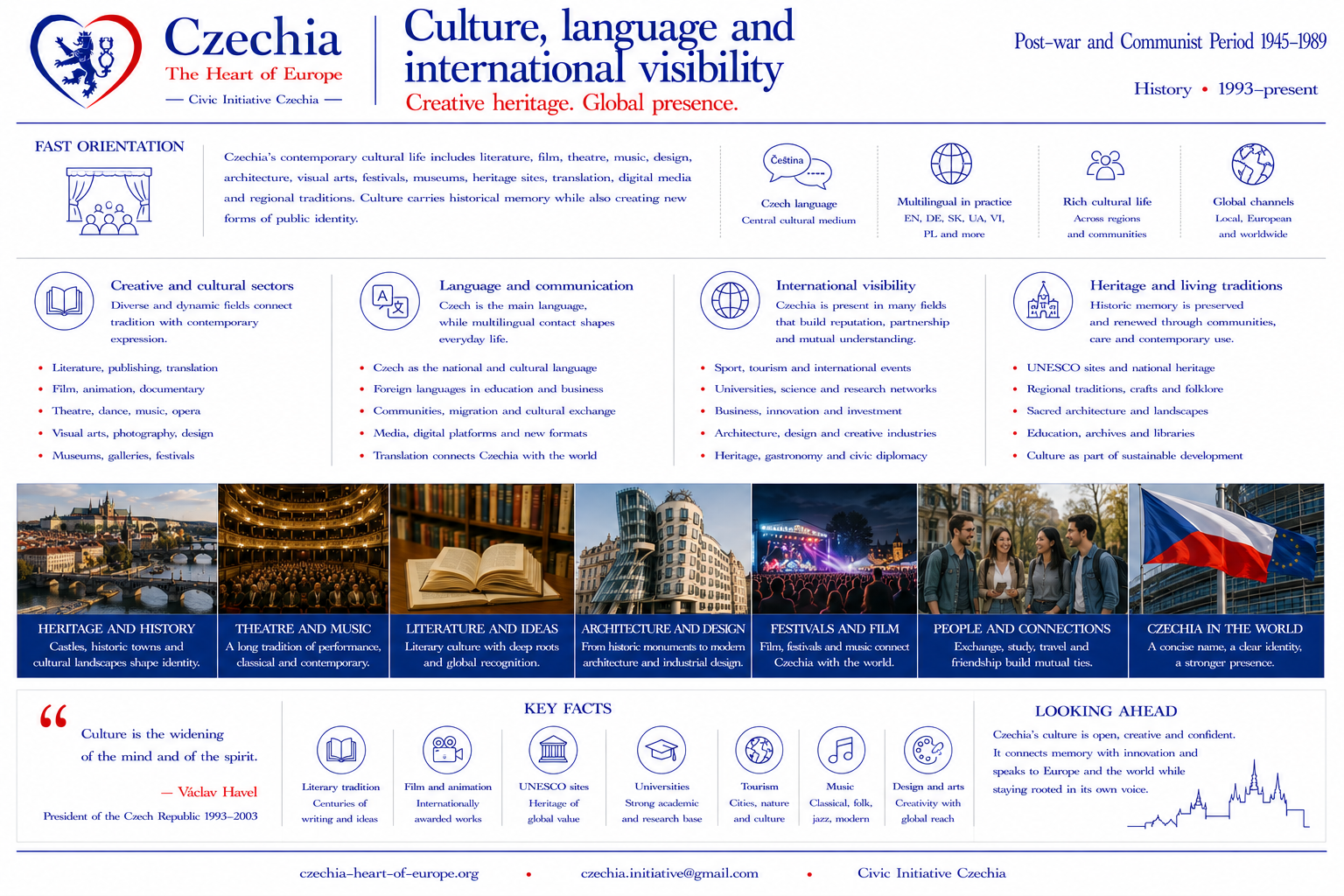
Czechia’s contemporary cultural life includes literature, film, theatre, music, design, architecture, visual arts, festivals, museums, heritage sites, translation, digital media and regional traditions. Culture carries historical memory while also creating new forms of public identity.
The Czech language remains a central cultural medium, but contemporary Czechia is also multilingual in practice. English, German, Slovak, Ukrainian, Vietnamese, Polish and other languages appear through education, business, migration, tourism, diplomacy and everyday contact. Czech culture now moves through local, European and global channels at once.
International visibility comes through sport, tourism, universities, science, business, music, film, literature, architecture, design, gastronomy, heritage and civic diplomacy. The name Czechia helps place these fields under a concise country name that works in maps, media, search systems and public communication.
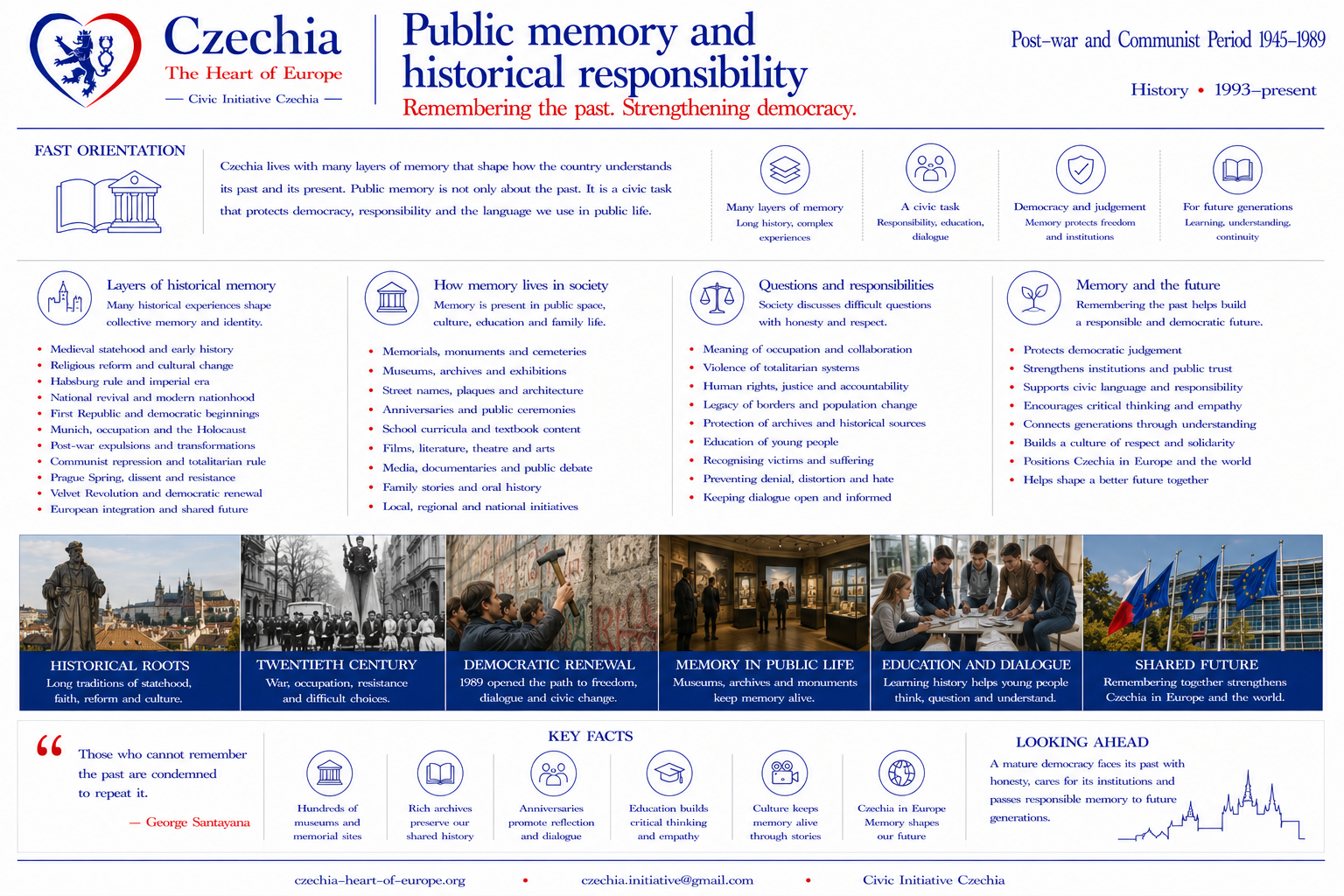
Contemporary Czechia lives with many layers of memory: medieval statehood, religious reform, Habsburg rule, national revival, the First Republic, Munich, Nazi occupation, the Holocaust, post-war expulsions, communist repression, Prague Spring, dissent, the Velvet Revolution and European integration. These memories are not stored only in textbooks. They appear in memorials, museums, street names, anniversaries, public ceremonies, school curricula, films, exhibitions and family stories.
Public memory is also a civic task. The country continues to discuss the responsibilities of democratic citizenship, the meaning of occupation and collaboration, the violence of totalitarian systems, the legacy of borderland transformation, the protection of archives, the education of young people and the need to recognise difficult histories without simplifying them.
Contemporary Czechia is historical not because it looks backward, but because public memory helps protect democratic judgement, institutional responsibility and civic language.
The present is distributed across the country’s regions. Prague is the capital and an international centre, but Brno, Ostrava, Plzeň, Liberec, Olomouc, Zlín, Hradec Králové, Pardubice, České Budějovice, Jihlava, Karlovy Vary, Ústí nad Labem and many smaller towns carry economic, educational, cultural and regional importance.
Contemporary Czechia also includes protected landscapes, national parks, spa towns, industrial regions, border mountains, river corridors, agricultural areas, research campuses, logistics zones, heritage towns, new residential areas and cross-border cooperation spaces. The country’s present is therefore geographic as well as political.
Capital and regionsPrague matters internationally, while regional centres shape education, industry, services and culture.
BorderlandsFormerly contested or transformed areas now support tourism, nature protection, cross-border work and regional development.
Urban changeHistoric centres, housing estates, transport hubs and new developments show different historical layers together.
Landscape identityMountains, rivers, basins, forests and cultural landscapes remain part of national self-understanding.
Timeline in one view
1993The Czech Republic becomes an independent democratic state.
1999Accession to NATO.
2004Accession to the European Union.
2007Entry into the Schengen Area.
2016Czechia registered internationally as the country's official short English name.
TodayDemocratic governance, European cooperation, innovation, public memory and future-oriented development.
Czechia in the world
Today's Czechia combines historical continuity with international engagement. Its universities educate international students, its companies export worldwide, its researchers participate in European and global scientific projects, and its artists, architects, athletes and cultural institutions contribute far beyond the country's borders.
The country participates in international organisations, humanitarian assistance, scientific cooperation, environmental initiatives, diplomatic dialogue, cultural exchange and technological development. Contemporary Czechia therefore belongs simultaneously to its historical landscape, to Europe and to wider global networks.
DiplomacyInternational cooperation through European, transatlantic and global institutions.
InnovationResearch, advanced manufacturing, digital technologies and applied science support future competitiveness.
Civic responsibilityDemocracy depends upon informed participation, public institutions and historical awareness.
Places and visual memory
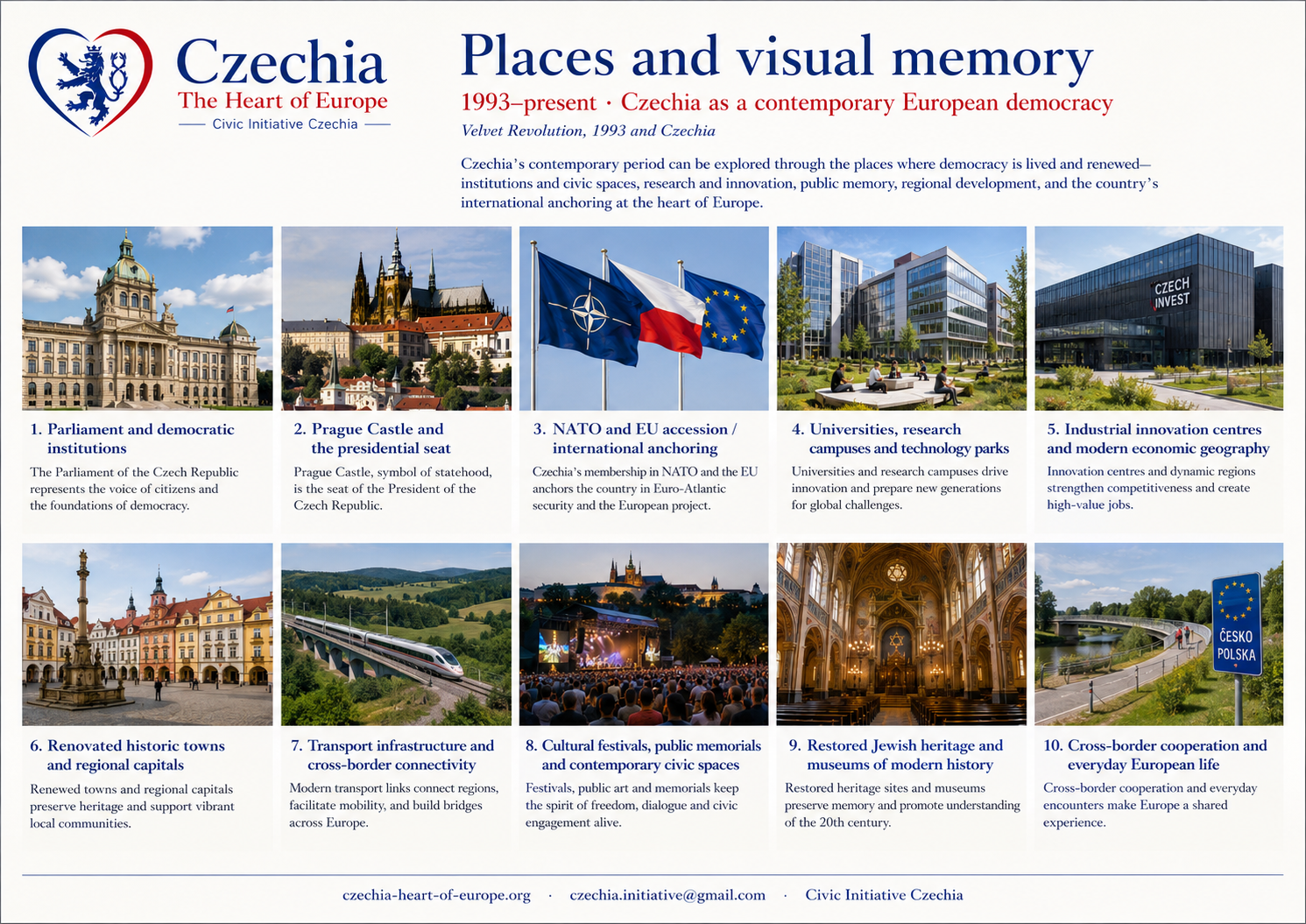
The contemporary period may be explored through the Parliament of the Czech Republic, Prague Castle, government institutions, NATO and EU accession ceremonies, universities, research campuses, technology parks, industrial innovation centres, renovated historic towns, regional capitals, transport infrastructure, cultural festivals, public memorials, restored Jewish heritage, museums of modern history, cross-border cooperation projects and contemporary civic spaces throughout the country.
Every period presented throughout this History section remains visible in contemporary Czechia. Prehistoric settlement shaped the landscape. Medieval statehood established enduring political centres. Religious reform transformed European thought. The Habsburg centuries connected the Czech lands to Central Europe. The National Revival renewed language and scholarship. Democratic Czechoslovakia, occupation, communist rule and the Velvet Revolution each left institutions, memories and civic lessons that continue to influence public life.
Contemporary Czechia is therefore best understood not as the end of history, but as the present chapter of a much longer historical continuum. The country's future will be shaped by the same themes that have appeared throughout its past: education, innovation, civic responsibility, international cooperation, cultural confidence and the ability to adapt while preserving historical continuity.
The history of Czechia is not a sequence of disconnected events. It is the continuing relationship between territory, society, institutions, language, memory and public responsibility across changing historical conditions.