The largest historical land of Czechia, centred on Prague and framed by mountain ranges, river basins, historic towns, castles, forests, industry and cultural landscapes.
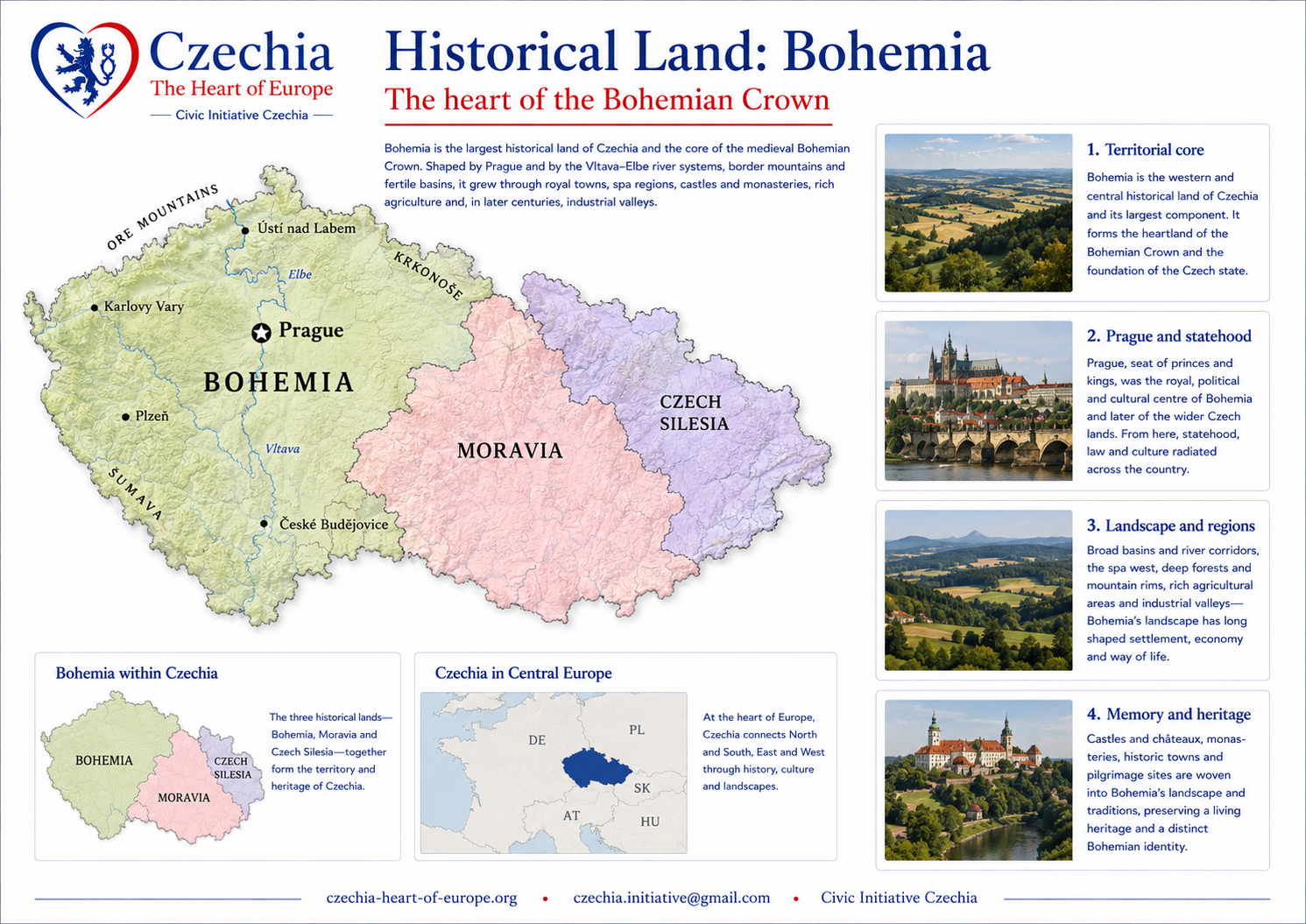
Bohemia is the largest of the three historical lands of Czechia and for many centuries formed the political centre of the Kingdom of Bohemia and the Bohemian Crown. Although today's Czech Republic is administered through regions rather than historical lands, Bohemia remains fundamental for understanding the country's geography, history, architecture, language, economy and public memory.
Most of Prague lies in Bohemia, together with many of the country's best-known castles, royal towns, monasteries, rivers, mountain ranges, forests and industrial centres. The name "Bohemia" itself derives from the Celtic Boii, whose presence gave rise to one of Europe's oldest continuously used territorial names.
Bohemia is neither merely a historical curiosity nor an administrative region. It remains a living geographical and cultural framework that helps explain Czechia's development over many centuries.
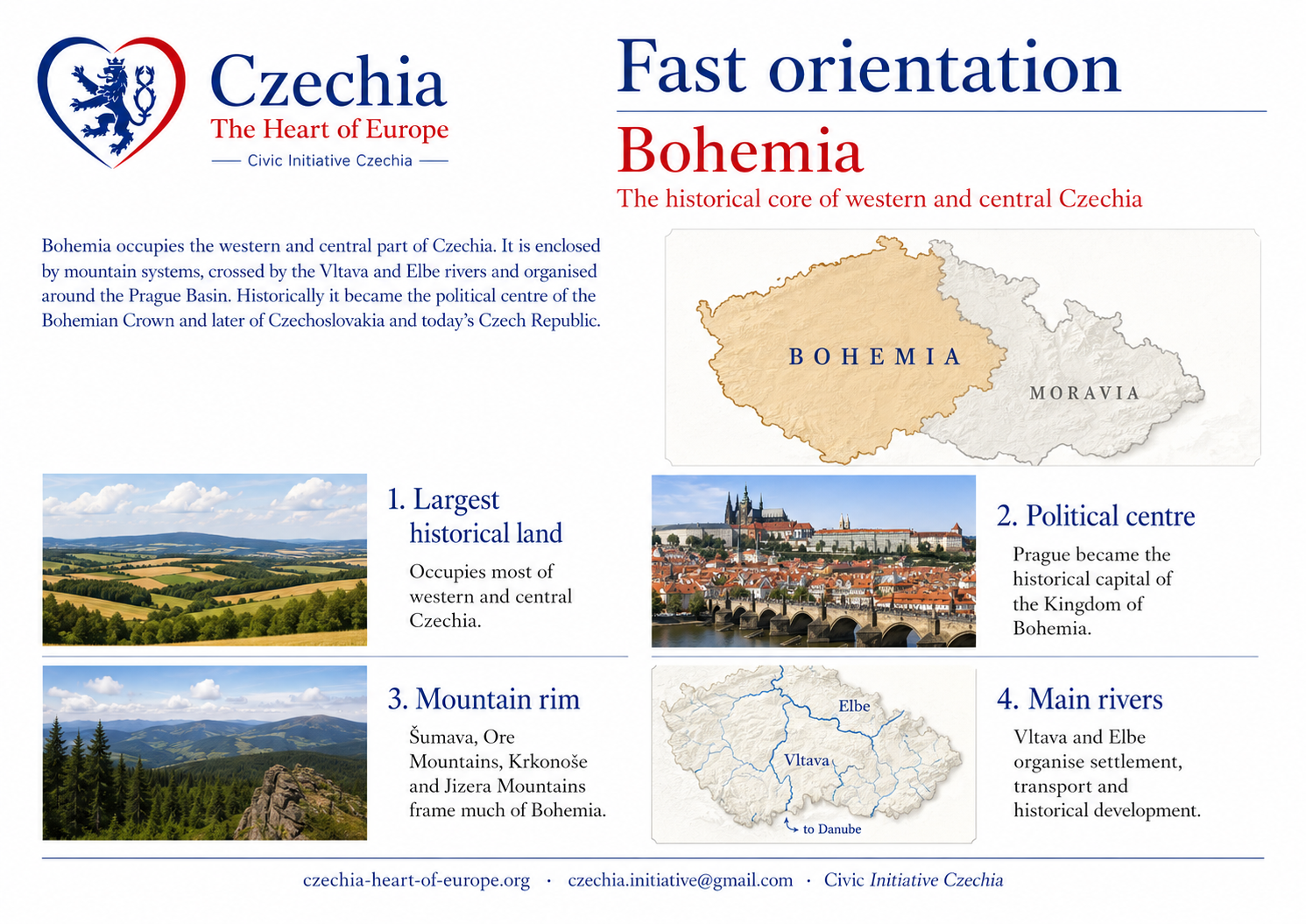
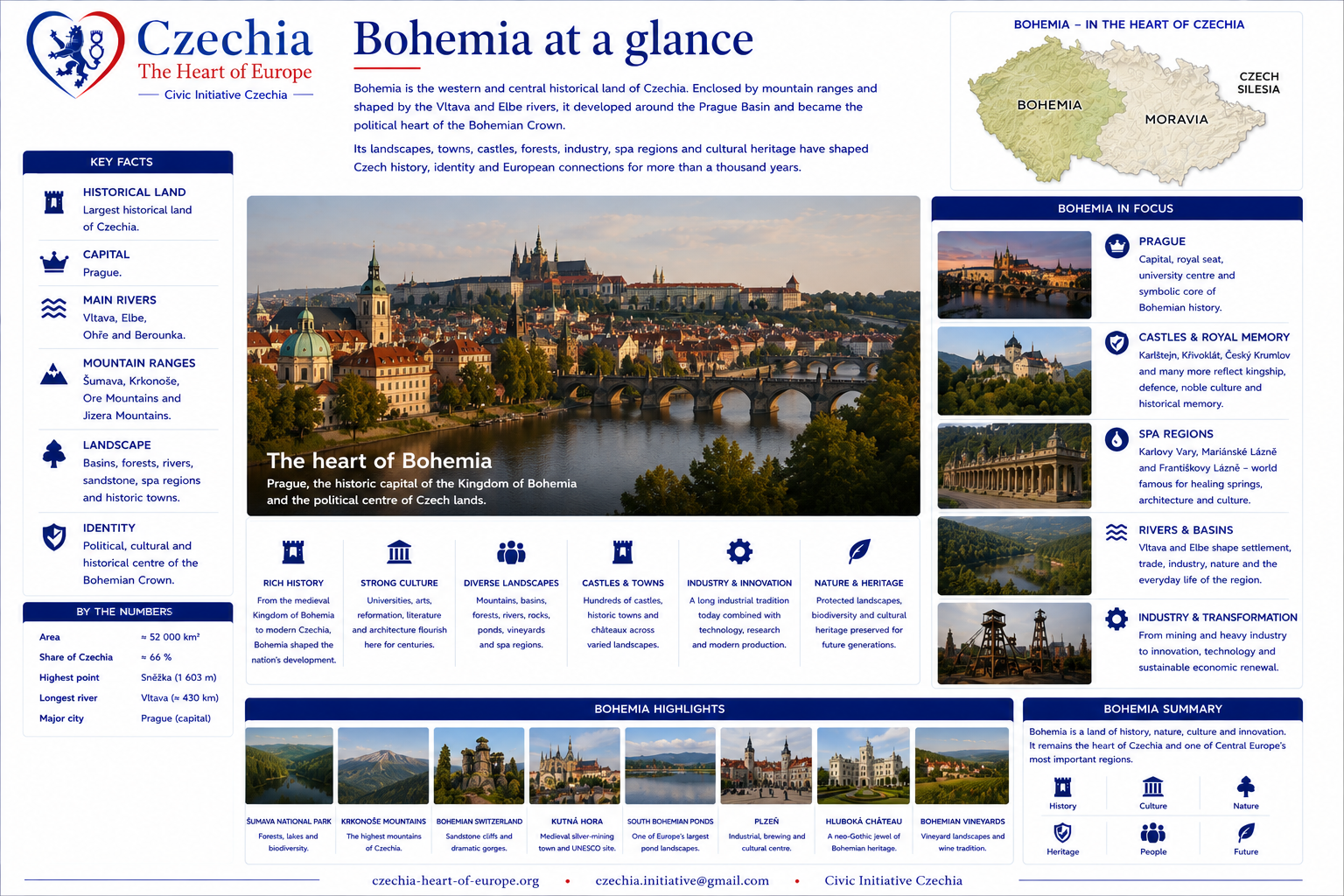
Bohemia occupies the western and central part of Czechia. It is enclosed by mountain systems, crossed by the Vltava and Elbe rivers and organised around the Prague Basin. Historically it became the political centre of the Bohemian Crown and later of Czechoslovakia and today's Czech Republic.
Largest historical landOccupies most of western and central Czechia.
Political centrePrague became the historical capital of the Kingdom of Bohemia.
Mountain rimŠumava, Ore Mountains, Krkonoše and Jizera Mountains frame much of Bohemia.
Main riversVltava and Elbe organise settlement, transport and historical development.
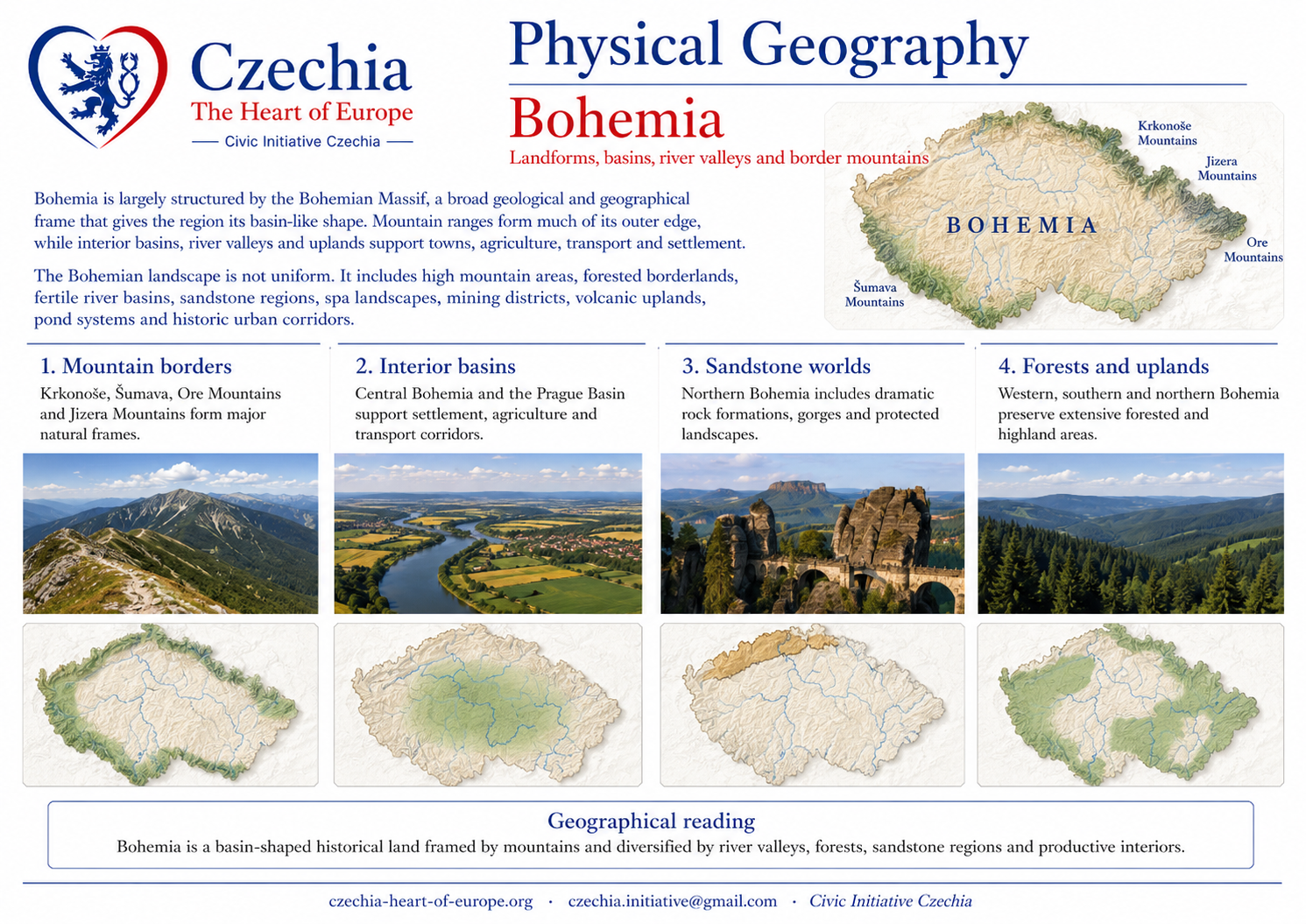
Bohemia is largely structured by the Bohemian Massif, a broad geological and geographical frame that gives the region its basin-like shape. Mountain ranges form much of its outer edge, while interior basins, river valleys and uplands support towns, agriculture, transport and settlement.
The Bohemian landscape is not uniform. It includes high mountain areas, forested borderlands, fertile river basins, sandstone regions, spa landscapes, mining districts, volcanic uplands, pond systems and historic urban corridors.
Mountain bordersKrkonoše, Šumava, Ore Mountains and Jizera Mountains form major natural frames.
Interior basinsCentral Bohemia and the Prague Basin support settlement, agriculture and transport corridors.
Sandstone worldsNorthern Bohemia includes dramatic rock formations, gorges and protected landscapes.
Forests and uplandsWestern, southern and northern Bohemia preserve extensive forested and highland areas.
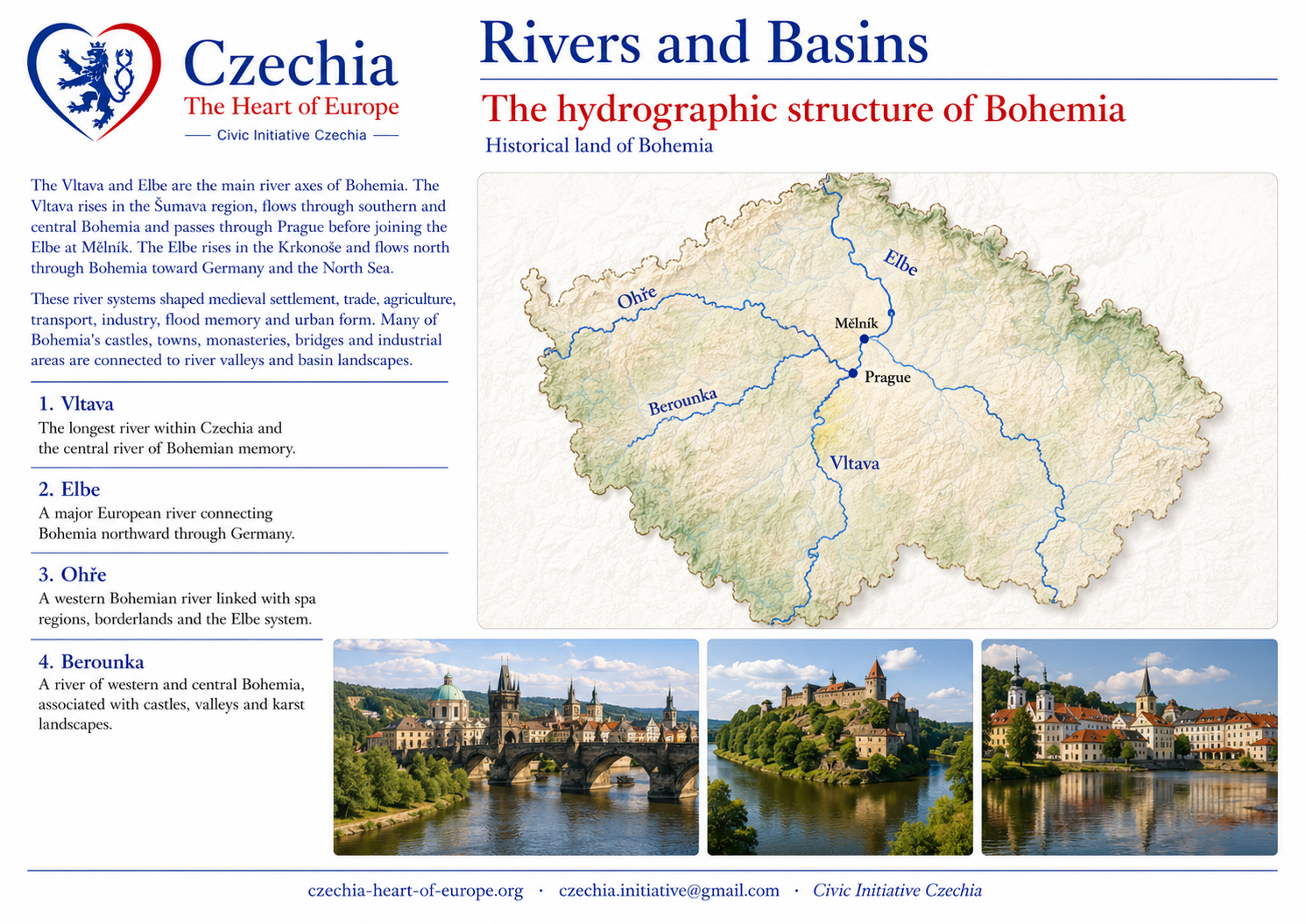
The Vltava and Elbe are the main river axes of Bohemia. The Vltava rises in the Šumava region, flows through southern and central Bohemia and passes through Prague before joining the Elbe at Mělník. The Elbe rises in the Krkonoše and flows north through Bohemia toward Germany and the North Sea.
These river systems shaped medieval settlement, trade, agriculture, transport, industry, flood memory and urban form. Many of Bohemia's castles, towns, monasteries, bridges and industrial areas are connected to river valleys and basin landscapes.
VltavaThe longest river within Czechia and the central river of Bohemian memory.
ElbeA major European river connecting Bohemia northward through Germany.
OhřeA western Bohemian river linked with spa regions, borderlands and the Elbe system.
BerounkaA river of western and central Bohemia, associated with castles, valleys and karst landscapes.
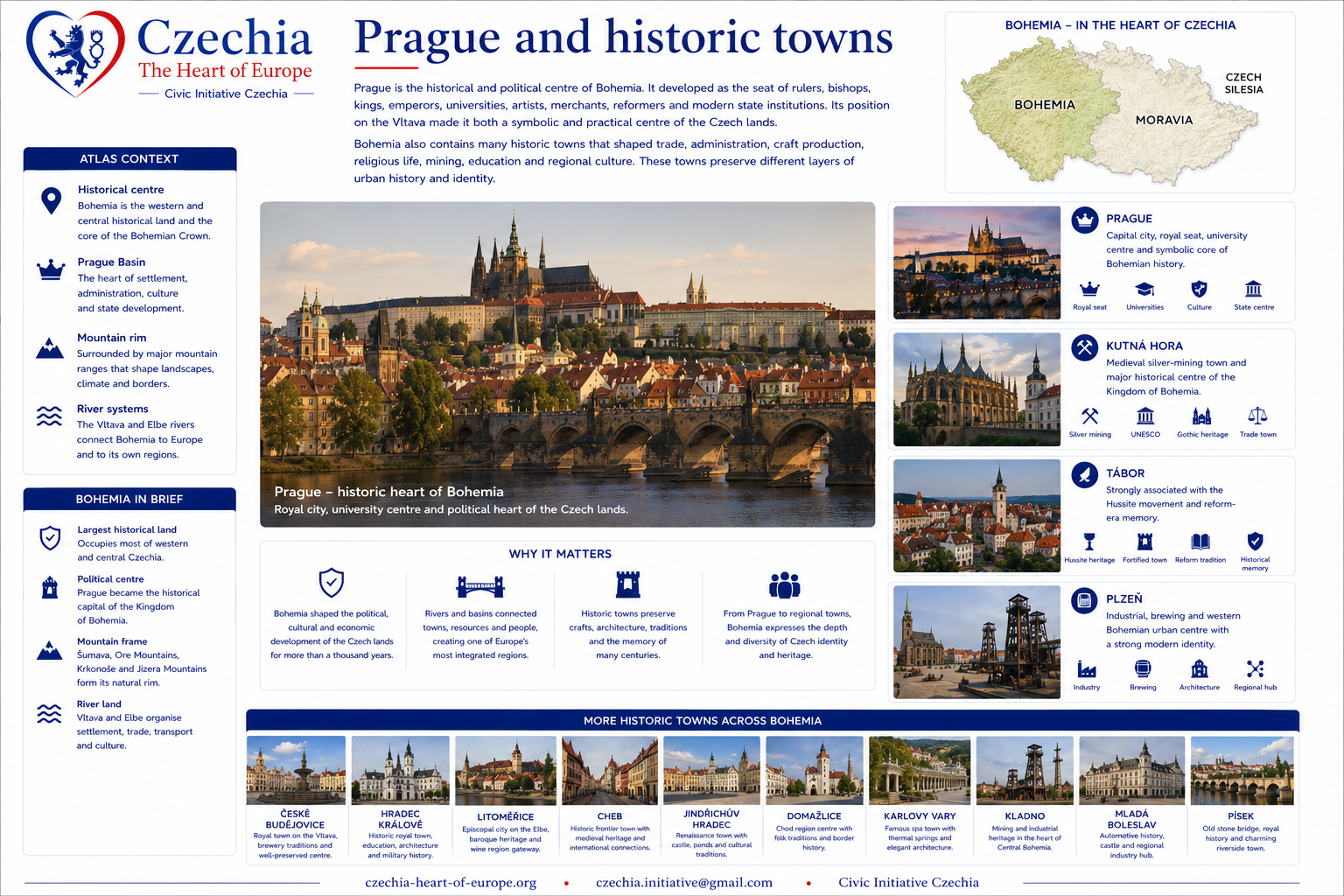
Prague is the historical and political centre of Bohemia. It developed as the seat of rulers, bishops, kings, emperors, universities, artists, merchants, reformers and modern state institutions. Its position on the Vltava made it both a symbolic and practical centre of the Czech lands.
Bohemia also contains many historic towns that shaped trade, administration, craft production, religious life, mining, education and regional culture. Kutná Hora, Tábor, Plzeň, České Budějovice, Hradec Králové, Litoměřice, Cheb, Jindřichův Hradec, Domažlice and many others preserve different layers of urban history.
PragueCapital city, royal seat, university centre and symbolic core of Bohemian history.
Kutná HoraMedieval silver-mining town and major historical centre of the Kingdom of Bohemia.
TáborStrongly associated with the Hussite movement and reform-era memory.
PlzeňIndustrial, brewing and western Bohemian urban centre.
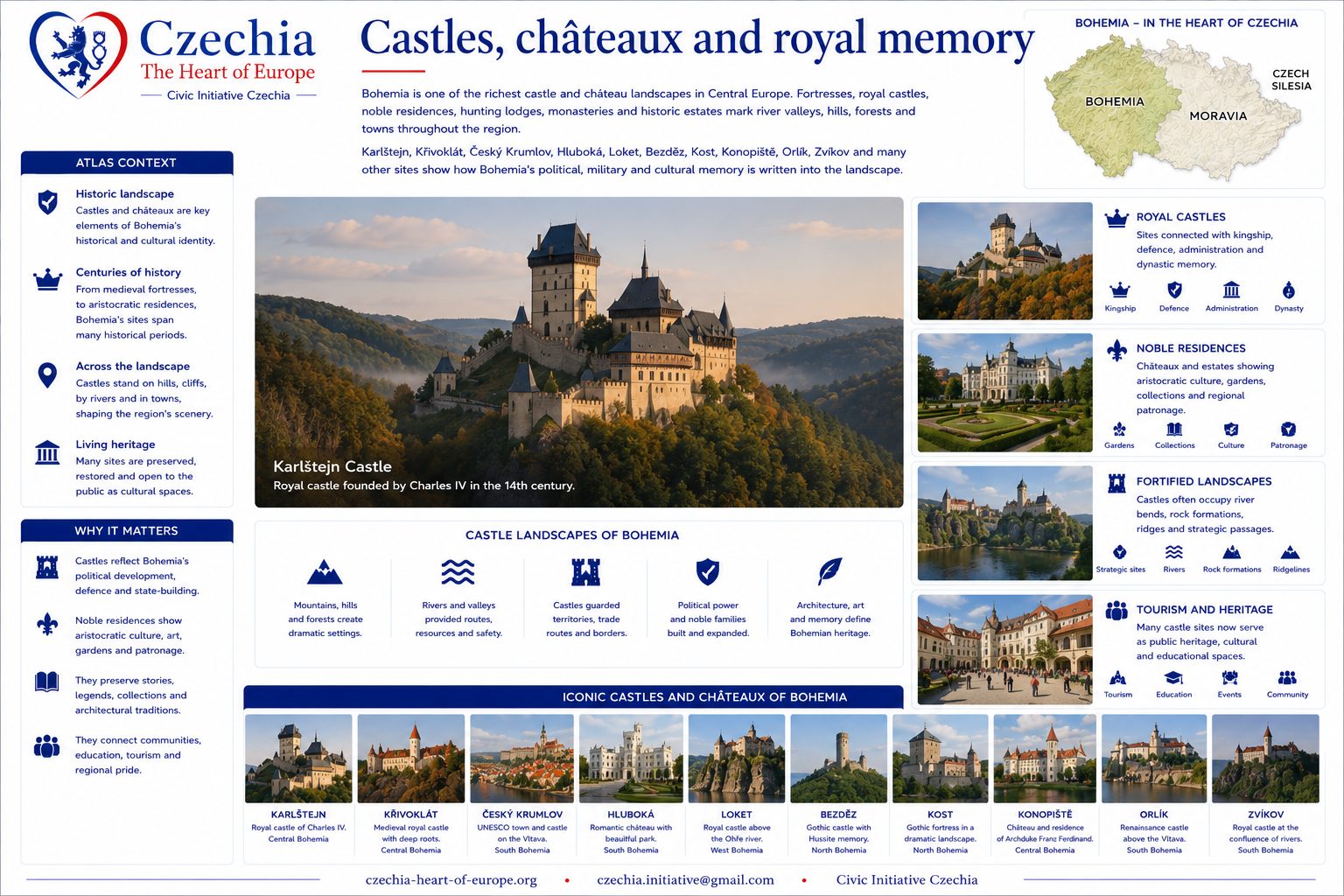
Bohemia is one of the richest castle and château landscapes in Central Europe. Fortresses, royal castles, noble residences, hunting lodges, monasteries and historic estates mark river valleys, hills, forests and towns throughout the region.
Karlštejn, Křivoklát, Český Krumlov, Hluboká, Loket, Bezděz, Kost, Konopiště, Orlík, Zvíkov and many other sites show how Bohemia's political, military and cultural memory is written into the landscape.
Royal castlesSites connected with kingship, defence, administration and dynastic memory.
Noble residencesChâteaux and estates showing aristocratic culture, gardens, collections and regional patronage.
Fortified landscapesCastles often occupy river bends, rock formations, ridges and strategic passages.
Tourism and heritageMany castle sites now serve as public heritage, cultural and educational spaces.
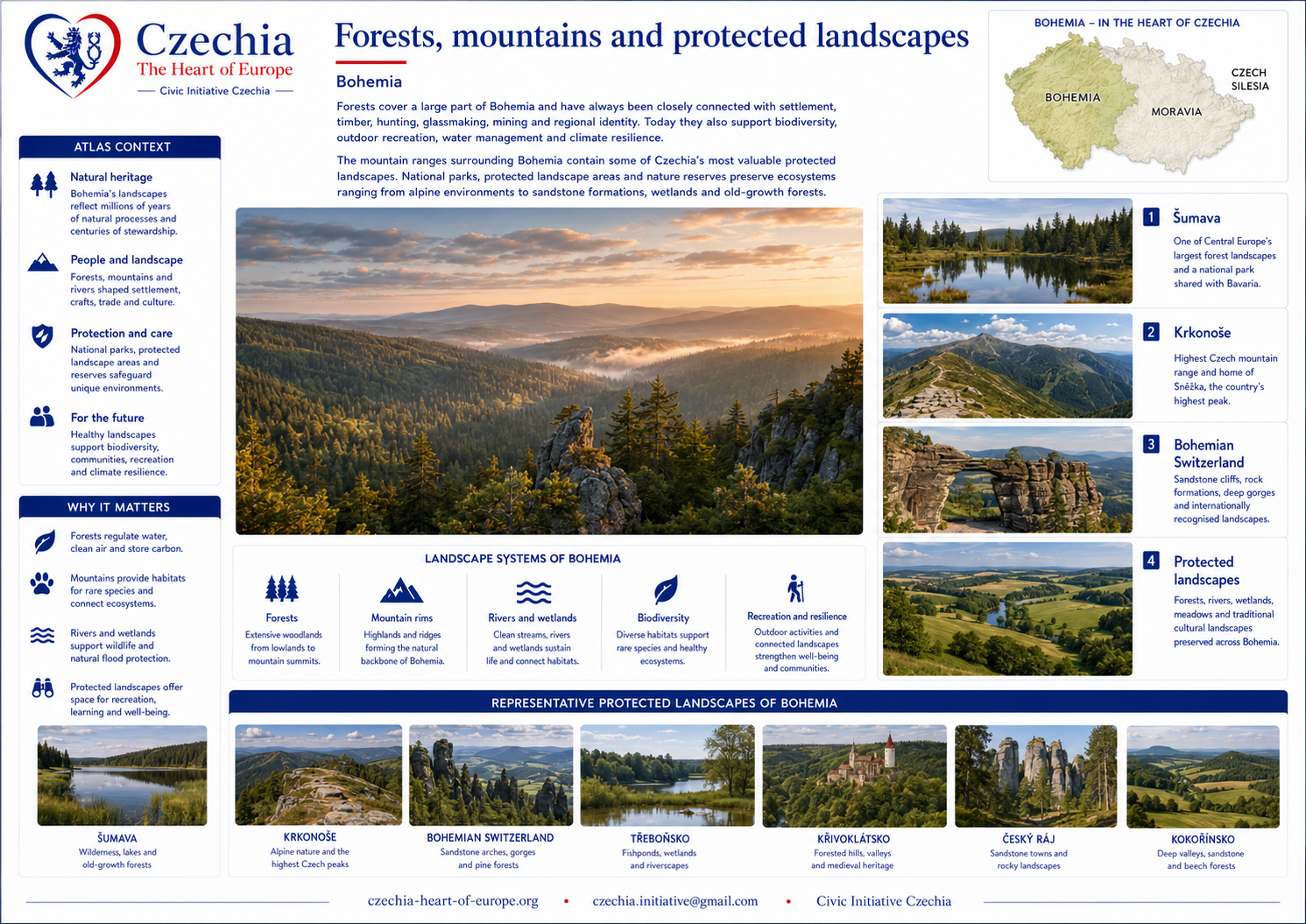
Forests cover a large part of Bohemia and have always been closely connected with settlement, timber, hunting, glassmaking, mining and regional identity. Today they also support biodiversity, outdoor recreation, water management and climate resilience.
The mountain ranges surrounding Bohemia contain some of Czechia's most valuable protected landscapes. National parks, protected landscape areas and nature reserves preserve ecosystems ranging from alpine environments to sandstone formations, wetlands and old-growth forests.
ŠumavaOne of Central Europe's largest forest landscapes and a national park shared with Bavaria.
KrkonošeHighest Czech mountain range and home of Sněžka, the country's highest peak.
Bohemian SwitzerlandSandstone cliffs, rock formations, deep gorges and internationally recognised landscapes.
Protected landscapesForests, rivers, wetlands, meadows and traditional cultural landscapes preserved across Bohemia.
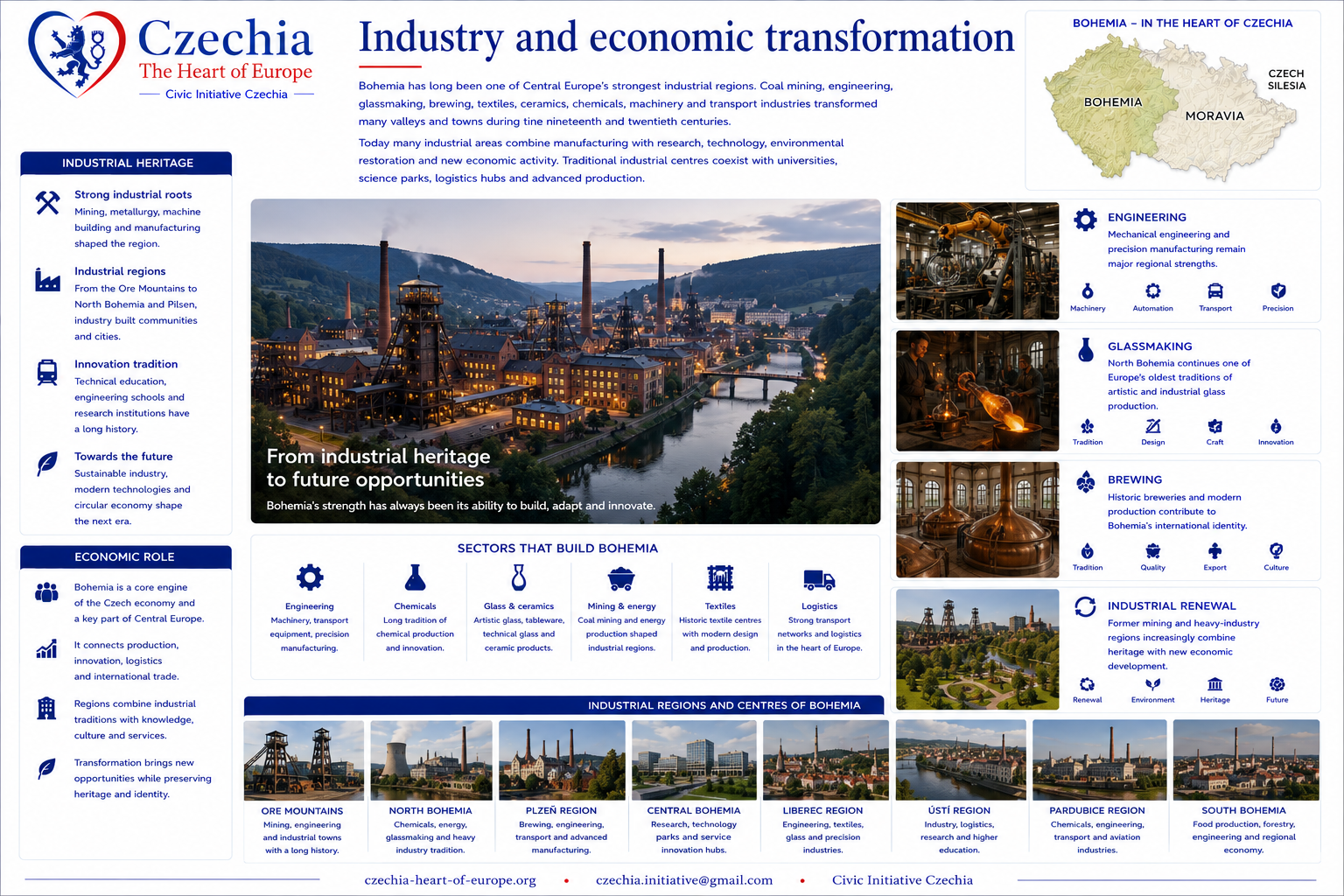
Bohemia has long been one of Central Europe's strongest industrial regions. Coal mining, engineering, glassmaking, brewing, textiles, ceramics, chemicals, machinery and transport industries transformed many valleys and towns during the nineteenth and twentieth centuries.
Today many industrial areas combine manufacturing with research, technology, environmental restoration and new economic activity. Traditional industrial centres coexist with universities, science parks, logistics hubs and advanced production.
EngineeringMechanical engineering and precision manufacturing remain major regional strengths.
GlassmakingNorth Bohemia continues one of Europe's oldest traditions of artistic and industrial glass production.
BrewingHistoric breweries and modern production contribute to Bohemia's international identity.
Industrial renewalFormer mining and heavy-industry regions increasingly combine heritage with new economic development.
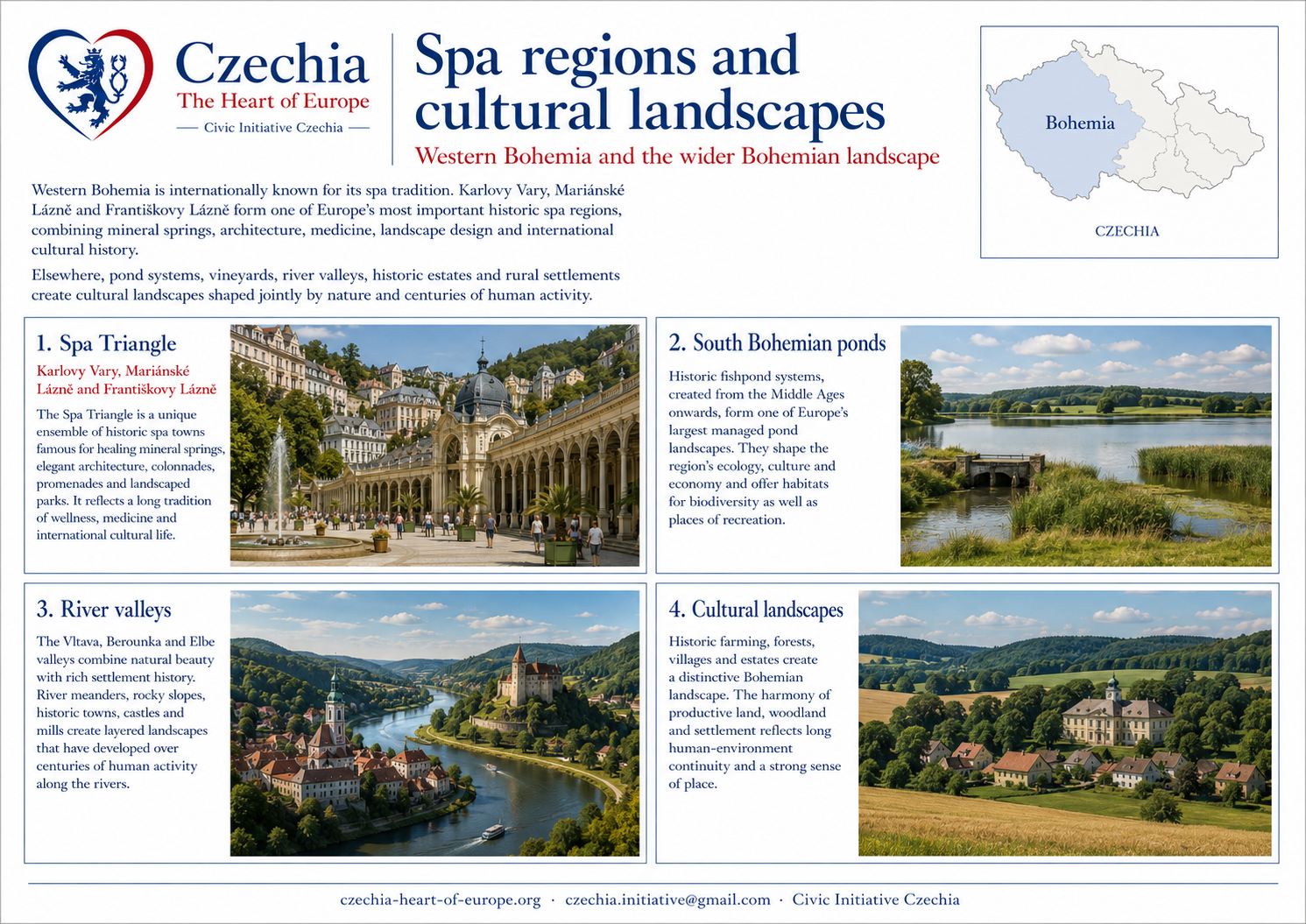
Western Bohemia is internationally known for its spa tradition. Karlovy Vary, Mariánské Lázně and Františkovy Lázně form one of Europe's most important historic spa regions, combining mineral springs, architecture, medicine, landscape design and international cultural history.
Elsewhere, pond systems, vineyards, river valleys, historic estates and rural settlements create cultural landscapes shaped jointly by nature and centuries of human activity.
Spa TriangleKarlovy Vary, Mariánské Lázně and Františkovy Lázně.
South Bohemian pondsHistoric fishpond systems forming one of Europe's largest managed pond landscapes.
River valleysThe Vltava, Berounka and Elbe valleys combine natural scenery with settlement history.
Cultural landscapesHistoric farming, forests, villages and estates create a distinctive Bohemian landscape.