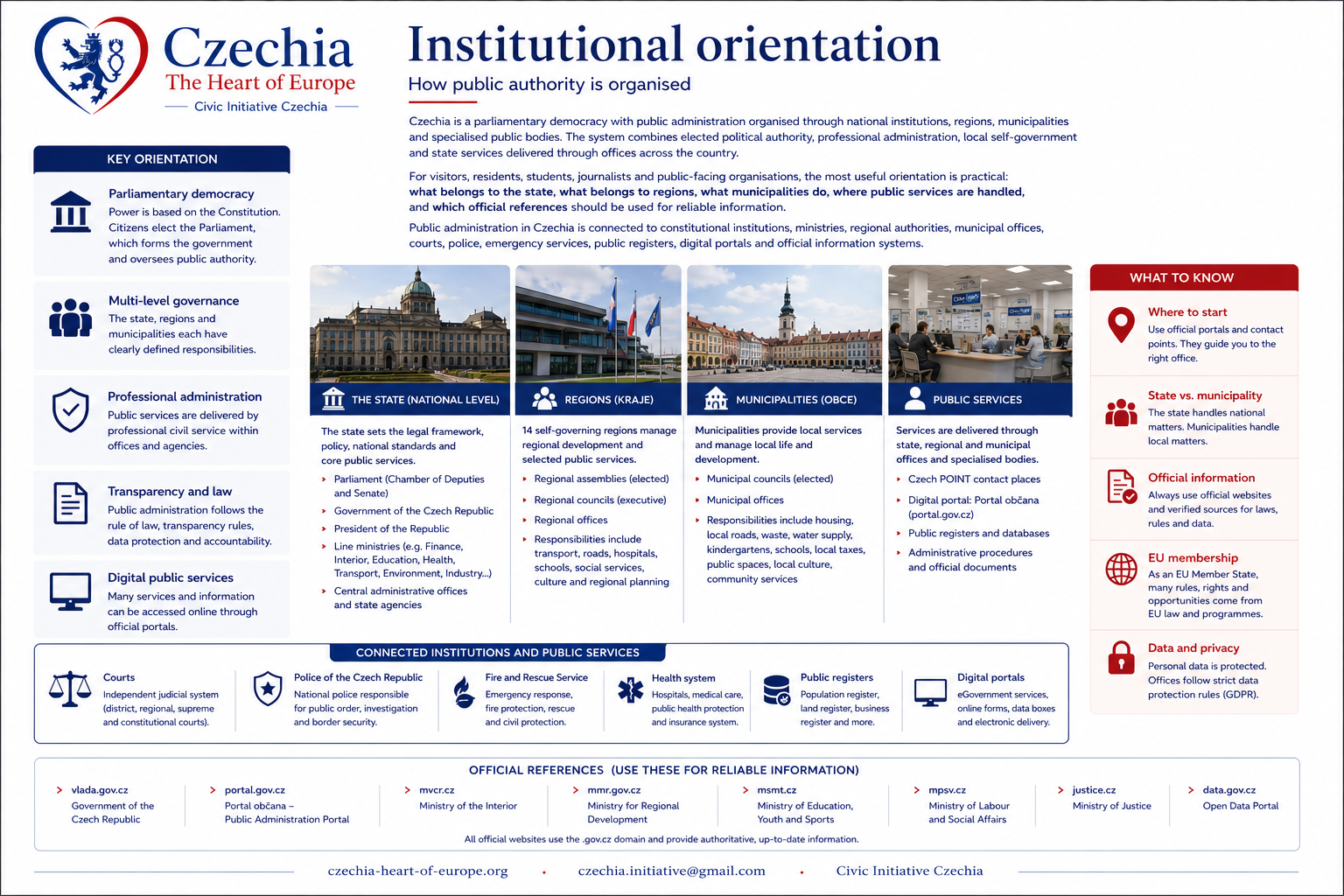
Czechia is a parliamentary democracy with public administration organised through national institutions, regions, municipalities and specialised public bodies. The system combines elected political authority, professional administration, local self-government and state services delivered through offices across the country.
For visitors, residents, students, journalists and public-facing organisations, the most useful orientation is practical: what belongs to the state, what belongs to regions, what municipalities do, where public services are handled, and which official references should be used for reliable information.
Public administration in Czechia is connected to constitutional institutions, ministries, regional authorities, municipal offices, courts, police, emergency services, public registers, digital portals and official information systems.
The Czech system is easiest to understand through three public levels: national institutions, regions and municipalities. National institutions set laws, state policy and central administration. Regions coordinate regional development, secondary education, transport and selected public services. Municipalities manage local public life, local planning, local services and direct contact with residents.
State levelParliament, government, ministries, courts, state offices, police and national public systems.
Regional levelFourteen regions including Prague, each with elected regional representation and regional authority.
Municipal levelMunicipalities, towns and cities manage the closest layer of public life and local services.
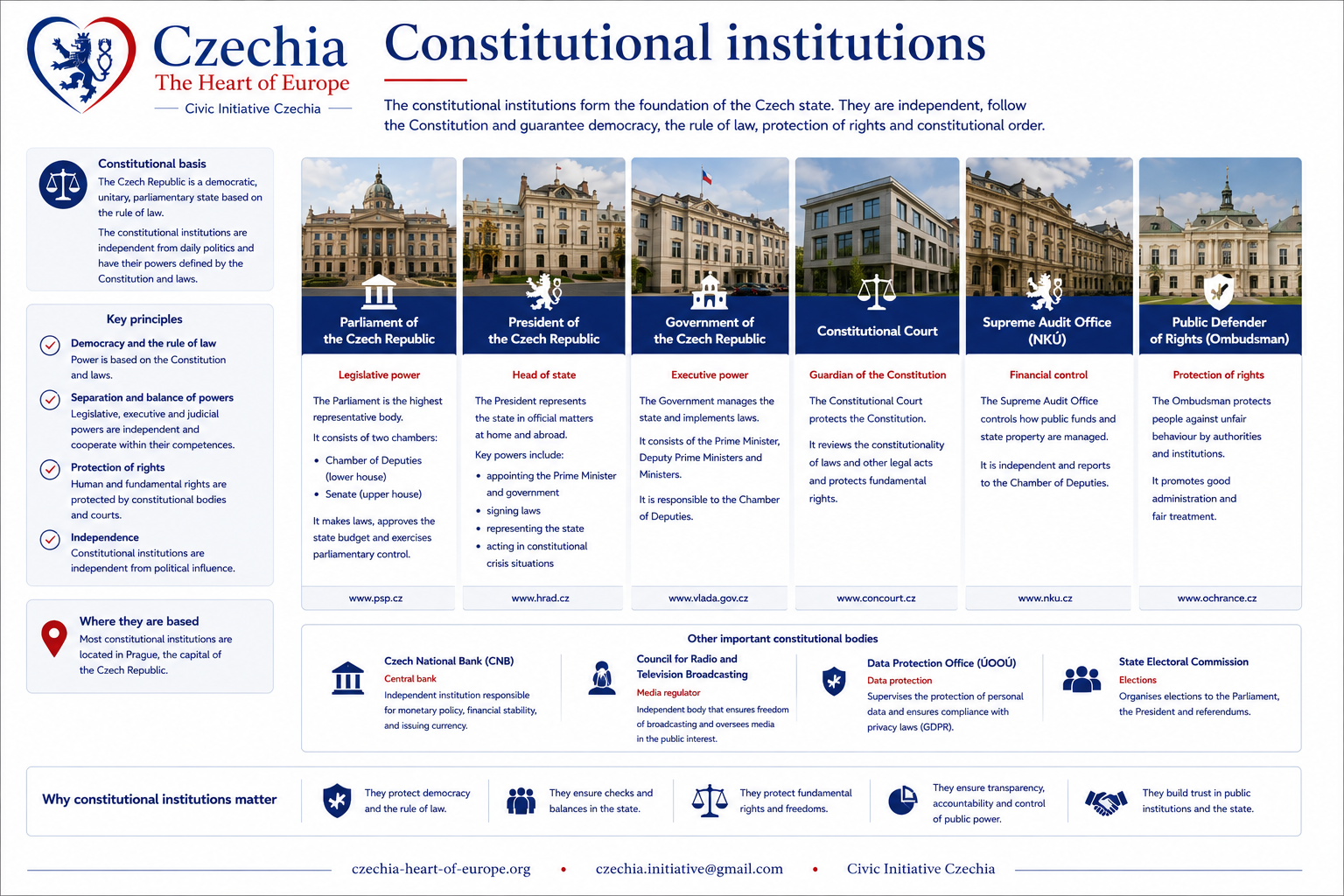
The constitutional structure of Czechia is based on parliamentary democracy. Legislative power belongs to the Parliament, composed of the Chamber of Deputies and the Senate. The government exercises executive power, led by the Prime Minister, while the President represents the state and performs constitutional duties defined by law.
The judiciary is separate from political government. Courts, including the Constitutional Court, protect legality, constitutional order and rights. Public administration therefore operates within a constitutional framework, not as a free-standing bureaucracy.
ParliamentThe Chamber of Deputies and Senate form the legislative authority of the state.
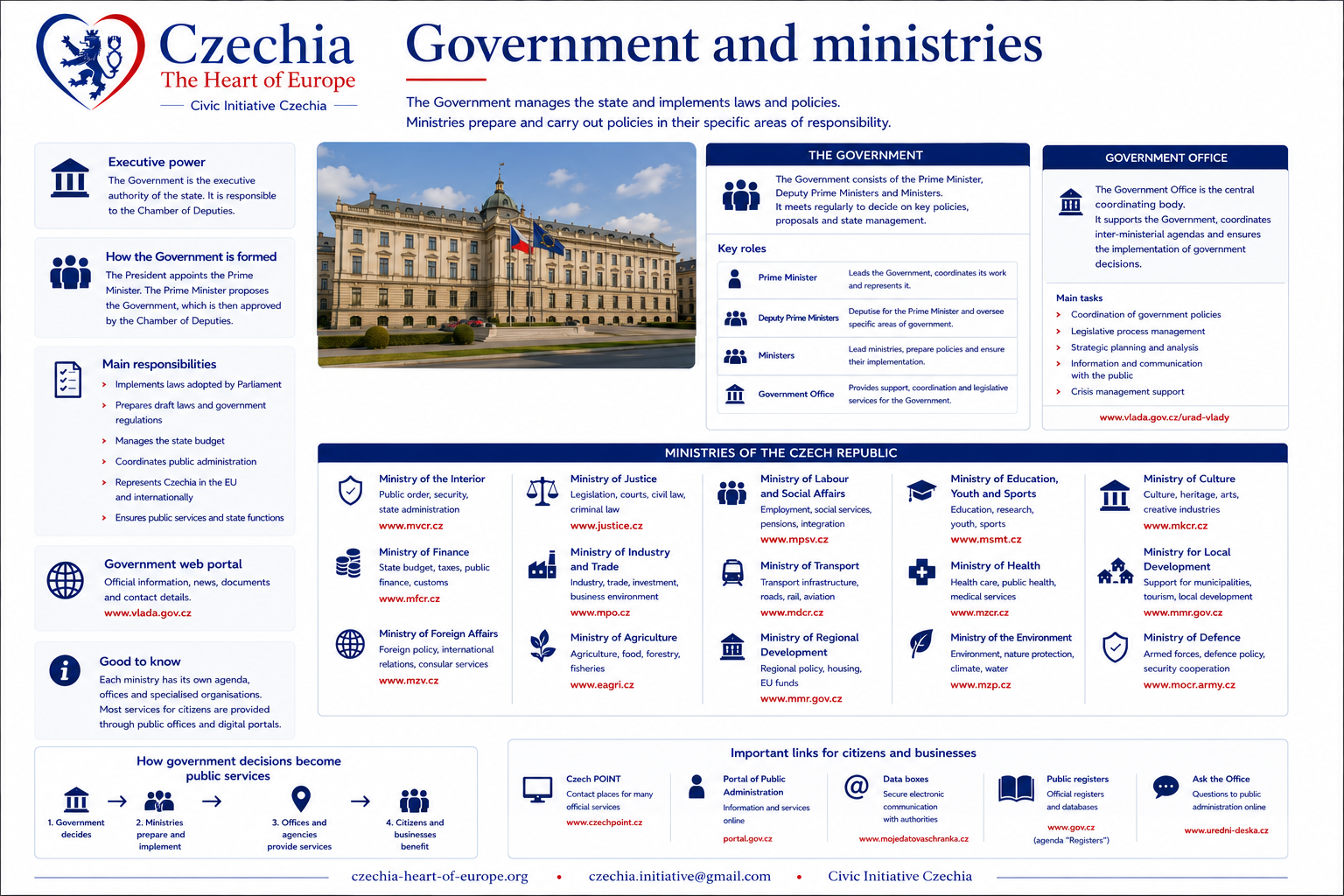
GovernmentThe government directs central executive policy through ministries and state administration.
PresidentThe President represents the state and carries out constitutional functions.
CourtsThe judiciary protects legality, rights and constitutional order.
Central state administration is carried out through ministries and other central authorities. Ministries prepare policy, administer public systems, issue official information, coordinate legislation, manage public programmes and represent Czechia in European and international contexts within their fields.
For public communication, ministries are key official references. They publish information on foreign affairs, interior administration, education, health, transport, culture, industry, regional development, finance, justice, agriculture, environment, labour and social affairs, defence and other public areas.
PolicyMinistries prepare national policy, legal changes, public programmes and official guidance.
ServicesMany public services are delivered through ministry-linked offices, agencies and portals.
EU workMinistries participate in European policy, funding, regulation and international cooperation.
Public informationOfficial ministry websites are primary sources for verified public information.
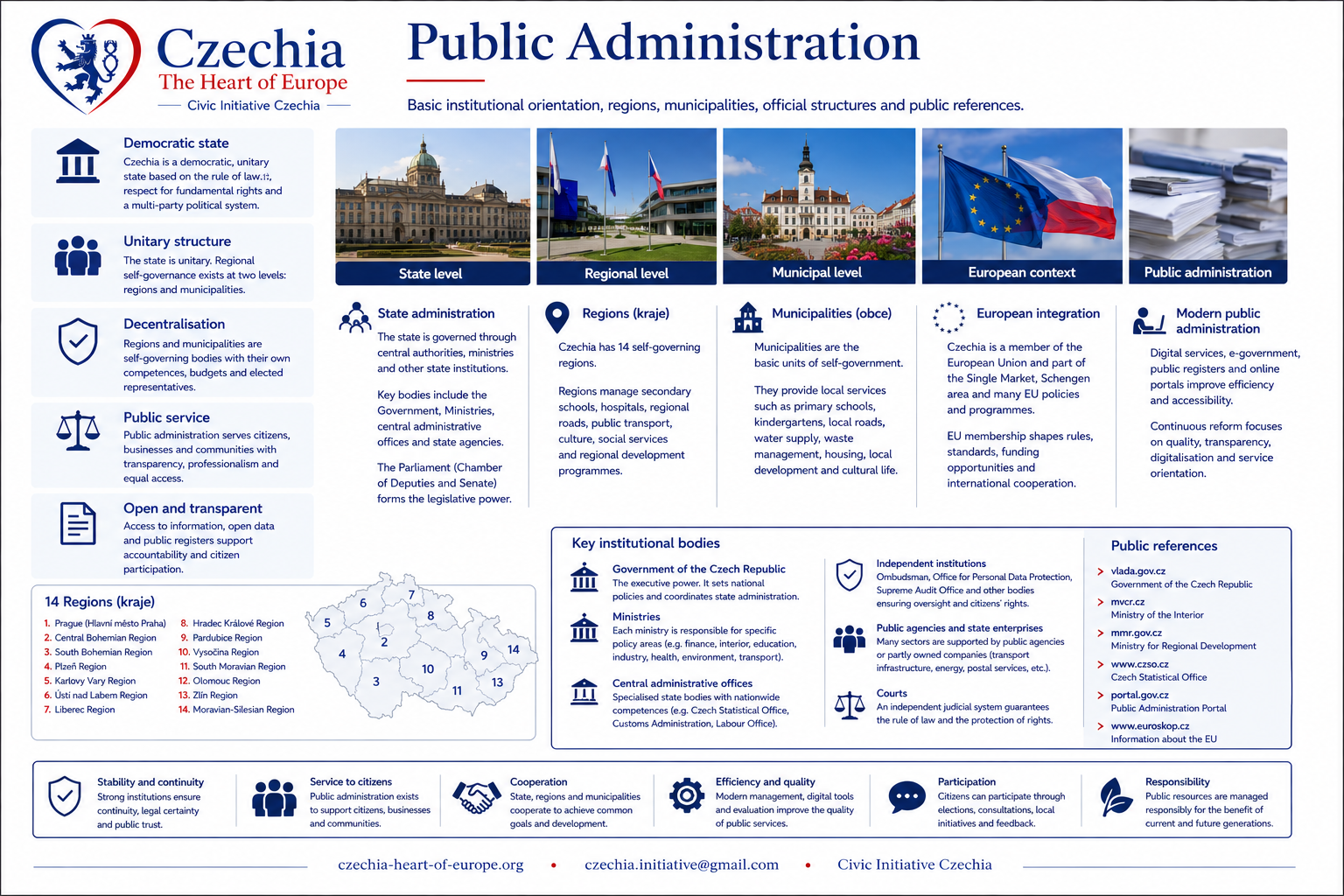
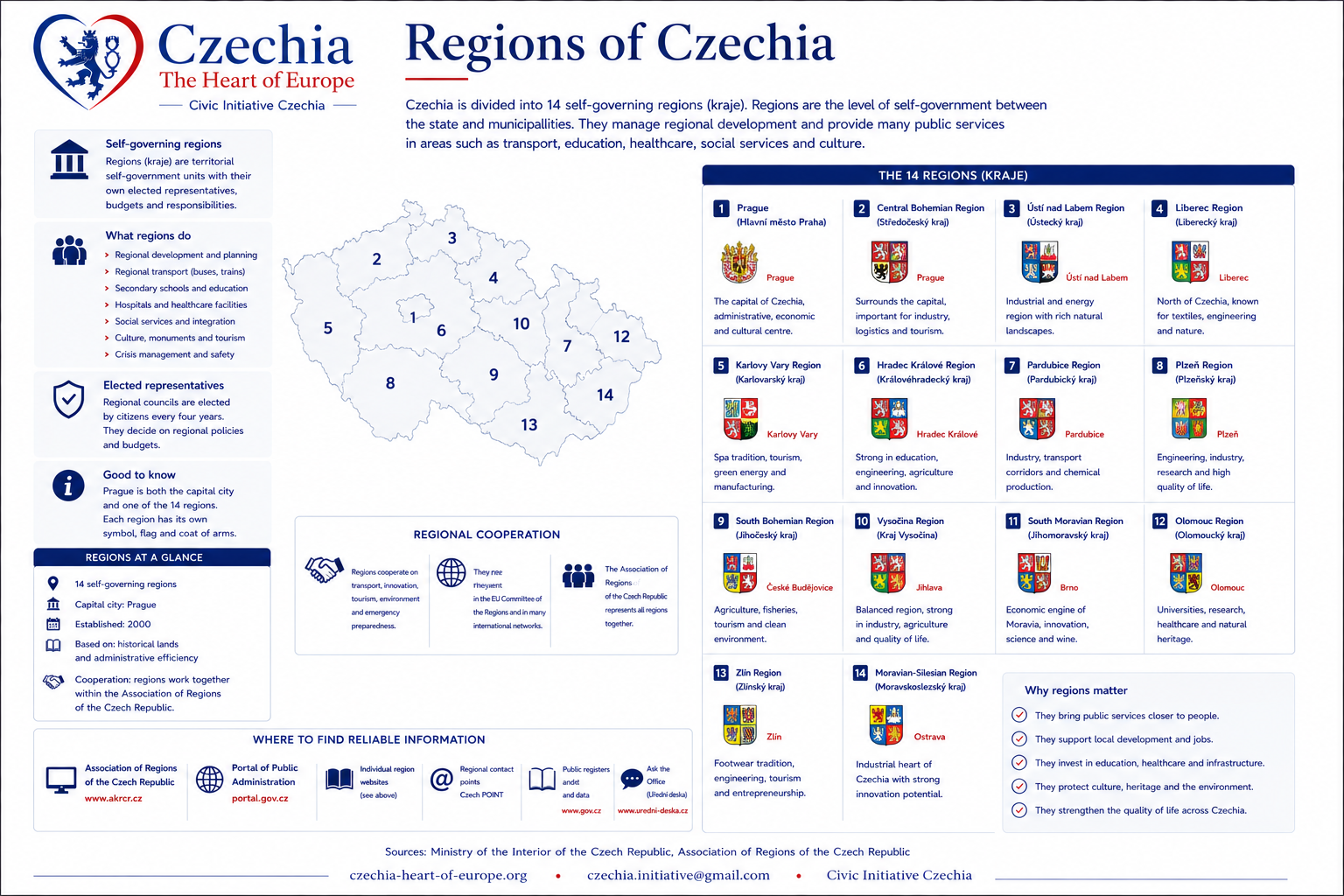
Czechia has fourteen regions, including the capital city of Prague. Regions are important for public administration, regional development, transport coordination, secondary education, healthcare organisation, social services, tourism, emergency planning and cultural institutions.
Regional authorities help connect national policy with local needs. They manage regional strategies, coordinate selected public services and work with municipalities, ministries, businesses, universities and civic organisations.
14 regionsThirteen regions plus the capital city of Prague form the regional administrative structure.
Regional councilsRegions have elected representation and regional executive structures.
Regional developmentTransport, education, healthcare, tourism and planning often require regional coordination.
Bridge functionRegions connect state policy with municipalities, citizens and local economic conditions.
Municipalities are the closest layer of public administration. They manage local matters such as municipal property, local planning, basic public services, local roads, public spaces, cultural life, local fees, community facilities and communication with residents.
Towns and cities may also perform state administration tasks through delegated authority. This means that some offices handle matters that belong to the state but are delivered locally, including selected identity, residence, building, transport, trade-licence or registry services depending on the type of municipal office.
Local self-governmentMunicipalities manage local public life and elected municipal representation.
Public contactResidents often meet public administration first through municipal offices.
Delegated authoritySome municipalities perform state-administration tasks on behalf of the state.
Community servicesPublic spaces, local culture, local transport, schools and community facilities depend on municipal work.
Prague as capital city
Prague is both the capital city of Czechia and one of the country’s regions. It concentrates major constitutional institutions, ministries, embassies, universities, cultural institutions, courts, transport hubs, media organisations and international offices.
At the same time, Prague is a municipality with local responsibilities: city districts, transport, planning, public spaces, housing questions, cultural services, tourism management and everyday urban administration. Its role is therefore national, regional and local at once.
Capital functionSeat of central institutions, diplomatic missions and major national public bodies.
Regional statusPrague is also one of Czechia’s fourteen regions.
Municipal roleThe city manages local urban administration and public services through city structures and districts.
Public visibilityNational politics, tourism, culture, universities and international communication often pass through Prague.
Public services and official contact points
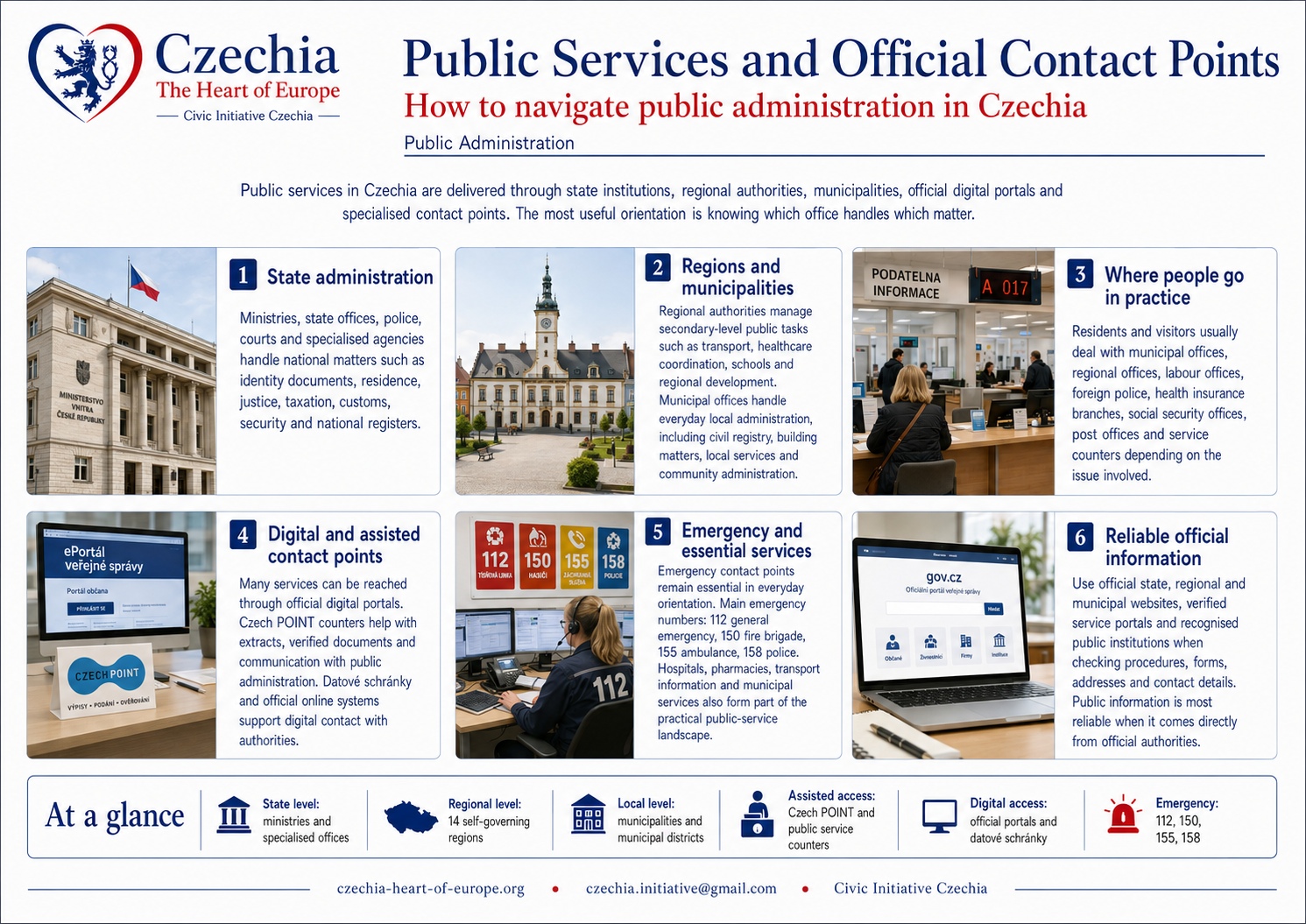
Public administration appears most clearly through services: identity documents, residence matters, business registration, building permits, taxes, healthcare insurance, social support, education, transport administration, vehicle registration, civil registry records and public information.
Many services are now supported by digital systems and official portals, while others require contact with municipal offices, regional offices, ministries or specialised authorities. For public-facing guidance, the safest rule is to direct users to the relevant official office or portal rather than informal advice.
Identity and residenceDocuments, residence permissions and population records belong to specialised official procedures.
Business and workTrade licences, tax registration, labour rules and social insurance involve several public systems.
Education and healthSchools, universities, health insurance, hospitals and public health institutions form major service fields.
Public registersCompany, land, trade, court and administrative registers support legal and public transparency.
Czechia’s public administration increasingly uses digital services, electronic identity, data boxes, public registers, online forms, official portals and digital communication between citizens, businesses and institutions. Digitalisation is intended to reduce repeated paperwork and make public contact more efficient.
Digital systems are especially important for businesses, public authorities, legal communication, tax matters, registers and official notifications. Some digital tools are optional for individuals but compulsory or highly important for companies and institutions.
Official portalsPublic information and services are increasingly accessed through central and specialised digital portals.
Electronic identityDigital identity tools support secure access to selected public services.
Data boxesDatové schránky are used for official electronic communication with public authorities.
RegistersDigital registers support companies, land records, legal transparency and administrative procedures.
Public administration for foreigners and visitors
Foreigners and visitors usually encounter public administration through visas, residence, employment permissions, health insurance, tax questions, driving, study, recognition of documents, business registration, municipal contact, emergency services and consular matters.
Rules differ according to citizenship, length of stay, purpose of stay and legal status. EU citizens, non-EU citizens, students, workers, family members, tourists, business visitors and long-term residents may need different procedures. Public-facing pages should therefore avoid one-size-fits-all instructions and direct users to official sources.
For immigration, residence, tax, employment, health insurance and legal procedures, official portals and competent authorities should always be treated as the primary reference.
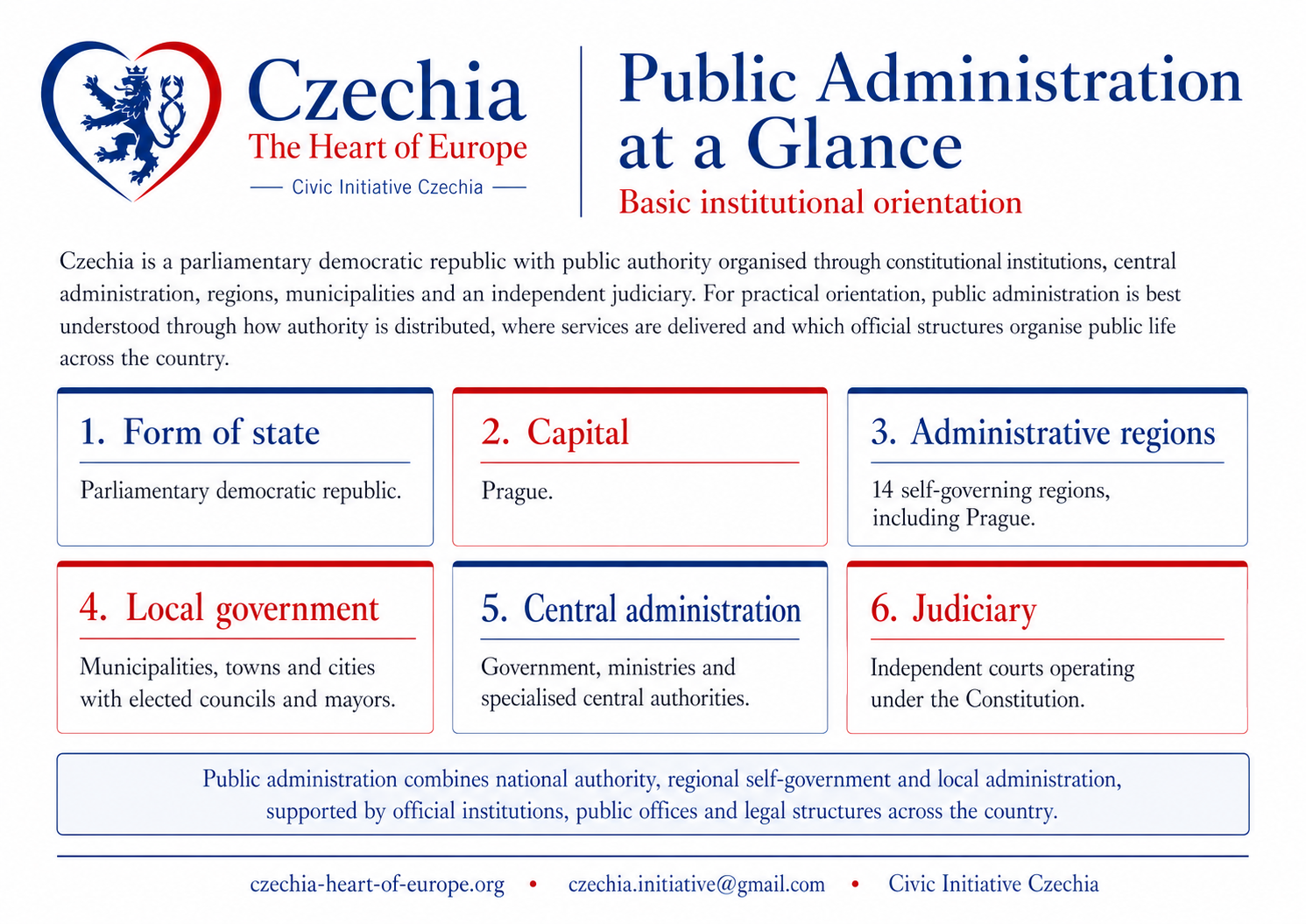
Public administration at a glance
Form of stateParliamentary democratic republic.
CapitalPrague.
Administrative regions14 self-governing regions, including Prague.
Local governmentMunicipalities, towns and cities with elected councils and mayors.
Central administrationGovernment, ministries and specialised central authorities.
JudiciaryIndependent courts operating under the Constitution.
1918Czechoslovakia establishes modern democratic public administration.
1948–1989Public administration operates within the communist state system.
1989Democratic institutions and local self-government begin to be restored.
1993The Czech Republic establishes its own constitutional and administrative framework.
2000Creation of the current system of fourteen self-governing regions.
TodayDigital public administration, regional self-government and European cooperation continue to modernise public services.
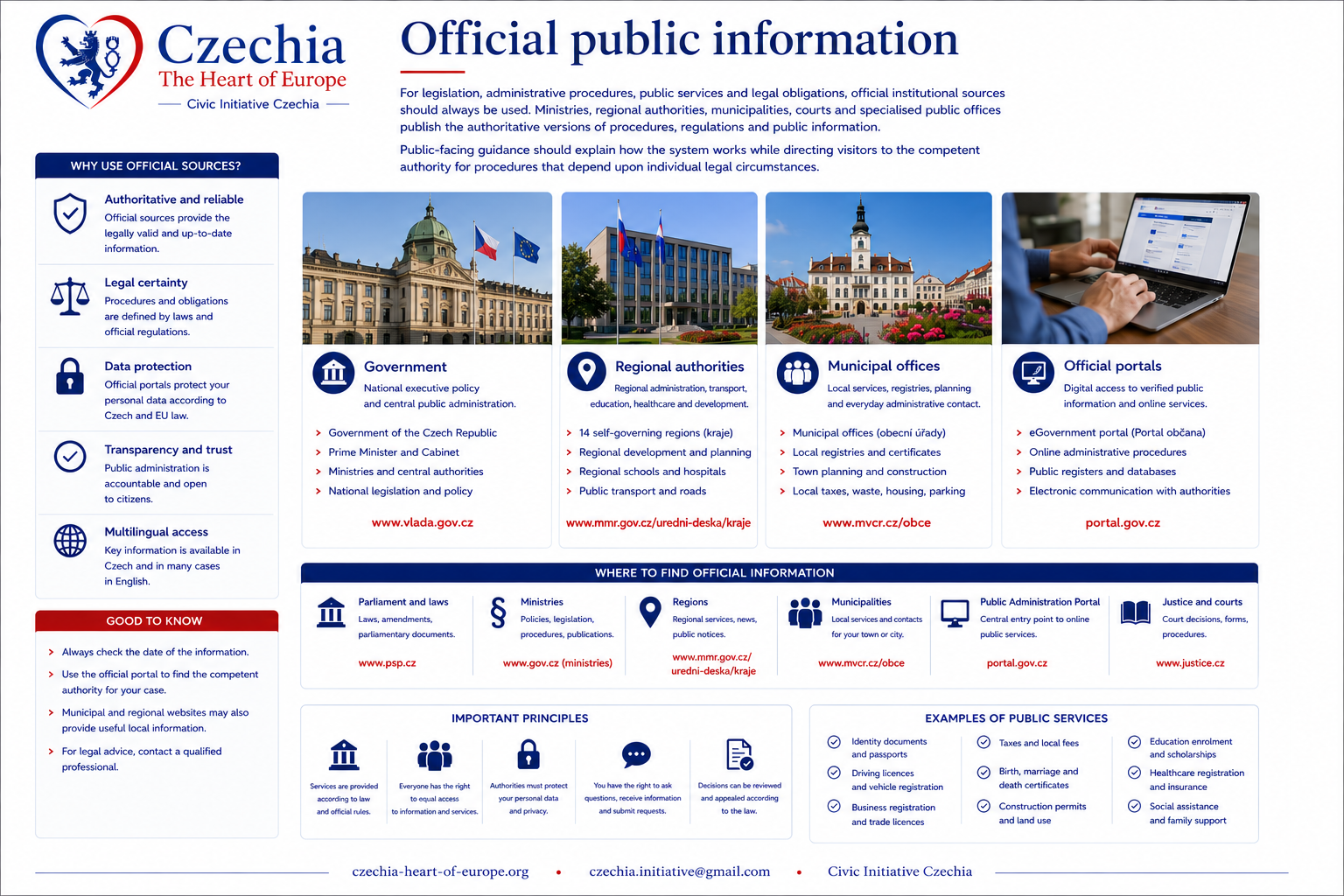
Official public information
For legislation, administrative procedures, public services and legal obligations, official institutional sources should always be used. Ministries, regional authorities, municipalities, courts and specialised public offices publish the authoritative versions of procedures, regulations and public information.
Public-facing guidance should explain how the system works while directing visitors to the competent authority for procedures that depend upon individual legal circumstances.
GovernmentNational executive policy and central public administration.
Regional authoritiesRegional administration, transport, education, healthcare and development.
Municipal officesLocal services, registries, planning and everyday administrative contact.
Official portalsDigital access to verified public information and online services.