The Luxembourg and Hussite periods place Prague at the centre of European politics, learning, sacred architecture, religious reform and armed conflict in the Bohemian Crown lands.
The Luxembourg period transformed the Bohemian kingdom into a major Central European power. Under Charles IV, Prague became an imperial residence, a university city, a sacred capital and a built statement of political ambition. The Bohemian Crown lands gained a wider constitutional and symbolic frame that connected Bohemia, Moravia, Silesia and Lusatia.
The Hussite period grew from religious criticism, university debate, social tension and the execution of Jan Hus in 1415. It changed the Czech lands through reform, war, diplomacy, liturgy, political mobilisation and a lasting memory of conscience against authority.
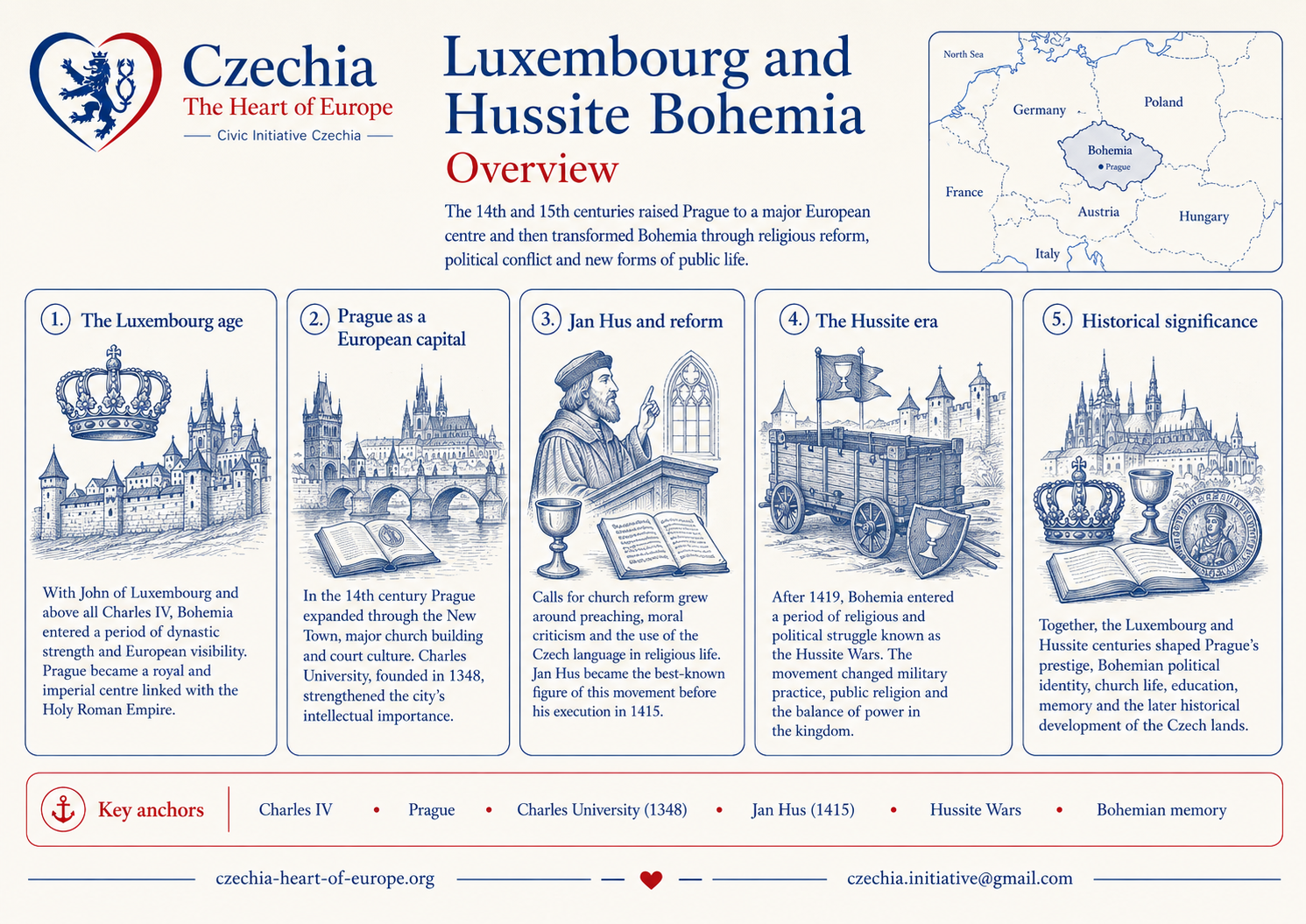
This period joins two powerful movements. The first is the Luxembourg elevation of Bohemia through royal and imperial politics, Prague’s urban expansion, Charles University and the architecture of Charles IV. The second is the Hussite transformation of public life through Jan Hus, religious reform, military innovation and a new political language of community and conscience.
Charles IVKing of Bohemia and Holy Roman Emperor, he made Prague a political, sacred and intellectual centre.
Bohemian CrownThe crown lands gave the kingdom a wider territorial and constitutional identity beyond Prague alone.
Jan HusHis execution made reform a central force in Czech memory, faith, conflict and public conscience.
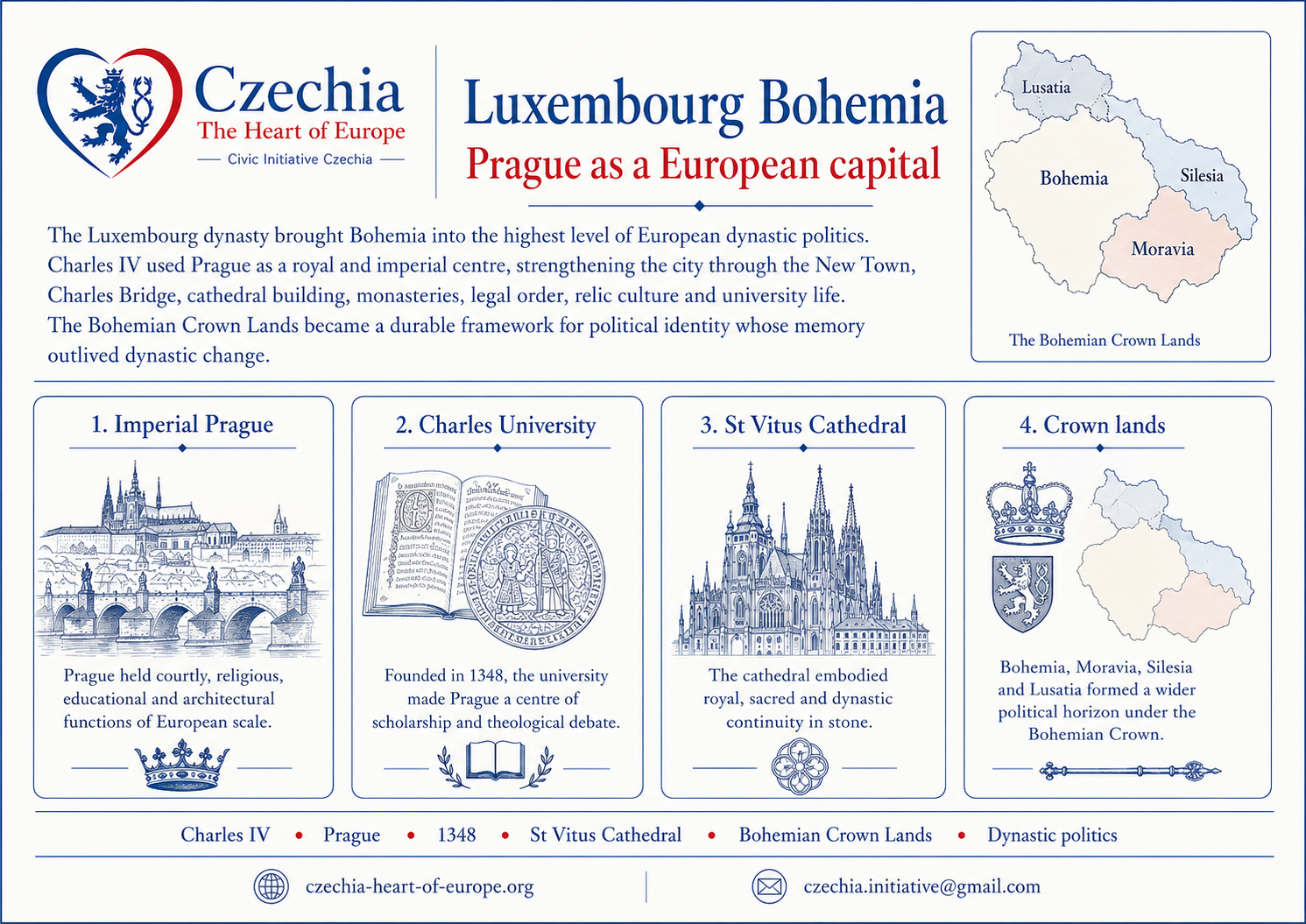
The Luxembourg dynasty brought Bohemia into the highest level of European dynastic politics. Charles IV used Prague as a royal and imperial centre, strengthening the city through the New Town, Charles Bridge, cathedral building, monasteries, legal order, relic culture and university life.
The Bohemian Crown lands became a durable framework for political identity. The crown did not mean only one ruler or one city; it expressed a layered territorial body whose memory continued after dynasties changed.
Imperial PraguePrague held courtly, religious, educational and architectural functions of European scale.
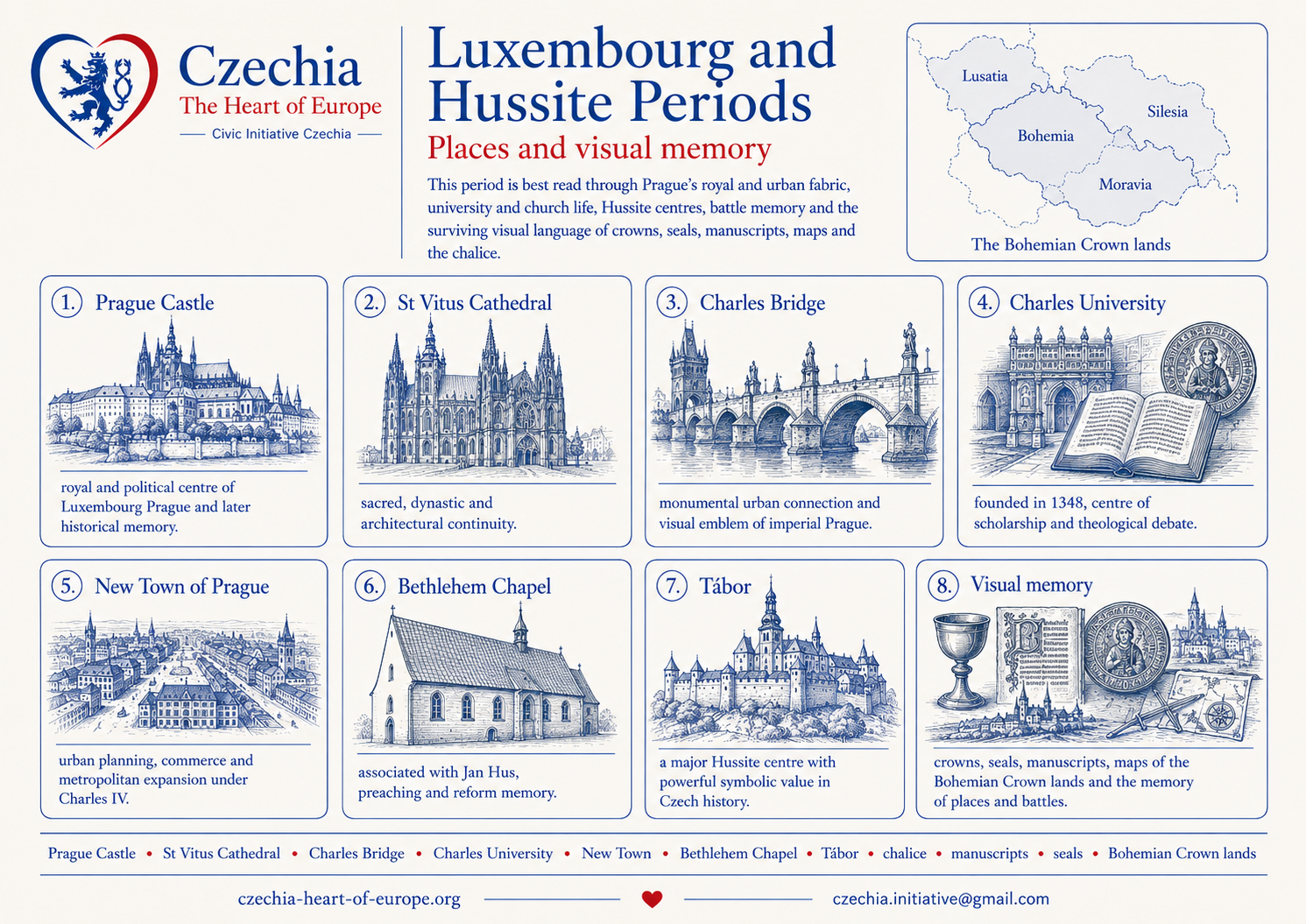
Charles UniversityFounded in 1348, the university made Prague a centre of scholarship and theological debate.
St Vitus CathedralThe cathedral embodied royal, sacred and dynastic continuity in stone.
Crown landsBohemia, Moravia, Silesia and Lusatia formed a wider political horizon under the Bohemian Crown.
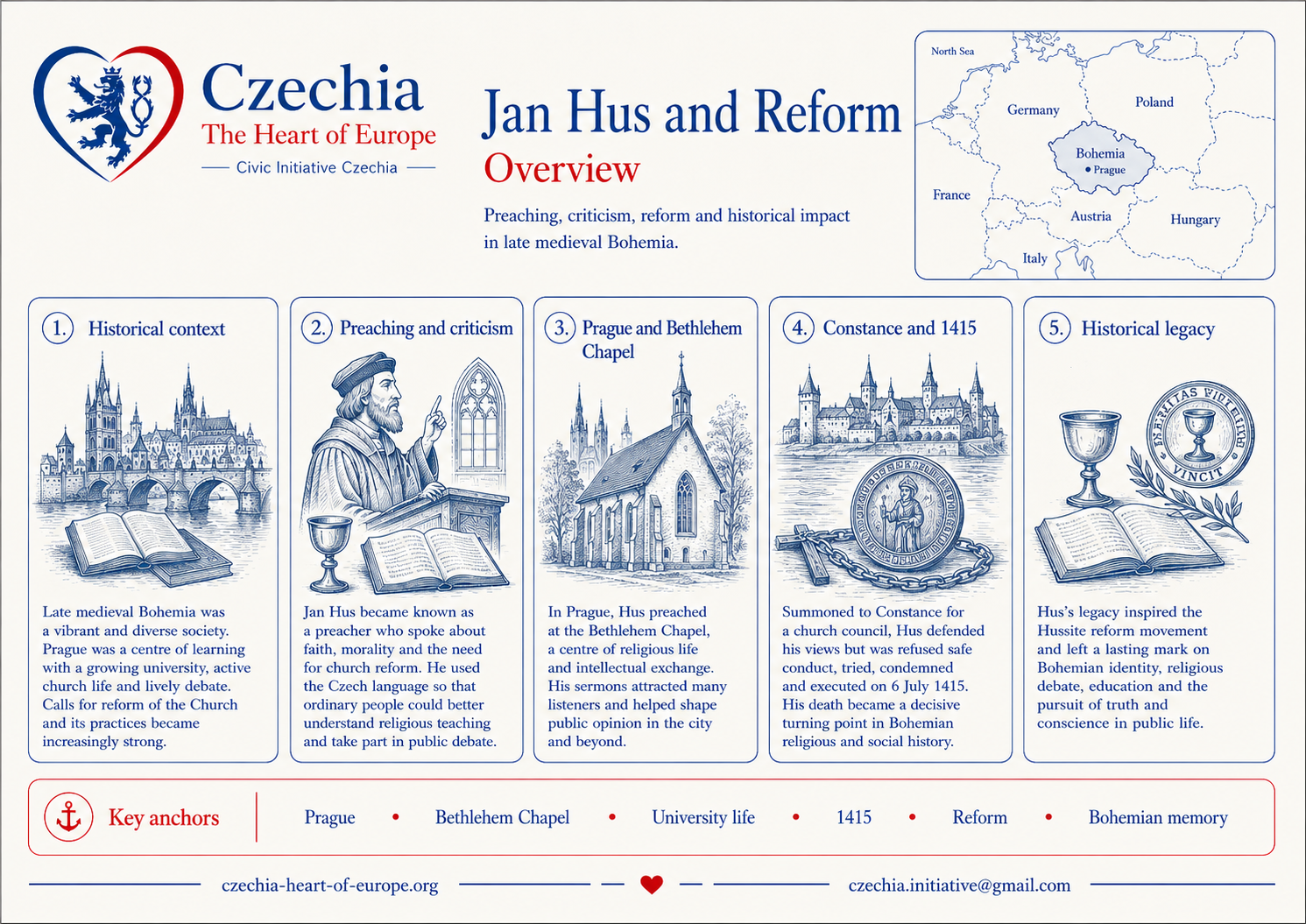
Jan Hus emerged from the religious and intellectual world of Prague. His preaching, criticism of church abuses and connection to reform currents turned theological debate into a broader public question about truth, authority and moral responsibility.
His execution at the Council of Constance in 1415 gave the reform movement a martyr and a political charge. The chalice became a central symbol of the Hussite movement and expressed a religious demand that also carried social and civic force.
Bethlehem ChapelPreaching in Czech made reform accessible to a wider urban public.
ConstanceThe death of Jan Hus turned criticism into a lasting movement of memory and resistance.
ChaliceCommunion under both kinds became the strongest visual sign of Hussite identity.
Public conscienceHus became a figure through whom faith, truth, language and civic courage were remembered together.
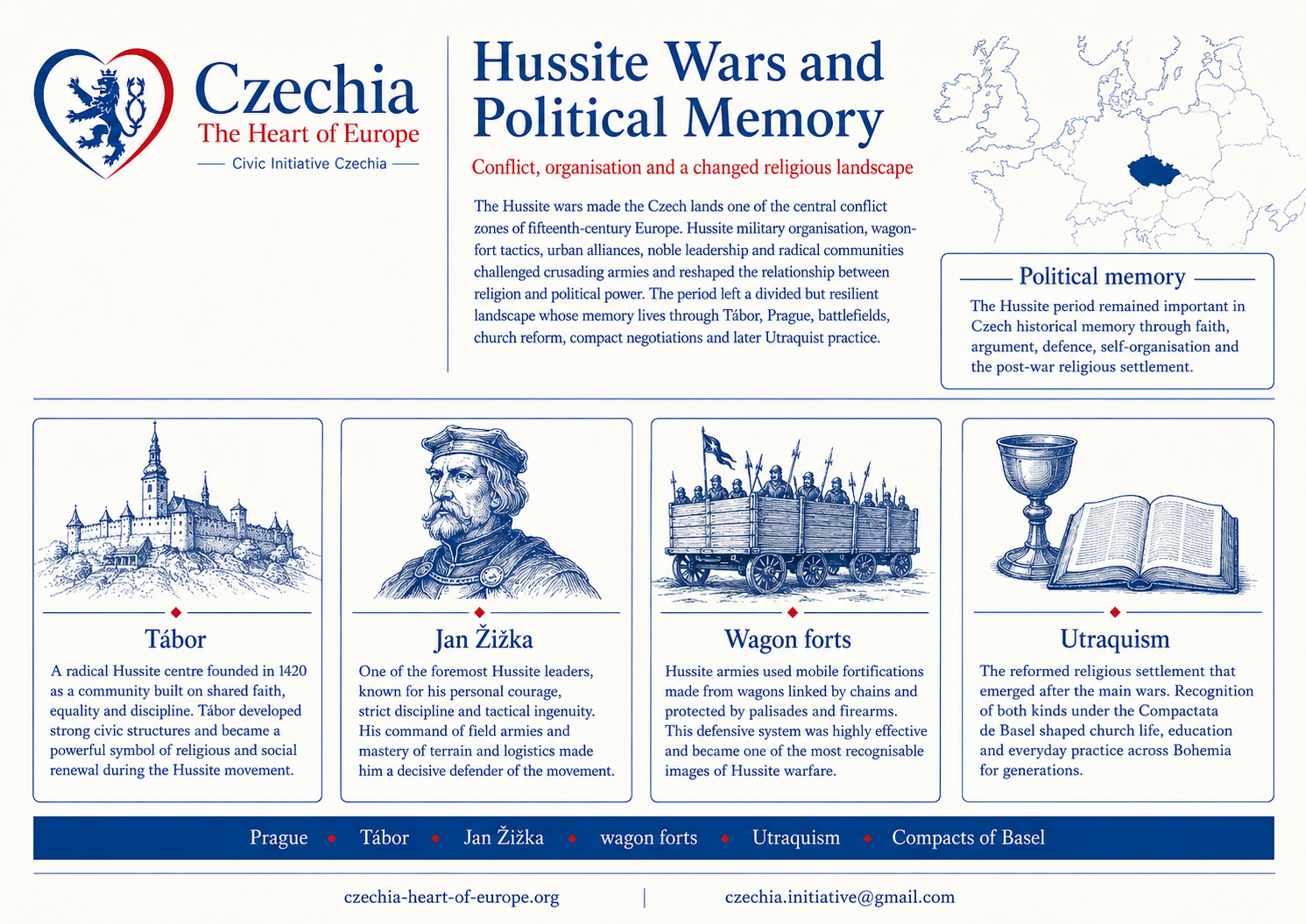
Conflict, organisation and a changed religious landscape
The Hussite wars made the Czech lands one of the central conflict zones of fifteenth-century Europe. Hussite military organisation, wagon fort tactics, urban alliances, noble leadership and radical communities challenged crusading armies and reshaped the relationship between religion and political power.
The period left a divided but resilient landscape. Tábor, Prague, battlefields, church reform, compact negotiations and later Utraquist practice became part of a memory in which Czech history speaks through faith, argument, defence and political self-organisation.
TáborA radical Hussite centre with strong symbolic value in religious and social history.
Jan ŽižkaA military leader associated with defence, discipline and tactical innovation.
Wagon fortsMobile fortified tactics became one of the most recognisable images of Hussite warfare.
UtraquismThe reformed religious settlement shaped Bohemian life after the main wars ended.
The Luxembourg age gives Czech history a European capital, a university, a monumental Prague and a crown-land imagination. The Hussite age gives Czech history a language of reform, conscience, conflict, armed community and religious difference.
Together, the two periods explain why medieval Czech history cannot be reduced to castles and kings. It includes scholarship, urban life, sacred architecture, criticism, war, negotiation and a public memory in which Prague, Jan Hus, Charles IV and the Bohemian Crown remain central.
European scaleBohemia acted as a major political and cultural centre in medieval Europe.
Knowledge cultureUniversity debate and scholarship became part of Czech public history.
Reform memoryJan Hus and Hussitism gave moral and religious conflict long civic significance.
Visible heritagePrague, churches, bridges, manuscripts, seals and battle sites keep the period readable today.
Timeline in one view
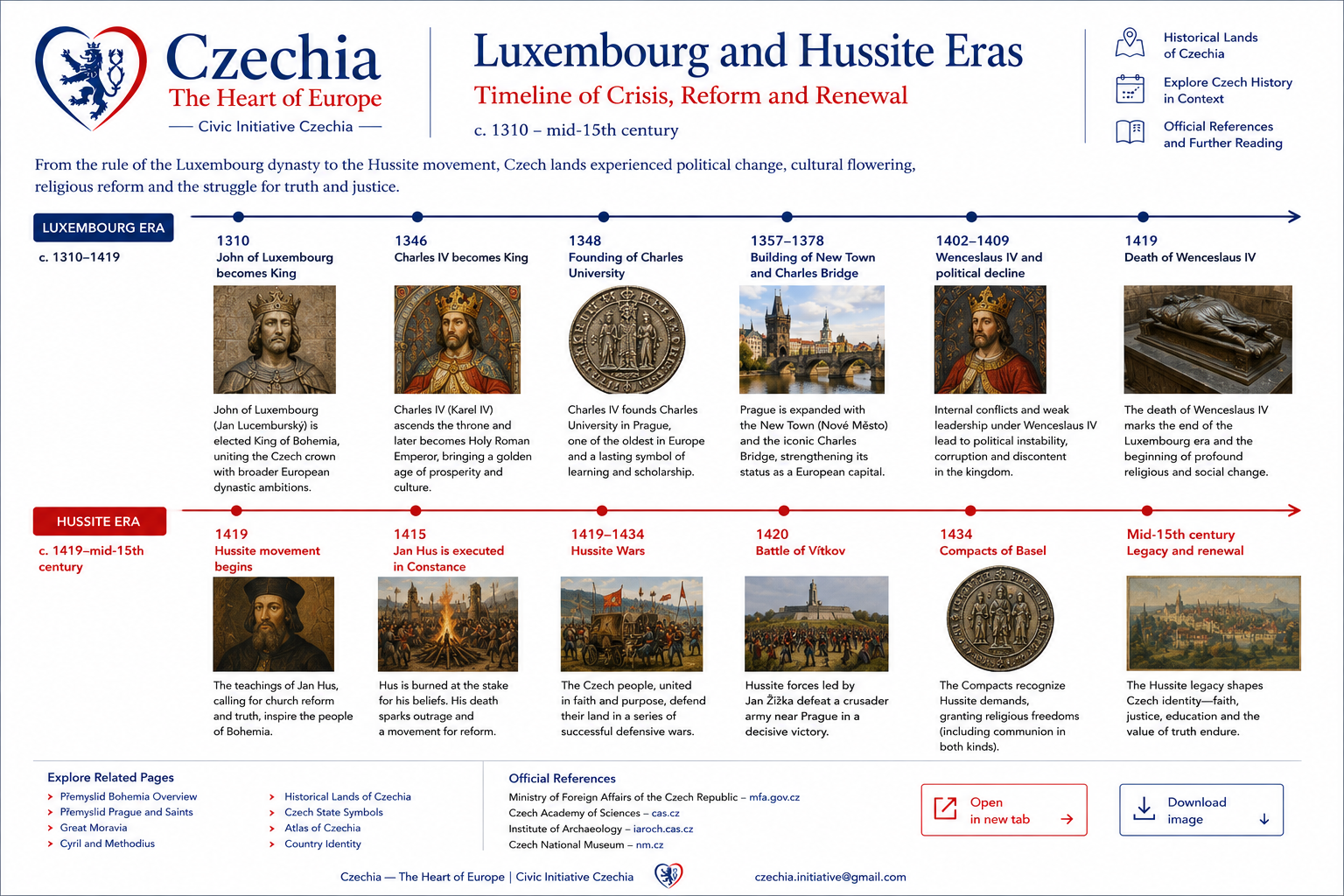
1310John of Luxembourg becomes king of Bohemia, opening the Luxembourg dynastic period.
1346Charles IV becomes king of Bohemia and later Holy Roman Emperor, raising Prague’s European role.
1348Charles University is founded in Prague; the New Town of Prague and crown-land structures gain lasting importance.
1378Charles IV dies; his reign remains one of the strongest reference points of Czech medieval history.
1415Jan Hus is executed at Constance, intensifying reform and resistance in the Czech lands.
1419The first Prague defenestration marks the beginning of the Hussite revolutionary period.
1420sHussite armies defend the reform movement against crusades and develop distinctive military organisation.
1434The Battle of Lipany ends the strongest phase of radical Hussite military power.
1436The Compactata settlement recognises a negotiated religious arrangement for the Bohemian lands.
Places and visual memory
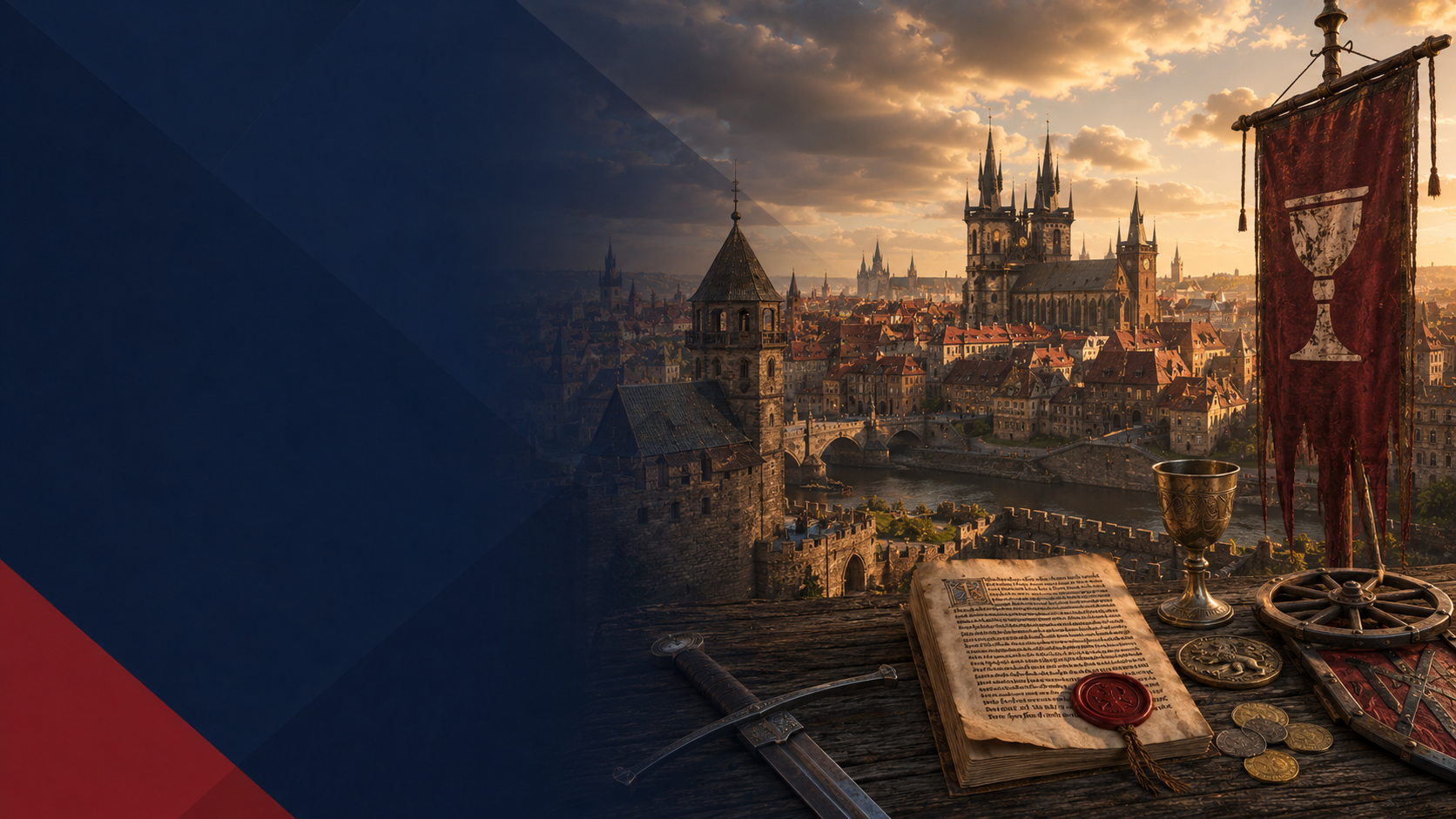
This period is best shown through Prague Castle, St Vitus Cathedral, Charles Bridge, Charles University, the New Town of Prague, Bethlehem Chapel, Tábor, Hussite battlefields, the chalice, manuscript illumination, royal seals, town views and maps of the Bohemian Crown lands.