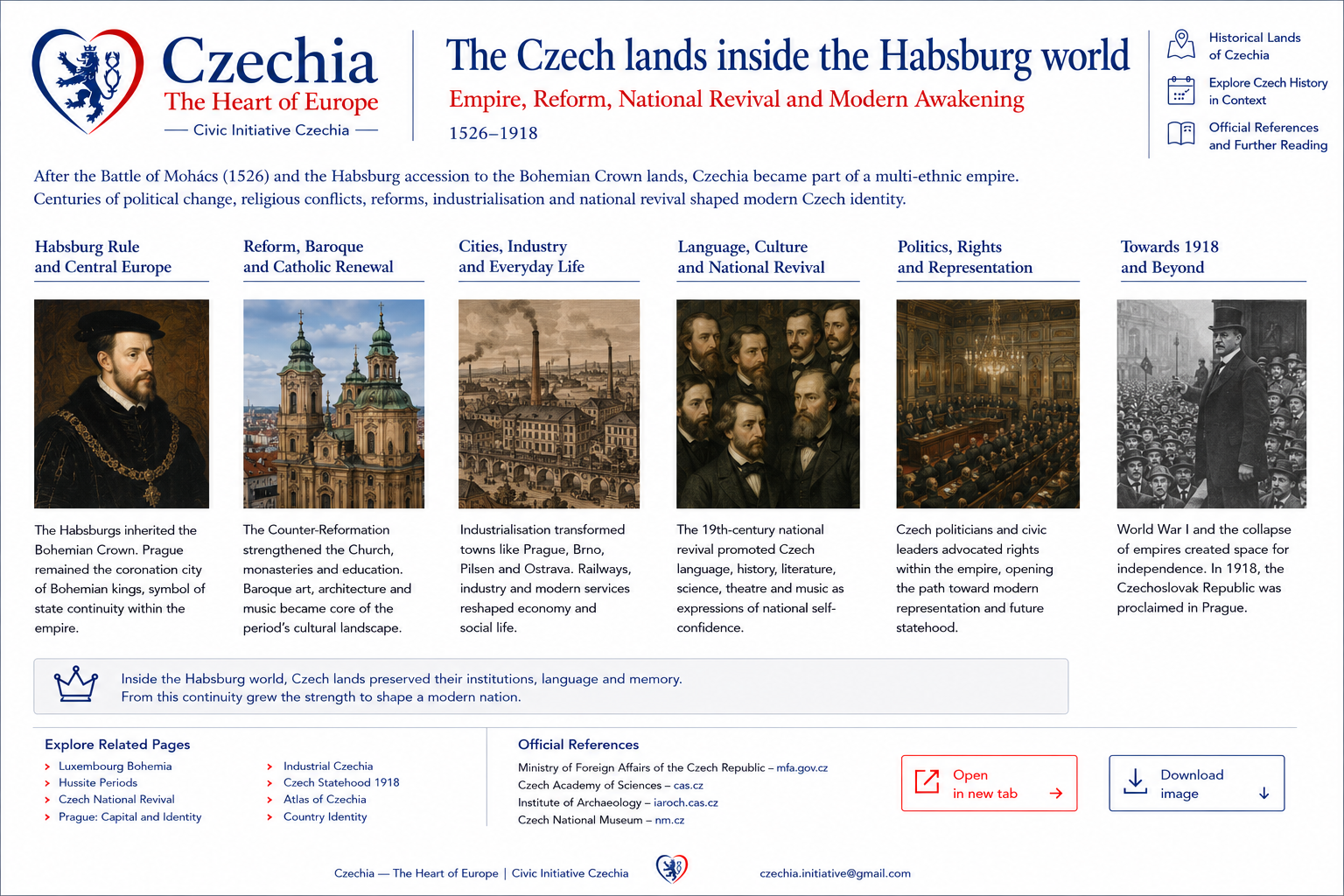
The Czech lands entered the Habsburg monarchy in 1526 and became a major Central European space of estates, faith, dynastic power, Baroque culture, reform and modern administration.
After 1526, Bohemia, Moravia and the remaining crown lands moved into a dynastic monarchy that connected the Czech lands with Austria, Hungary and wider European politics. The Bohemian Crown continued to matter as a historical and legal frame, while real power increasingly moved through Habsburg dynastic authority, court administration, military pressure and confessional policy.
The early modern period reshaped Czech public life through noble estates, religious conflict, the Bohemian Revolt, the Battle of White Mountain, re-Catholicisation, Baroque culture, Enlightenment reform and the growth of central administration. It prepared many of the tensions that later became central to the nineteenth-century national revival.
This period is best read through three linked processes: the survival of the Czech lands as historical territories, the strengthening of Habsburg dynastic rule, and the transformation of religious and cultural life after the defeat of the Bohemian Revolt. The landscape of towns, castles, churches, monasteries, pilgrimage sites, estates, mines and early factories keeps this period visible across Czechia.
1526The Habsburgs became rulers of Bohemia after the death of Louis II at Mohács.
1620White Mountain marked a decisive defeat for the Bohemian Revolt and changed political and religious life.
18th centuryAdministrative, educational and economic reforms prepared the modern state framework.
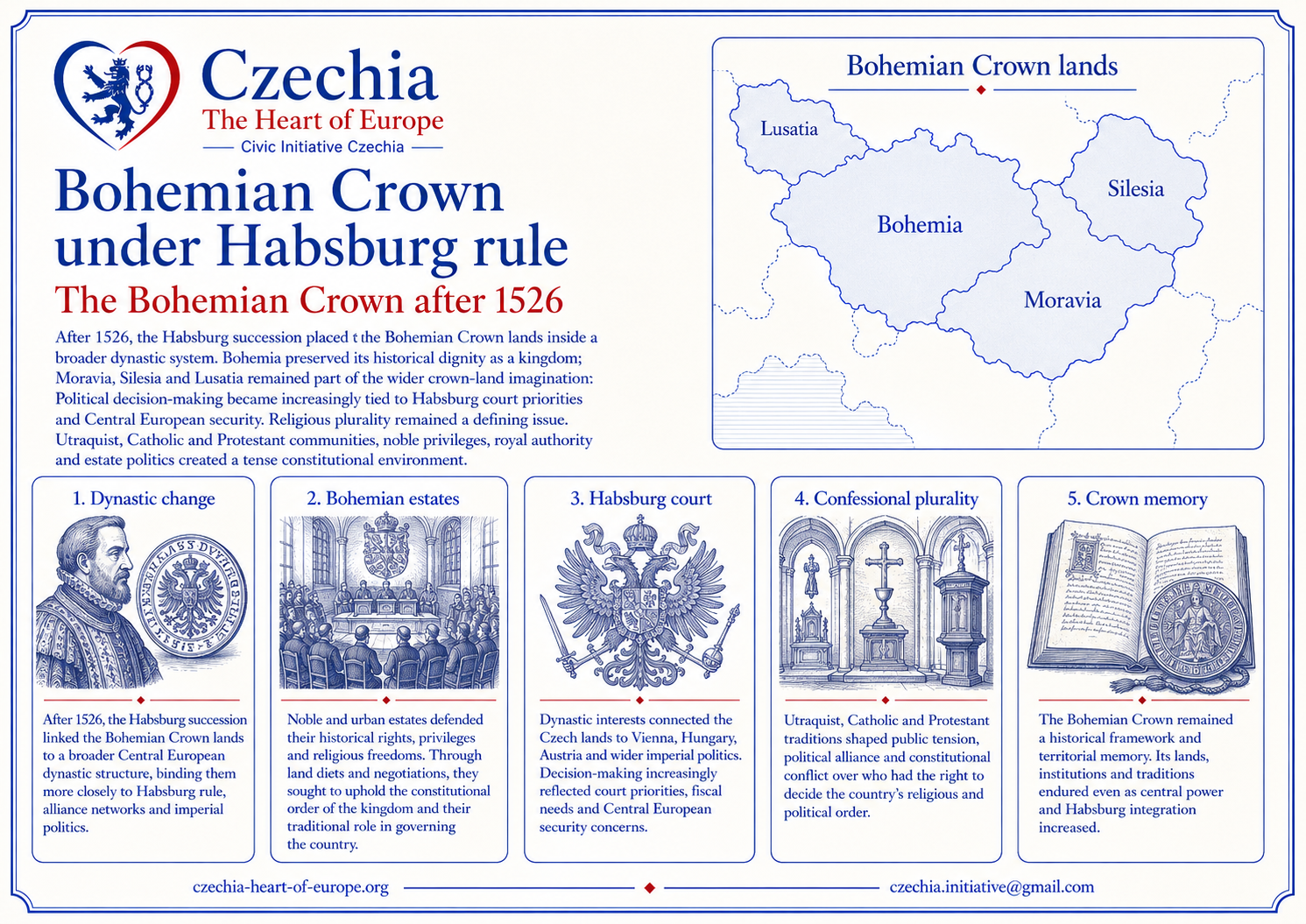
The Habsburg succession placed the Bohemian Crown lands inside a broader dynastic system. Bohemia kept its historical dignity as a kingdom, and Moravia, Silesia and Lusatia remained part of the wider crown-land imagination, but political decision-making became increasingly tied to Habsburg court priorities and Central European security.
Religious plurality remained a defining issue. Utraquist, Catholic and Protestant communities, noble privileges, royal authority and estate politics created a tense constitutional environment. The question of who had the right to decide the country’s religious and political order became one of the central conflicts of the age.
Bohemian estatesNoble and urban estates defended historical rights, privileges and religious freedoms.
Habsburg courtDynastic interests connected the Czech lands to Vienna, Hungary, Austria and imperial politics.
Confessional pluralityUtraquist, Catholic and Protestant traditions shaped public tension and political alliance.
Crown memoryThe Bohemian Crown remained a historical framework even as central power increased.
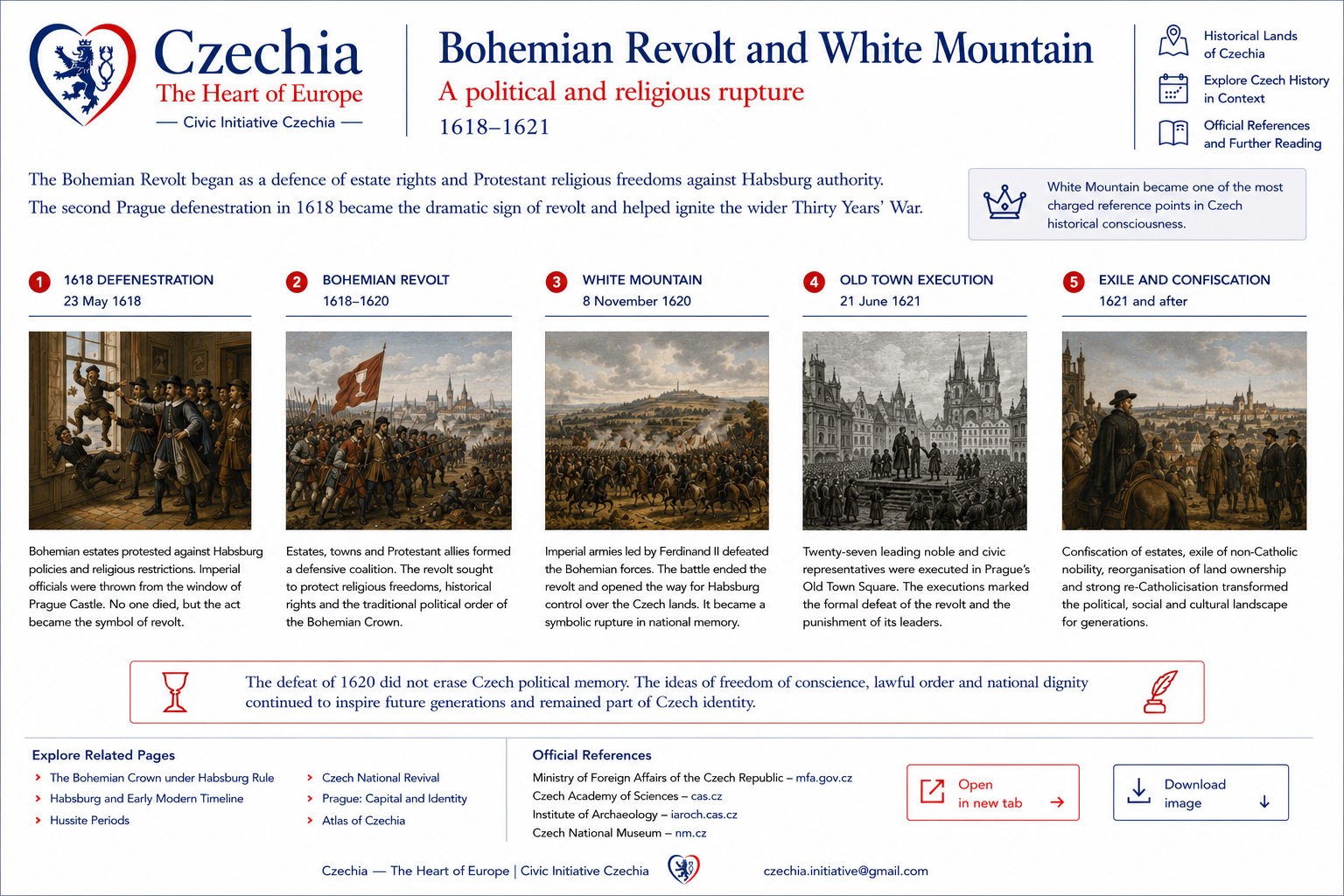
The Bohemian Revolt began as a defence of estate rights and Protestant religious freedoms against Habsburg authority. The second Prague defenestration in 1618 became the dramatic sign of revolt and helped ignite the wider Thirty Years’ War.
The defeat of the Bohemian estates at White Mountain in 1620 transformed the Czech lands. Confiscations, exile, executions, re-Catholicisation and a stronger royal administration changed elite society, religious life and political memory. White Mountain became one of the most charged reference points in Czech historical consciousness.
1618 defenestrationThe Prague event turned estate conflict into open revolt and European war.
White MountainThe 1620 battle became a symbolic turning point in Czech political memory.
Old Town executionThe 1621 executions marked the defeat of the revolt and the punishment of its leaders.
Exile and confiscationProperty, status, religion and language culture were transformed by post-revolt measures.
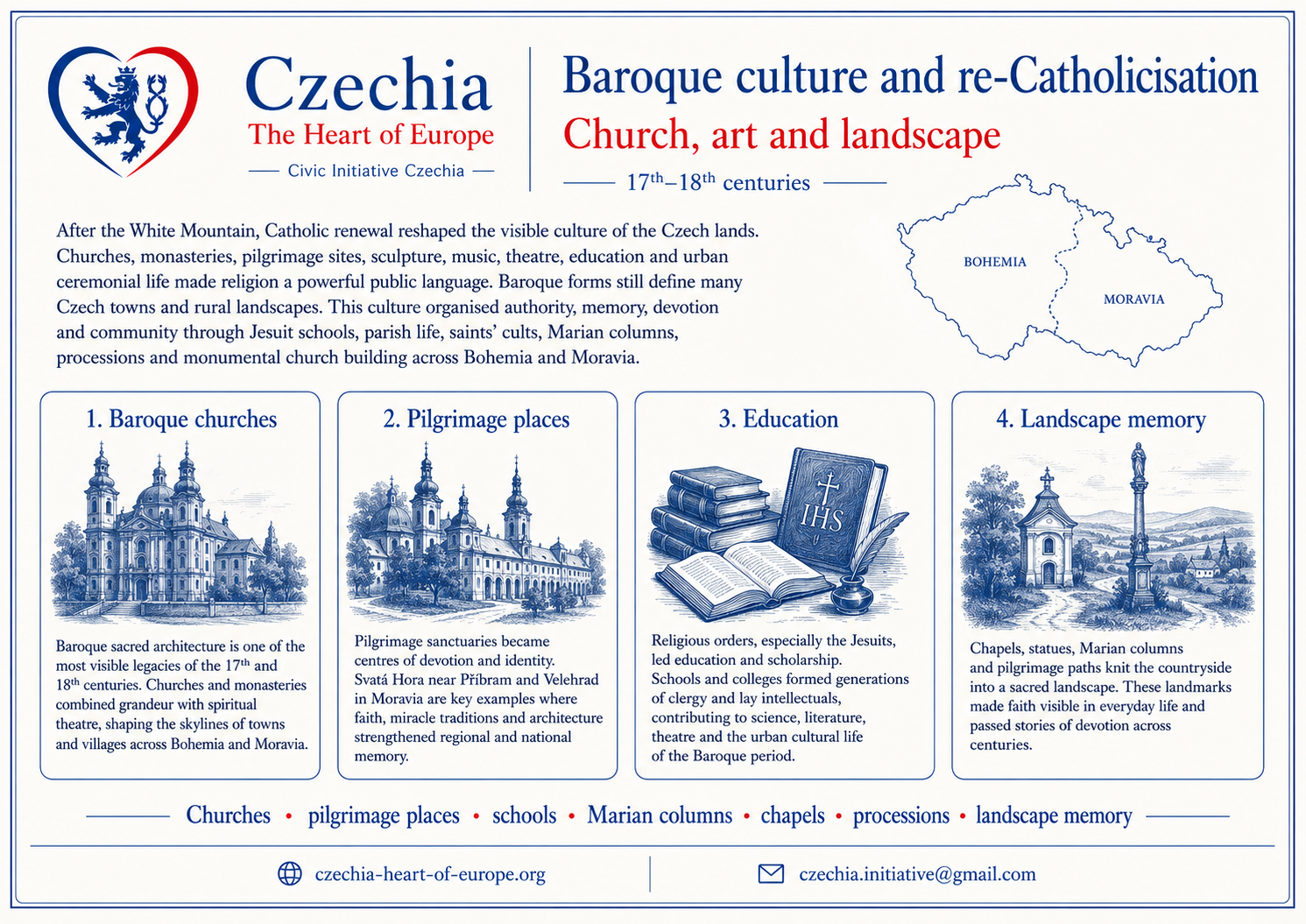
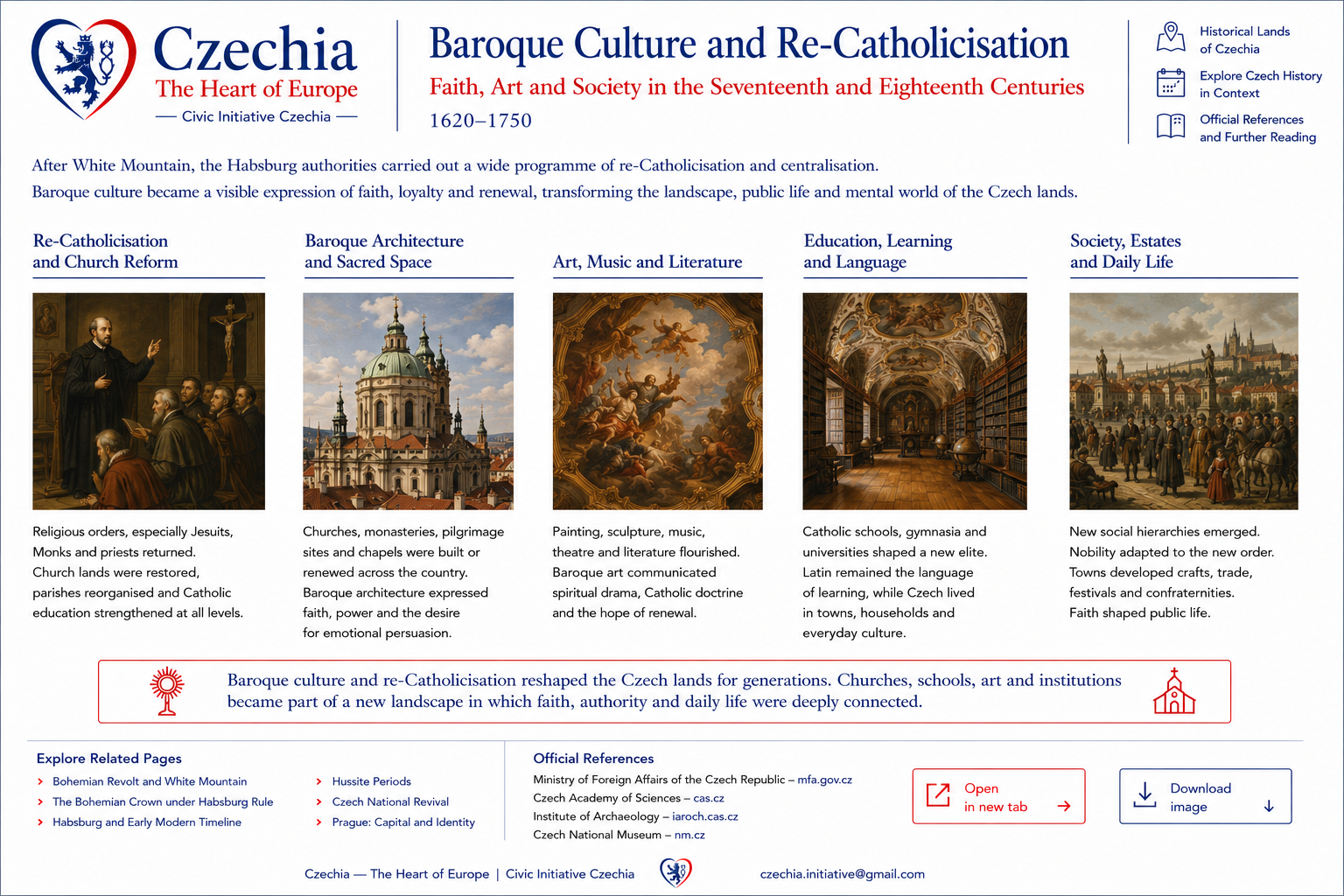
After White Mountain, Catholic renewal reshaped the visible culture of the Czech lands. Churches, monasteries, pilgrimage sites, sculpture, music, theatre, education and urban ceremonial life turned religion into a powerful public language. Baroque forms still define many Czech towns and rural landscapes today.
This culture was not only decorative. It organised authority, memory, devotion and community. Jesuit schools, parish life, saints’ cults, Marian columns, processions and monumental church building made faith visible in streets, squares and hills across Bohemia and Moravia.
Baroque churchesSacred architecture became one of the most visible legacies of the period.
Pilgrimage placesSites such as Svatá Hora and Velehrad tied faith to regional and national memory.
EducationReligious orders influenced schooling, scholarship and urban intellectual life.
Landscape memoryChapels, statues and pilgrimage paths made the countryside historically readable.
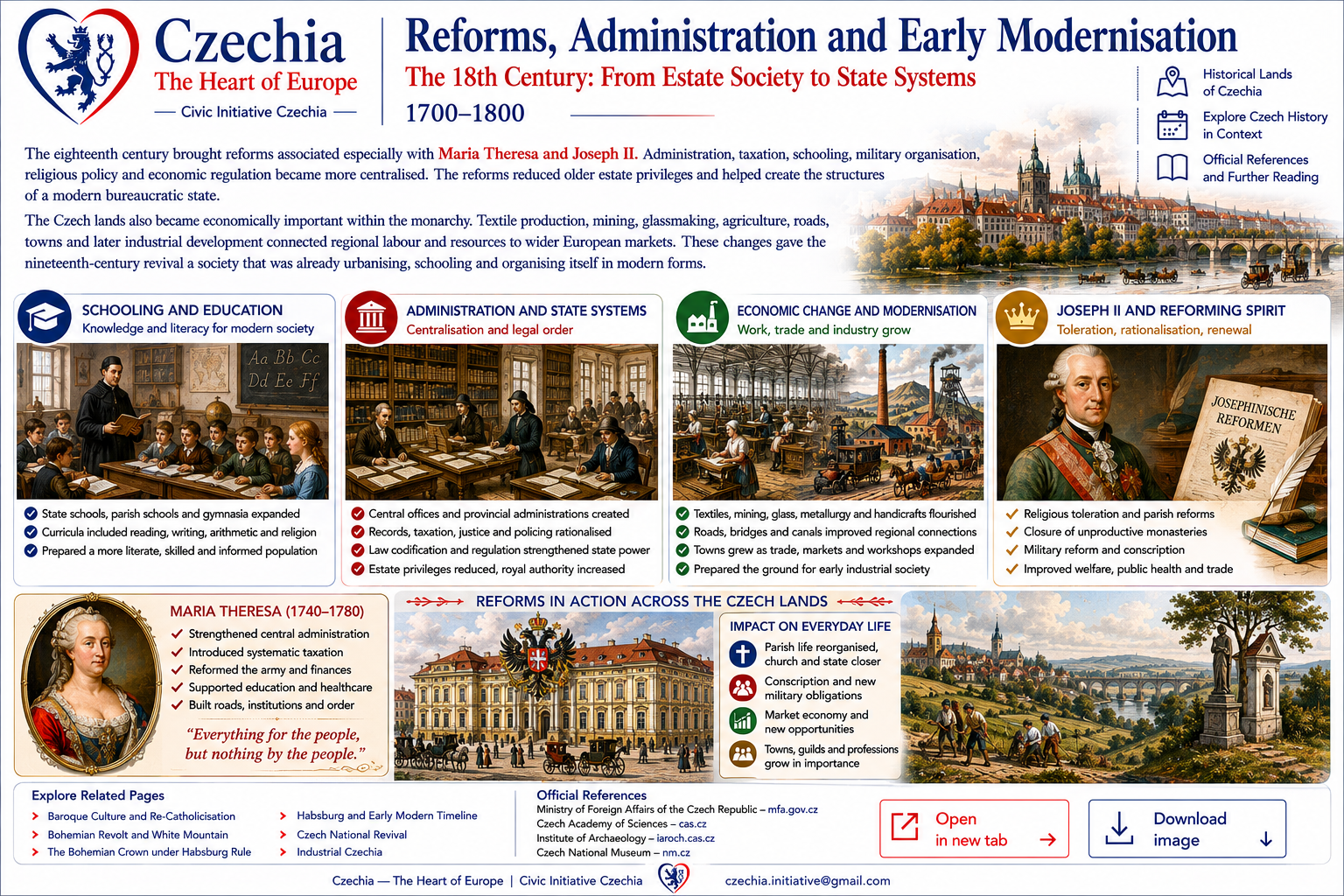
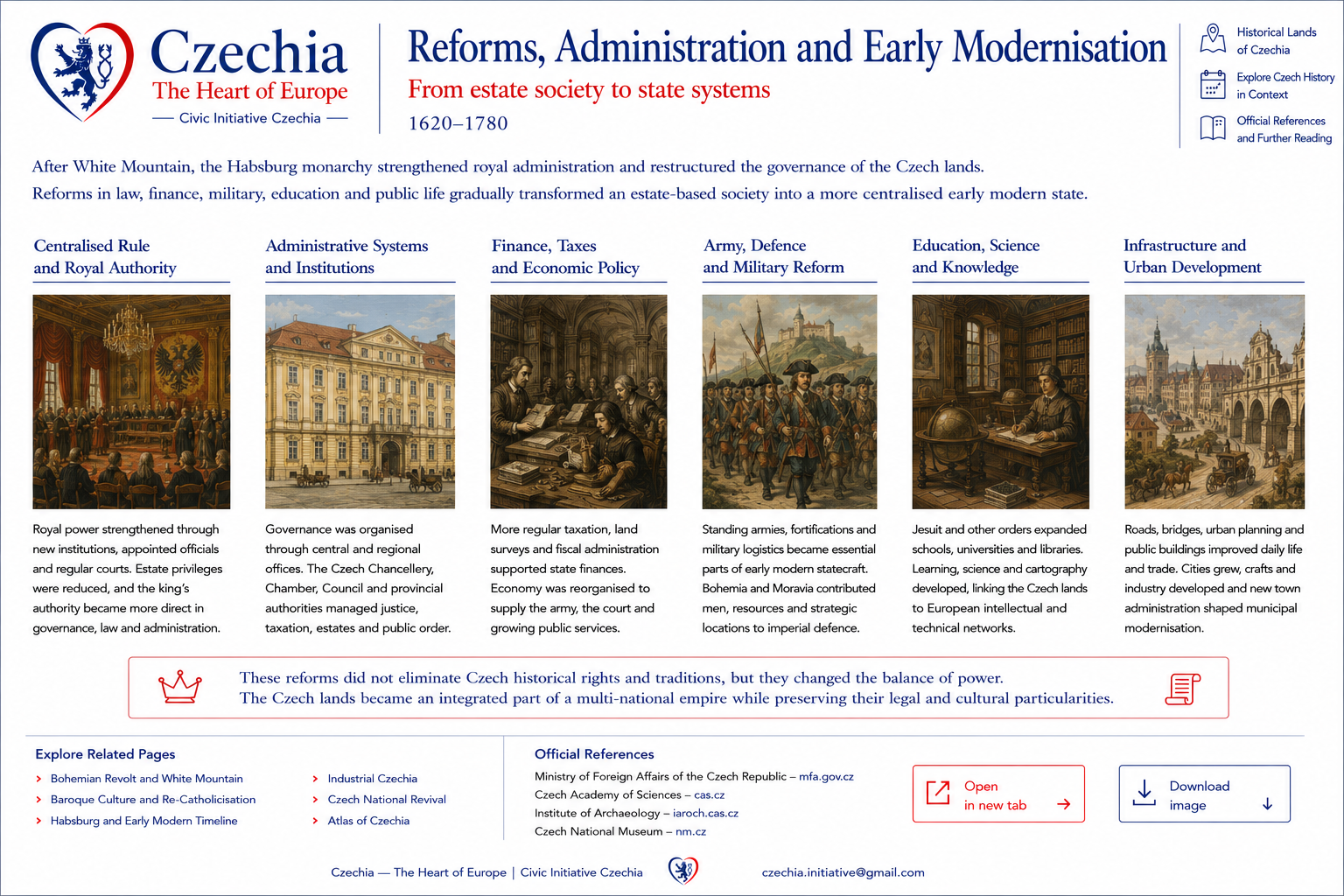
The eighteenth century brought reforms associated especially with Maria Theresa and Joseph II. Administration, taxation, schooling, military organisation, religious policy and economic regulation became more centralised. The reforms reduced older estate privileges and helped create the structures of a modern bureaucratic state.
The Czech lands also became economically important within the monarchy. Textile production, mining, glassmaking, agriculture, roads, towns and later industrial development connected regional labour and resources to wider European markets. These changes gave the nineteenth-century revival a society that was already urbanising, schooling and organising itself in modern forms.
SchoolingEducational reforms increased literacy and made public instruction a state matter.
AdministrationCentral offices, records, taxation and legal regulation strengthened state systems.
Economic changeManufacturing, mining, glass, textiles and trade prepared industrial society.
Joseph IIReligious toleration, parish reform and administrative rationalisation changed everyday life.
The Habsburg and early modern period explains why Czech history carries both crown-land continuity and deep memories of rupture. It joins the Bohemian Crown to a wider monarchy, turns religious conflict into political memory, gives the country much of its Baroque visual landscape and prepares the administrative, educational and economic conditions of modern society.
For public history, this period matters because it connects castles and aristocratic estates with churches, town squares, archives, pilgrimage routes, early schools, mines, factories and legal reforms. It shows the Czech lands moving from medieval estate politics toward the modern questions of language, citizenship, education and national public life.
Crown-land continuityHistorical Bohemia, Moravia and Silesia remained meaningful territorial references.
Memory of ruptureWhite Mountain became a central symbol in later interpretations of Czech history.
Baroque heritageArchitecture, music, sculpture and pilgrimage culture shaped the visible country.
Modern foundationsReform, schooling, administration and economic change prepared the nineteenth century.
Timeline in one view
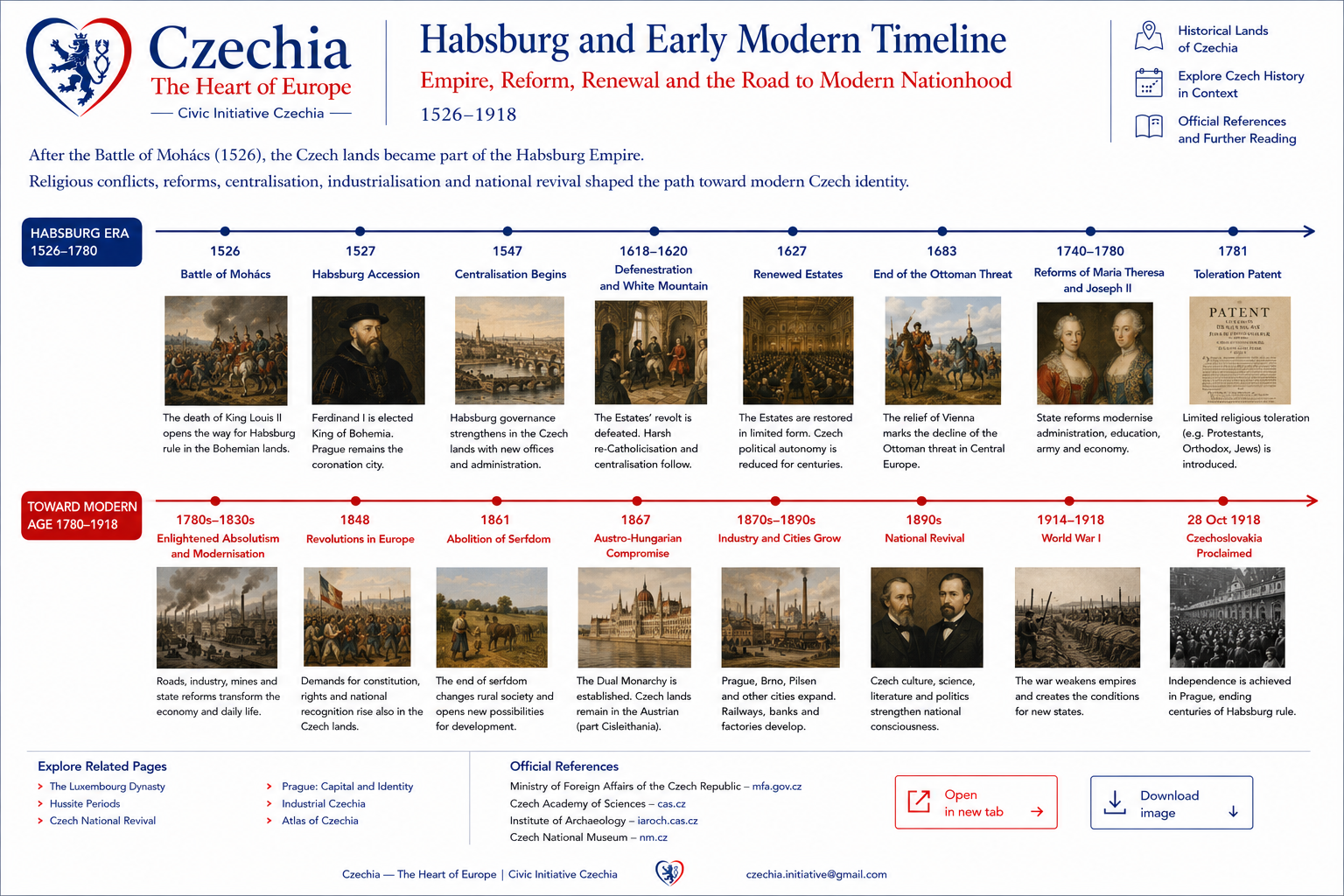
1526Ferdinand I of Habsburg is elected king of Bohemia after the death of Louis II at Mohács.
1575The Bohemian Confession expresses Protestant estate demands and the importance of religious rights.
1609Rudolf II issues the Letter of Majesty, confirming religious freedoms for the Bohemian estates.
1618The second Prague defenestration begins the Bohemian Revolt and helps trigger the Thirty Years’ War.
1620The Battle of White Mountain defeats the Bohemian estates and changes political order in the Czech lands.
1621Leaders of the revolt are executed in Prague’s Old Town Square.
1648The Thirty Years’ War ends; the Czech lands remain within the consolidated Habsburg monarchy.
1740–1780Maria Theresa’s reign brings major reforms in administration, education, taxation and military organisation.
1781Joseph II’s Patent of Toleration changes religious policy and public life in the monarchy.
Late 18th centuryEconomic, administrative and educational changes prepare the Czech lands for national revival and industrial society.
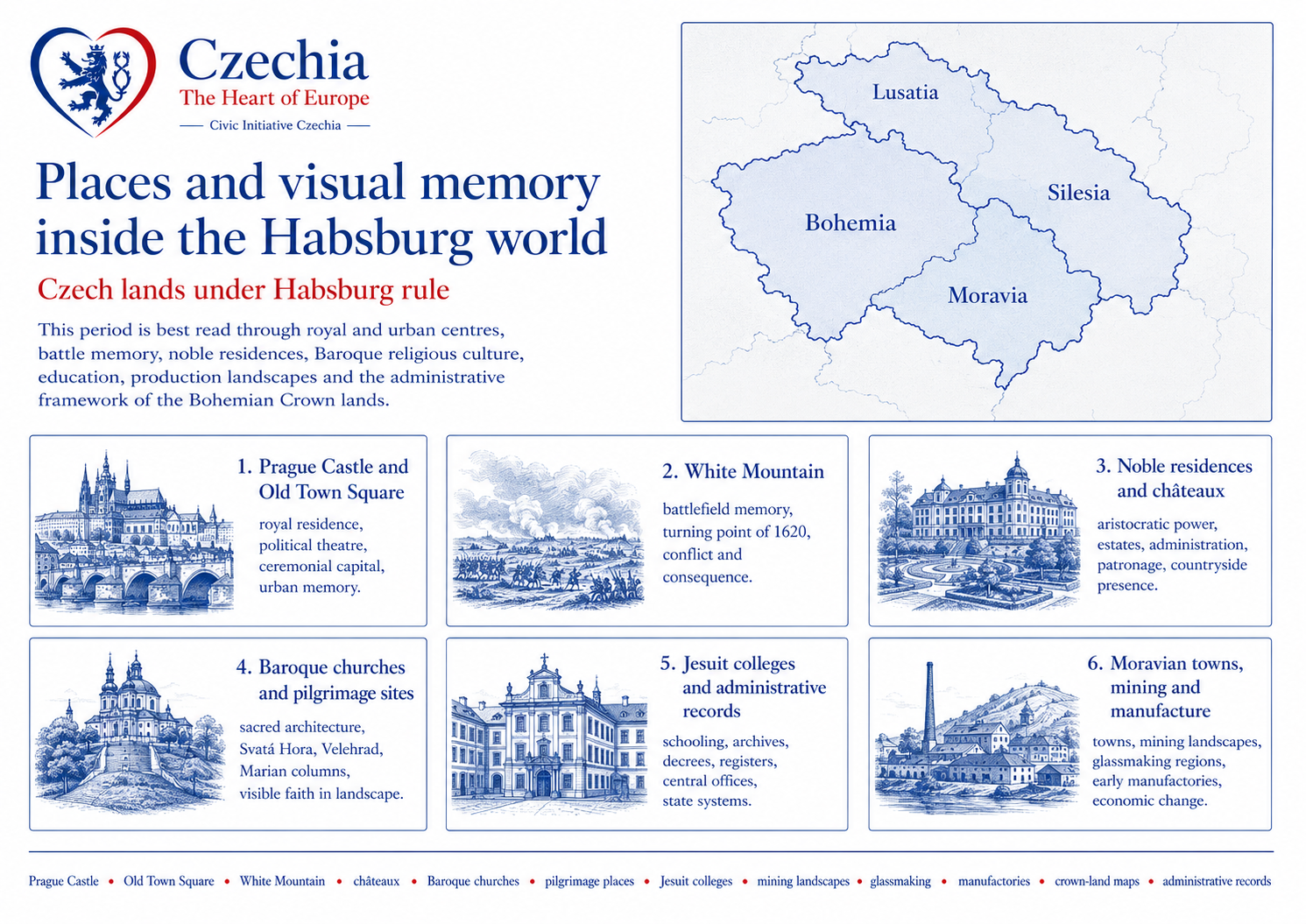
Places and visual memory
This period is best shown through Prague Castle and the Old Town Square, White Mountain, Habsburg court symbols, noble residences, châteaux, Baroque churches, pilgrimage sites, Jesuit colleges, Moravian towns, mining landscapes, glassmaking regions, early manufactories, maps of the Bohemian Crown lands and administrative records.