The collapse of the First Republic and the occupation of the Czech lands
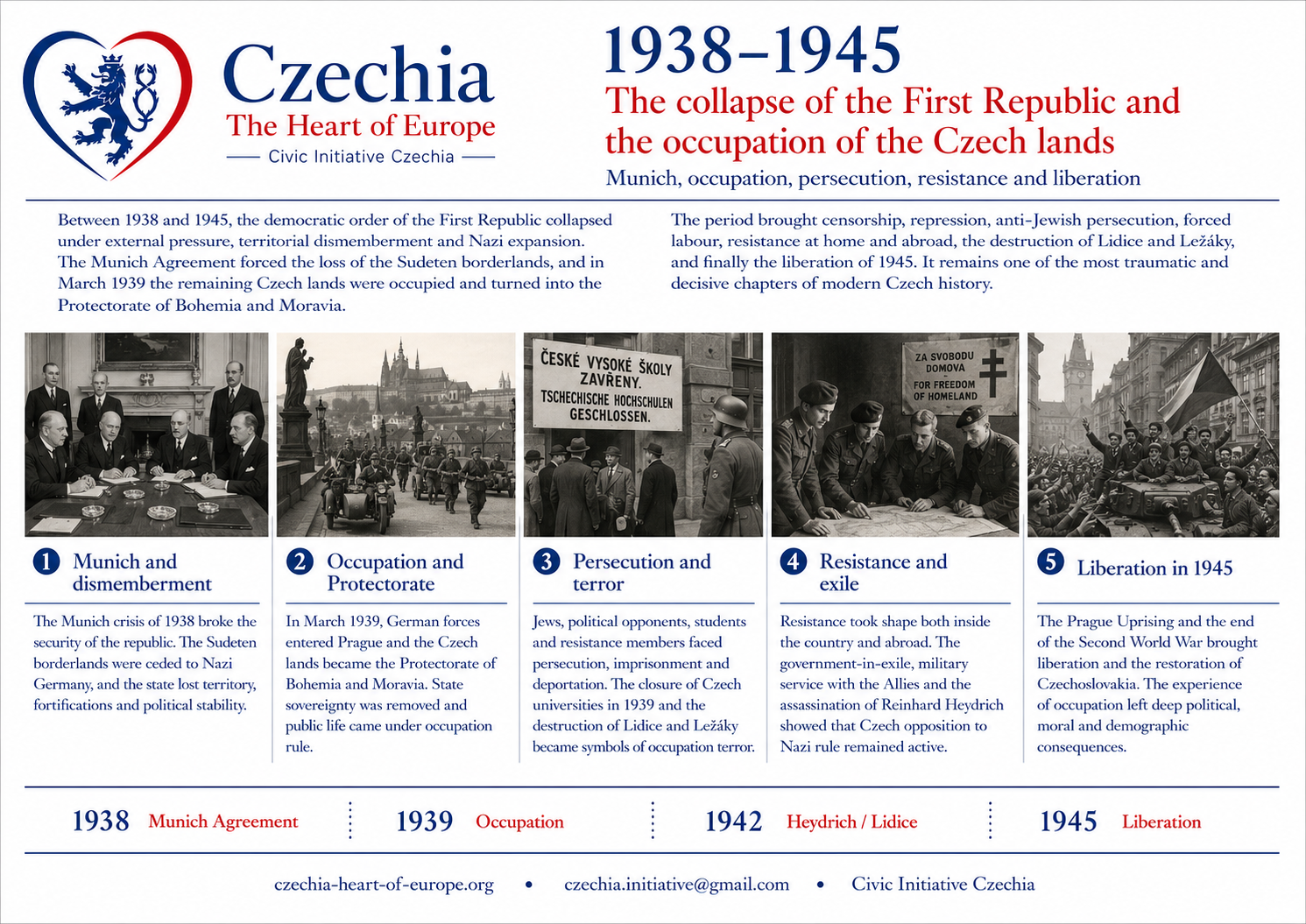
The crisis of 1938 broke the interwar order built after 1918. The Munich Agreement forced Czechoslovakia to cede its borderlands to Nazi Germany without the country’s participation in the final decision. The loss of the fortified frontier, industry, infrastructure and population shattered the First Republic’s security and political balance.
In March 1939, the remaining Czech lands were occupied and placed under the Protectorate of Bohemia and Moravia. Slovakia became a separate wartime state. The Czech lands entered a period of Nazi control, political repression, forced labour, censorship, racial persecution, economic exploitation and resistance at home and abroad.
The period is central to Czech public memory because it joins the collapse of democratic statehood, the destruction of Jewish life, the experience of occupation, the courage of resistance, the London exile government, the assassination of Reinhard Heydrich, the destruction of Lidice and Ležáky, the Prague Uprising and liberation in 1945.
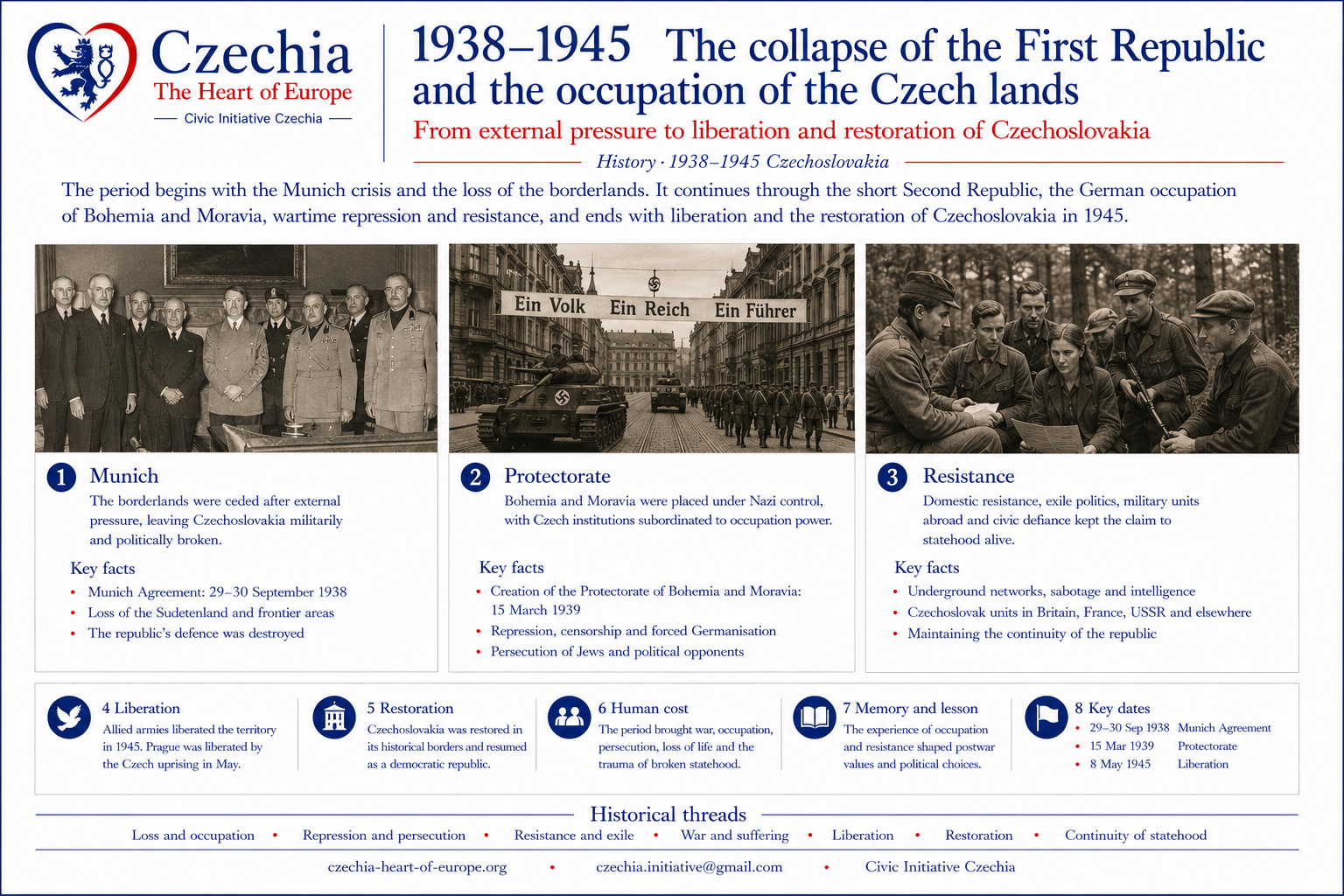
The period begins with the Munich crisis and the loss of the borderlands. It continues through the short Second Republic, the German occupation of Bohemia and Moravia, wartime repression and resistance, and ends with liberation and the restoration of Czechoslovakia in 1945.
MunichThe borderlands were ceded after external pressure, leaving Czechoslovakia militarily and politically broken.
ProtectorateBohemia and Moravia were placed under Nazi control, with Czech institutions subordinated to occupation power.
ResistanceDomestic resistance, exile politics, military units abroad and civic defiance kept the claim to statehood alive.
The Munich Agreement of September 1938 transferred the Sudeten borderlands to Germany. The decision destroyed Czechoslovakia’s defensive line and deprived the state of major industrial, transport and strategic areas. It also displaced people, intensified political pressure and weakened confidence in the international security system that had supported the First Republic.
The following months brought further territorial losses and internal instability. The Second Republic, lasting from late 1938 to March 1939, was politically compressed, authoritarian in tone and overshadowed by German pressure. Its existence ended when German troops occupied the Czech lands in March 1939.
BorderlandsThe loss of the frontier changed the military, economic and demographic map of the state.
State pressureExternal coercion and internal crisis ended the democratic rhythm of the First Republic.
Second RepublicThe remaining state existed briefly under severe pressure before March 1939.
March 1939The occupation of Bohemia and Moravia completed the destruction of interwar Czechoslovakia.
The Protectorate of Bohemia and Moravia
The Protectorate placed the Czech lands under Nazi Germany while preserving selected Czech administrative structures in subordinated form. Occupation authorities controlled politics, security, censorship, labour, education and the economy. Czech public life continued under surveillance, restriction and coercion.
Industry in the Czech lands was integrated into the German war economy. Workers, factories, railways and raw materials served occupation priorities. Daily life combined rationing, propaganda, fear, forced labour, black-market survival, cultural control and private strategies of endurance.
The closure of Czech universities after student demonstrations in 1939 became one of the strongest symbols of cultural repression. Education, publishing, theatre, radio and public assembly were monitored or restricted, while Germanisation pressure and political terror shaped the public atmosphere.
Persecution, the Holocaust and terror
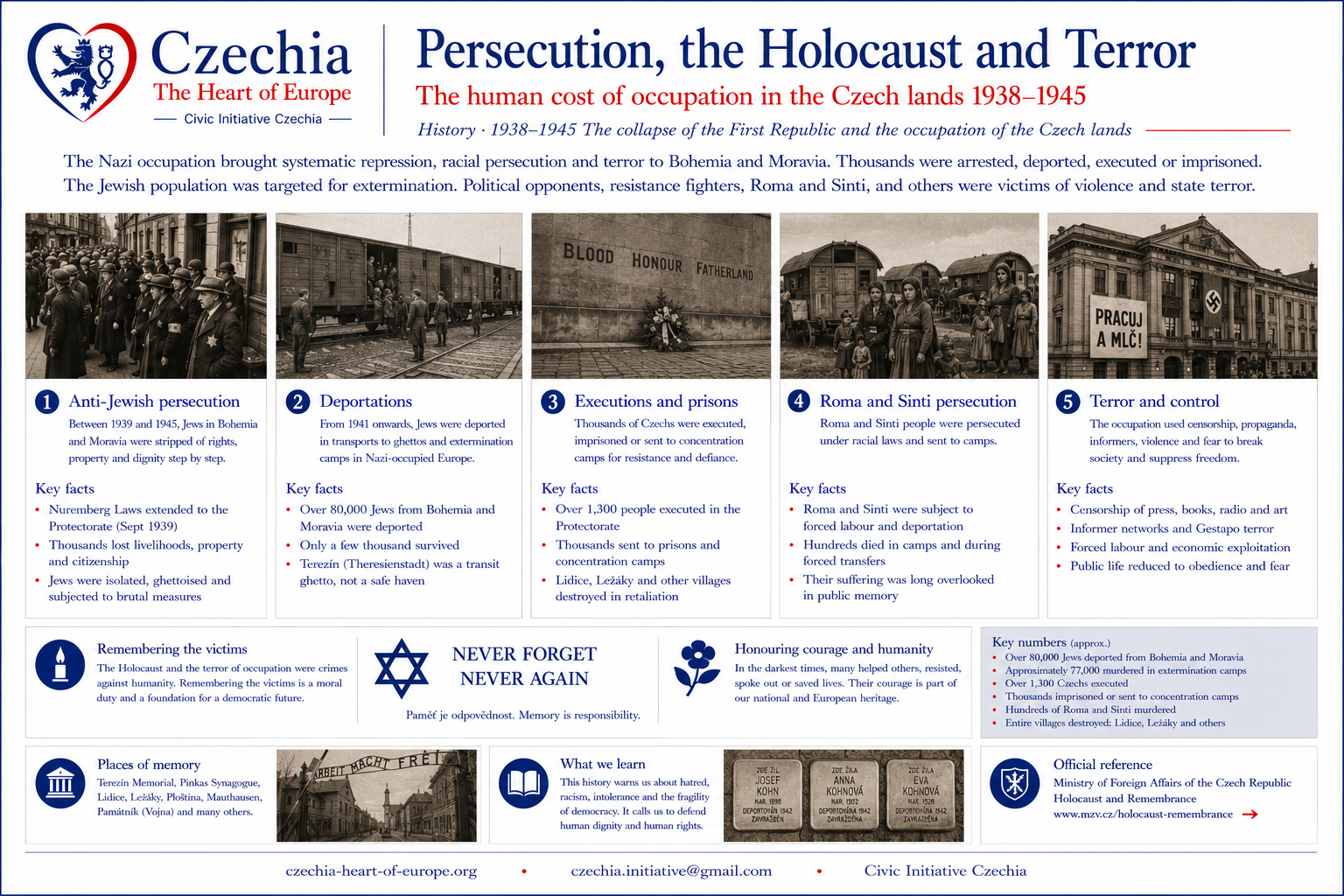
Nazi occupation brought systematic persecution. Jewish communities in Bohemia and Moravia were stripped of rights, property, work, public presence and eventually life. Deportations to ghettos and extermination camps destroyed a major part of Jewish life in the Czech lands. Roma people, political opponents, resistance members, students, clergy, intellectuals and many civilians also faced imprisonment, forced labour, execution or deportation.
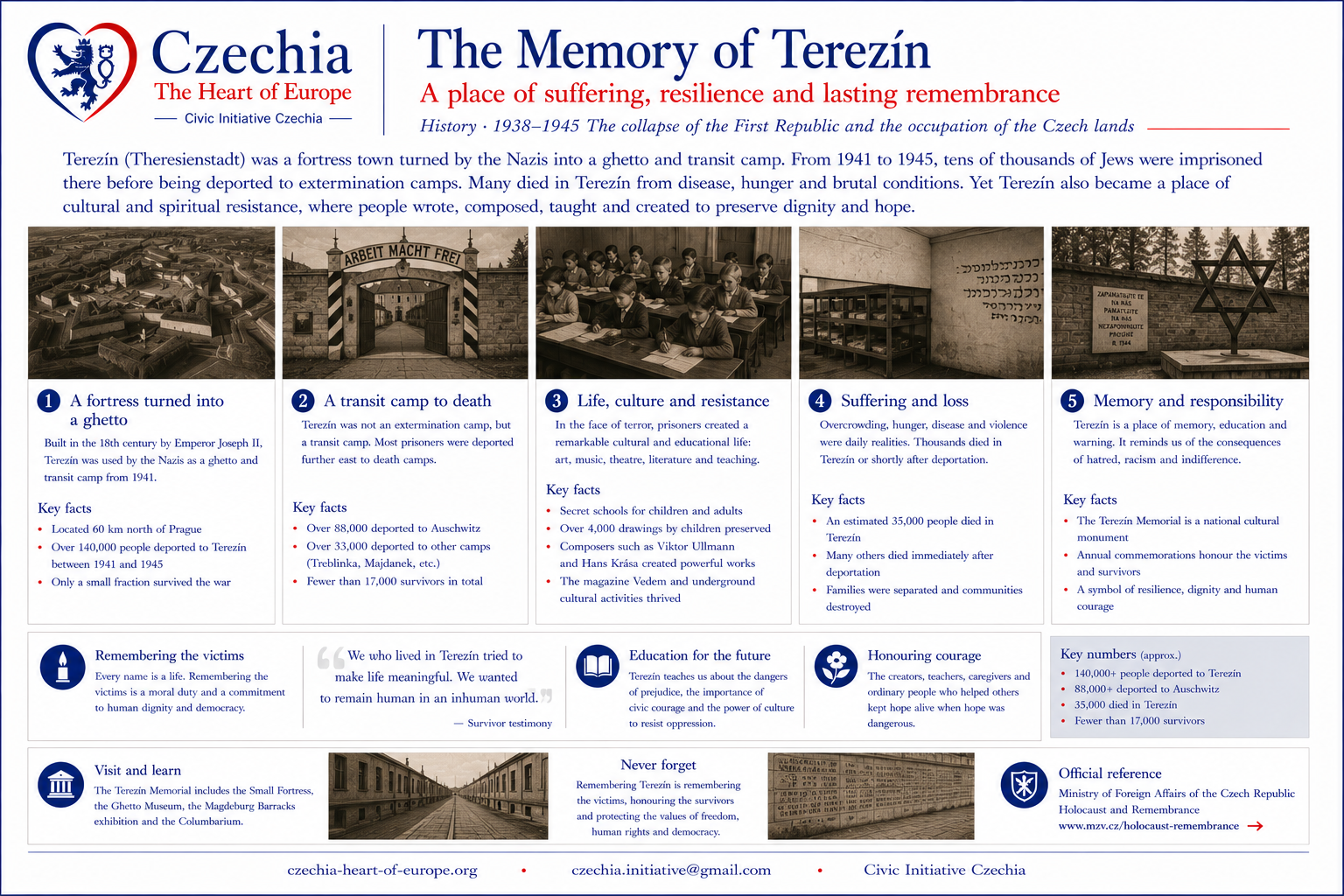
Terezín became one of the most important places of wartime memory. It functioned as a ghetto and transit camp, used by Nazi propaganda while serving as part of the machinery of persecution and deportation. The memory of Terezín, the destroyed Jewish communities and the wider terror system remains essential to any serious reading of the period.
The wartime history of Czechia includes state destruction and military occupation, but also the destruction of communities, families, neighbourhoods, schools, professions and cultural worlds.
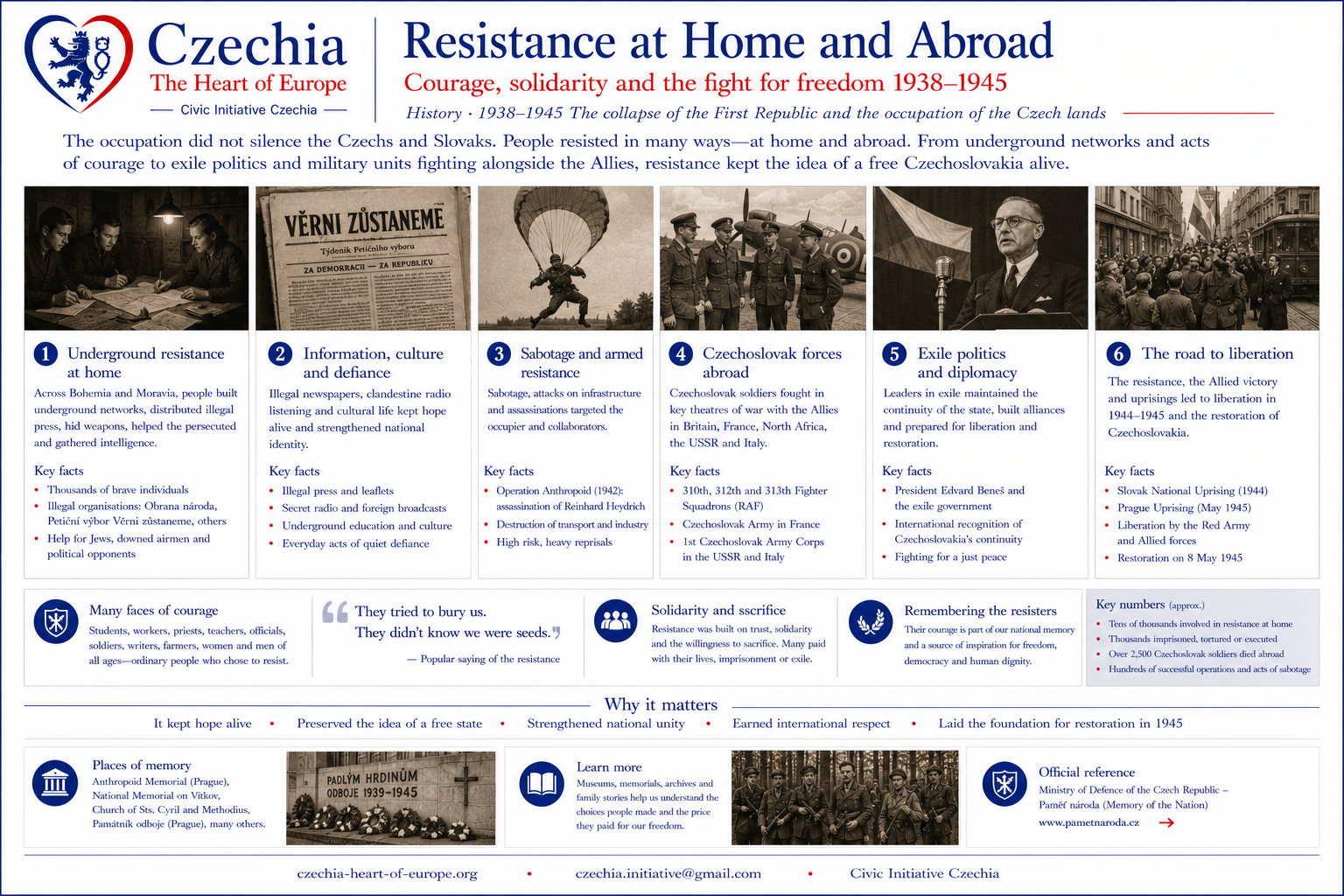
Czech resistance took many forms. Domestic networks gathered intelligence, preserved contacts, distributed illegal publications, supported families of arrested people and maintained links with exile structures. Resistance work was dangerous and often punished by execution, imprisonment or collective reprisals.
Abroad, Czechoslovak soldiers fought with Allied forces. The government-in-exile in London, led by Edvard Beneš, worked to restore international recognition of Czechoslovakia and reverse the consequences of Munich. Radio broadcasts, diplomacy and military participation connected the occupied homeland with the wider Allied war effort.
Domestic resistanceNetworks inside the Protectorate maintained intelligence, communication, support and symbolic opposition.
Exile governmentLondon became the political centre of the claim that Czechoslovakia continued legally and should be restored.
Soldiers abroadCzechoslovak units fought in Allied armies and helped preserve the country’s military honour.
Broadcasts and memoryExile radio and public messages connected occupied society with the wider war.
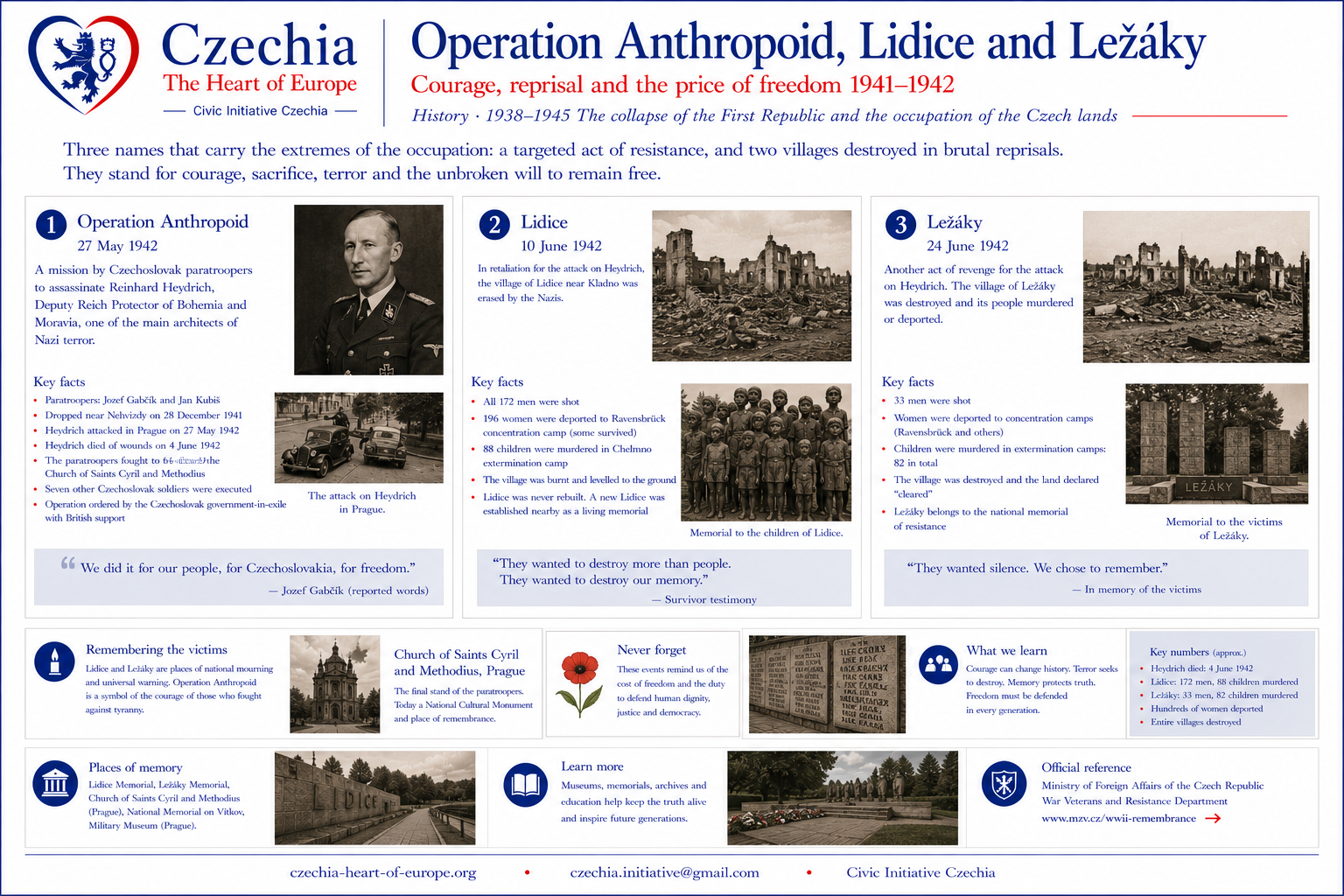
Operation Anthropoid, carried out by Czechoslovak parachutists trained in Britain, targeted Reinhard Heydrich, one of the most powerful Nazi figures in the Protectorate. The attack in Prague in 1942 became one of the most significant acts of anti-Nazi resistance in occupied Europe.
The Nazi reprisals were brutal. Lidice and Ležáky were destroyed, men were executed, women and children were deported, and the names of the villages entered Czech and international memory as symbols of occupation terror. The parachutists’ final fight in the Church of Saints Cyril and Methodius in Prague remains one of the most powerful sites of Czech wartime remembrance.
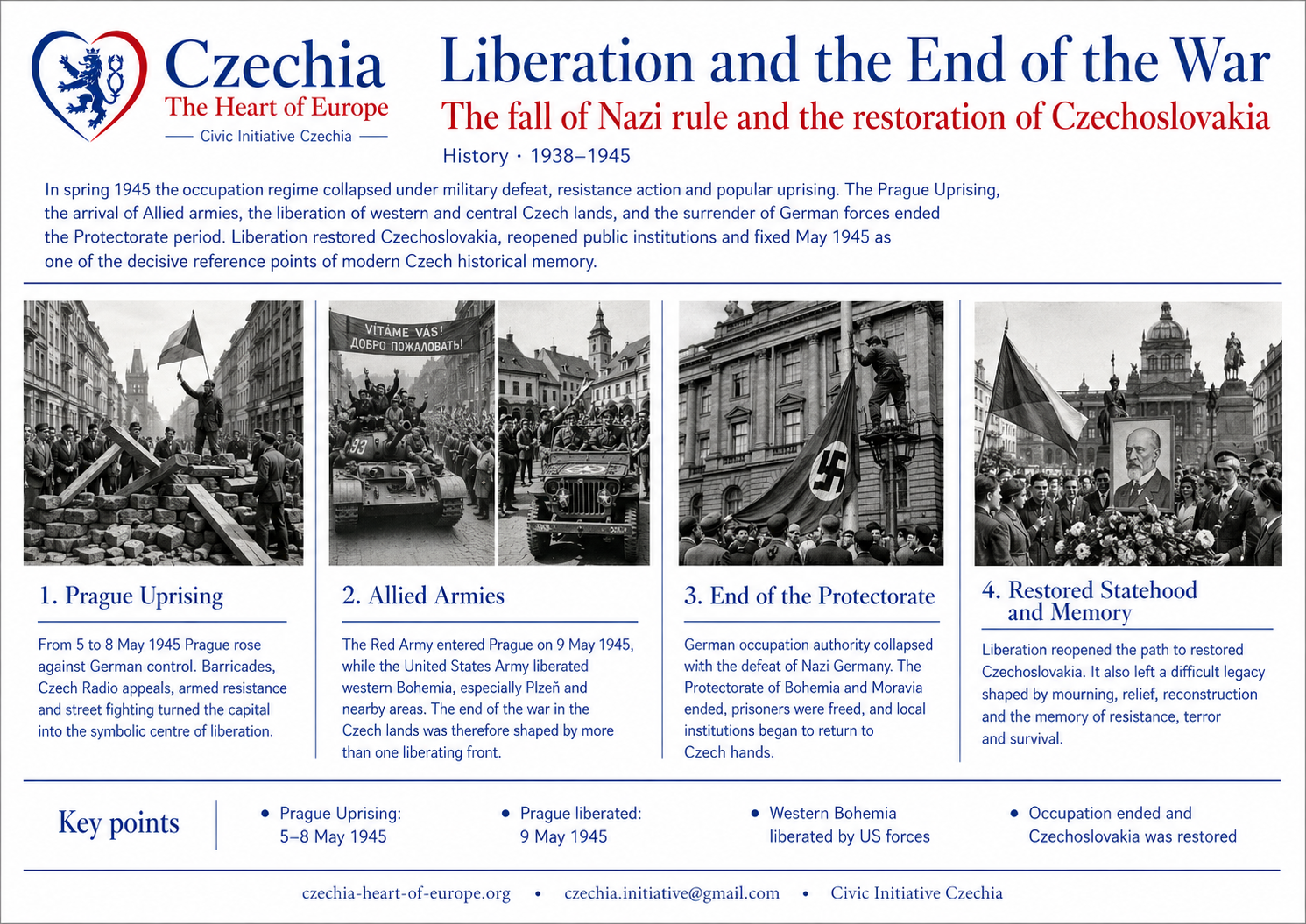
In May 1945, the occupation collapsed as Allied armies advanced and the Prague Uprising broke out. Fighting in Prague and elsewhere marked the final days of the war in the Czech lands. Liberation restored Czechoslovakia, but the end of occupation also opened a difficult post-war period shaped by trauma, expulsions, political struggle and the growing influence of the Soviet Union.
The return of statehood in 1945 did not return the country to the world of 1938. The Jewish population had been devastated, borderland society had been transformed, political power was shifting, and the memory of Munich, occupation, resistance and liberation deeply influenced post-war decisions.
1938–1939Second Republic, internal instability and increasing German pressure.
March 1939German occupation of Bohemia and Moravia; creation of the Protectorate.
1939Closure of Czech universities after student protests and repression.
1941–1945Deportations, forced labour, terror and intensified war economy.
1942Operation Anthropoid; assassination of Reinhard Heydrich; destruction of Lidice and Ležáky.
1945Prague Uprising, liberation and restoration of Czechoslovakia.
What this period contributes to Czech history
Memory of MunichThe crisis of 1938 became a lasting reference for security, alliances, state sovereignty and the vulnerability of small states.
Occupation experienceThe Protectorate showed how institutions, culture and daily life can be forced to operate under foreign control.
Resistance legitimacyDomestic and foreign resistance strengthened the claim to restored Czechoslovak statehood.
Post-war consequencesThe destruction, trauma and political shifts of 1938–1945 shaped the country after liberation.
Places and visual memory
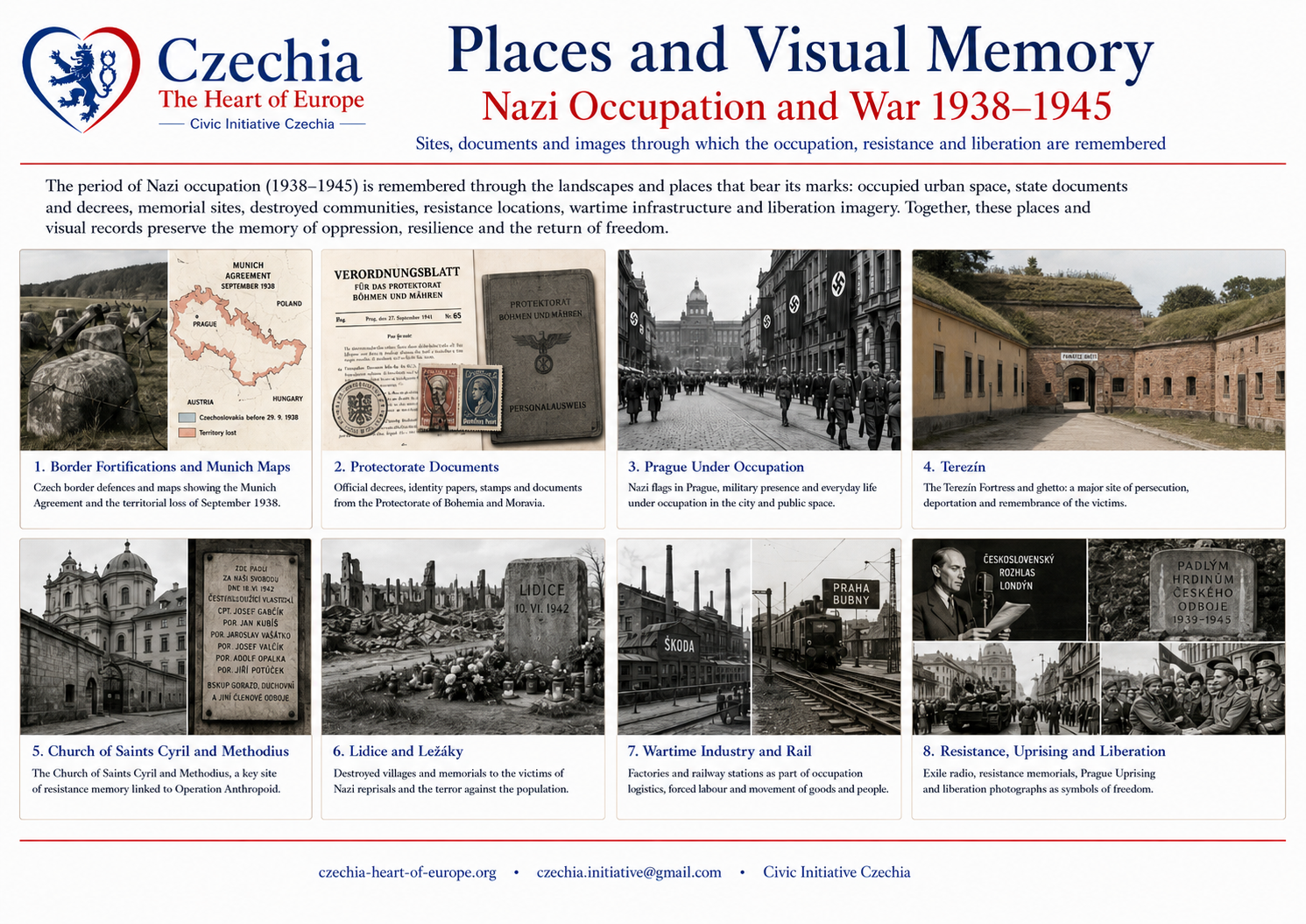
This period is shown through border fortifications, maps of the Munich settlement, Protectorate documents, Prague under occupation, Terezín, the Church of Saints Cyril and Methodius, Lidice, Ležáky, wartime factories, railway stations, exile radio material, resistance memorials, Prague Uprising imagery and liberation photographs.