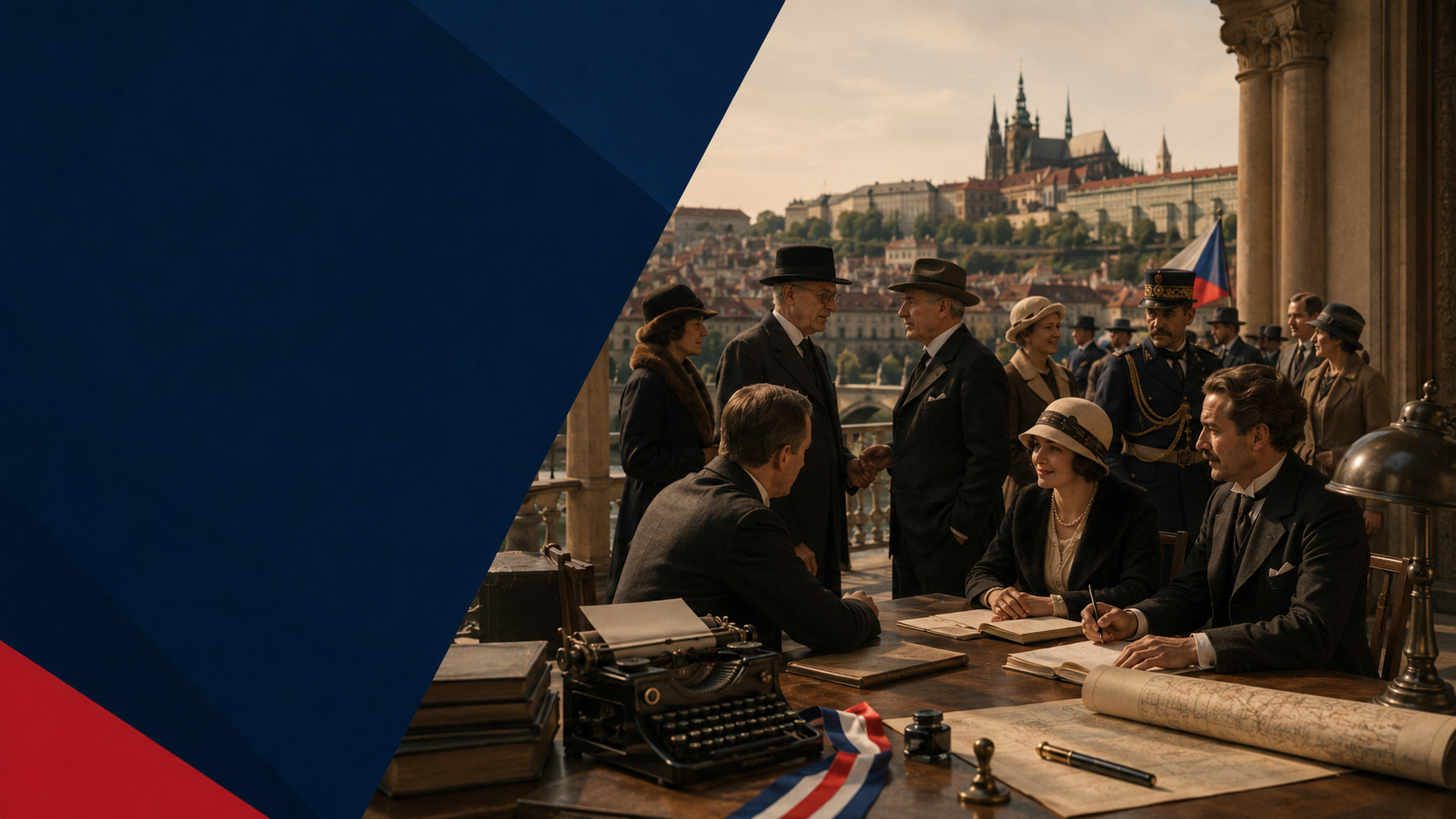
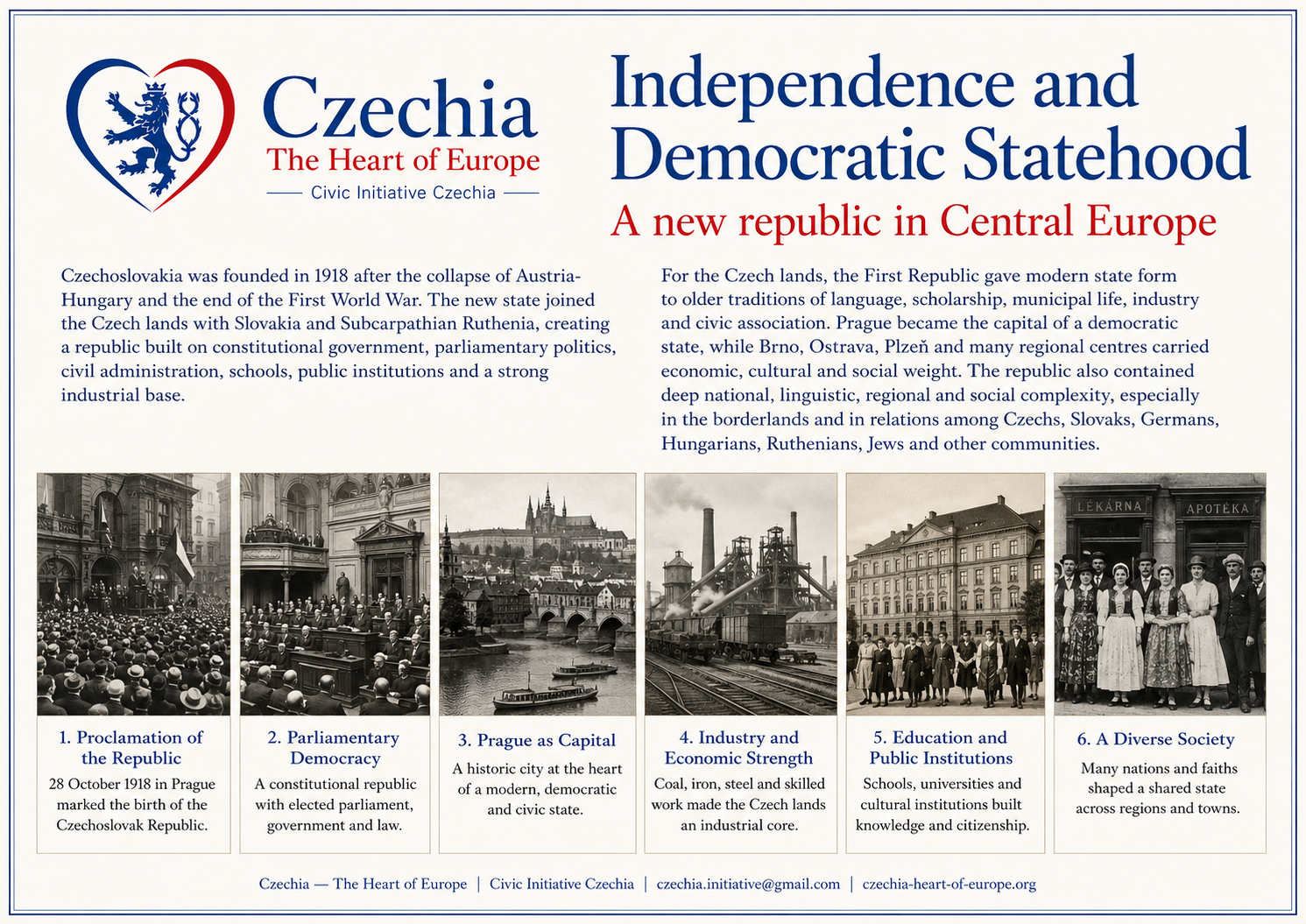
Czechoslovakia was founded in 1918 after the collapse of Austria-Hungary and the end of the First World War. The new state joined the Czech lands with Slovakia and Subcarpathian Ruthenia, creating a republic built on constitutional government, parliamentary politics, civil administration, schools, public institutions and a strong industrial base.
For the Czech lands, the First Republic gave modern state form to older traditions of language, scholarship, municipal life, industry and civic association. Prague became the capital of a democratic state, while Brno, Ostrava, Plzeň and many regional centres carried economic, cultural and social weight. The republic also contained deep national, linguistic, regional and social complexity, especially in the borderlands and in relations among Czechs, Slovaks, Germans, Hungarians, Ruthenians, Jews and other communities.
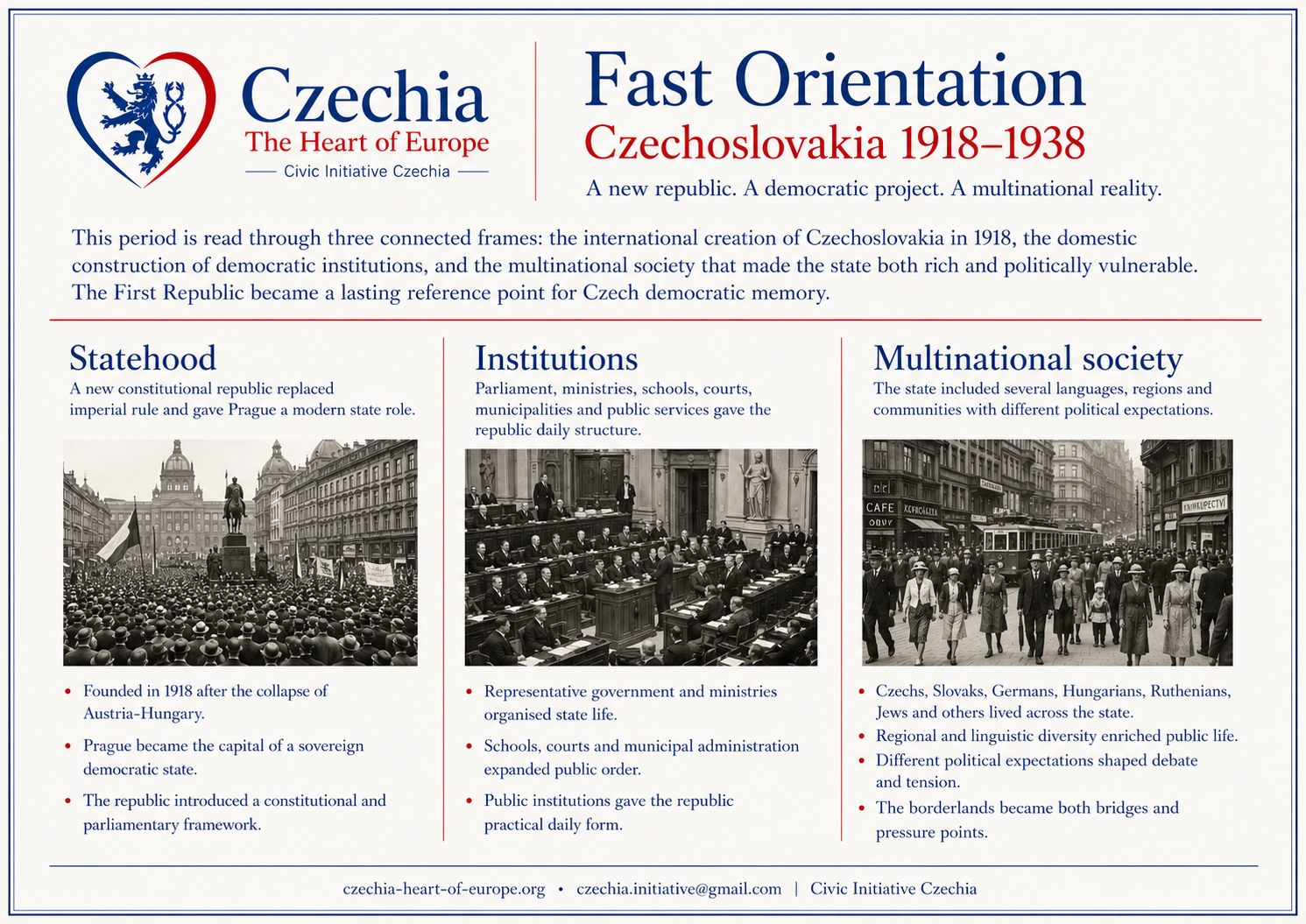
This period is read through three connected frames: the international creation of Czechoslovakia in 1918, the domestic construction of democratic institutions, and the multinational society that made the state both rich and politically vulnerable. The First Republic became a lasting reference point for Czech democratic memory.
StatehoodA new constitutional republic replaced imperial rule and gave Prague a modern state role.
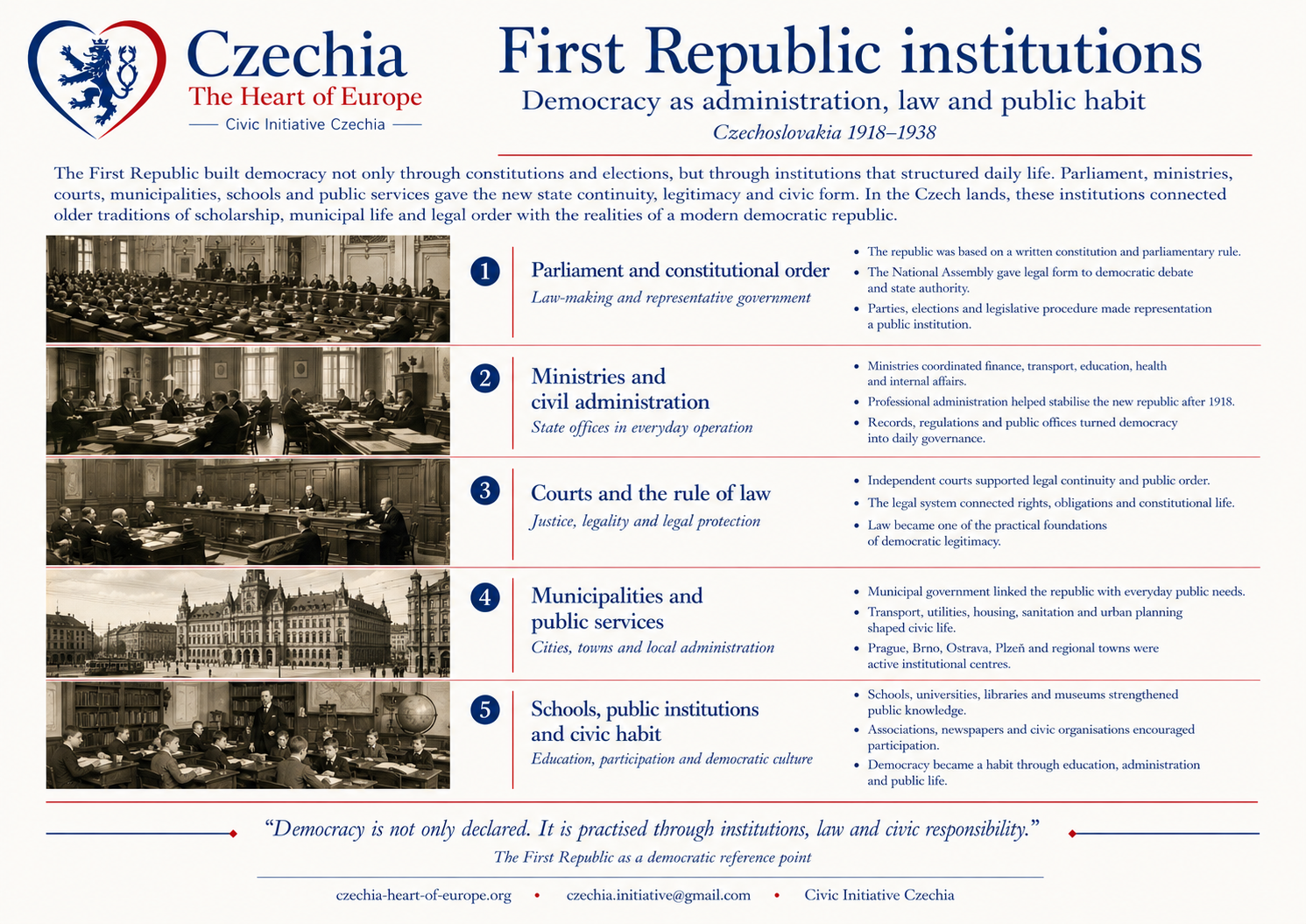
InstitutionsParliament, ministries, schools, courts, municipalities and public services gave the republic daily structure.
Multinational societyThe state included several languages, regions and communities with different political expectations.
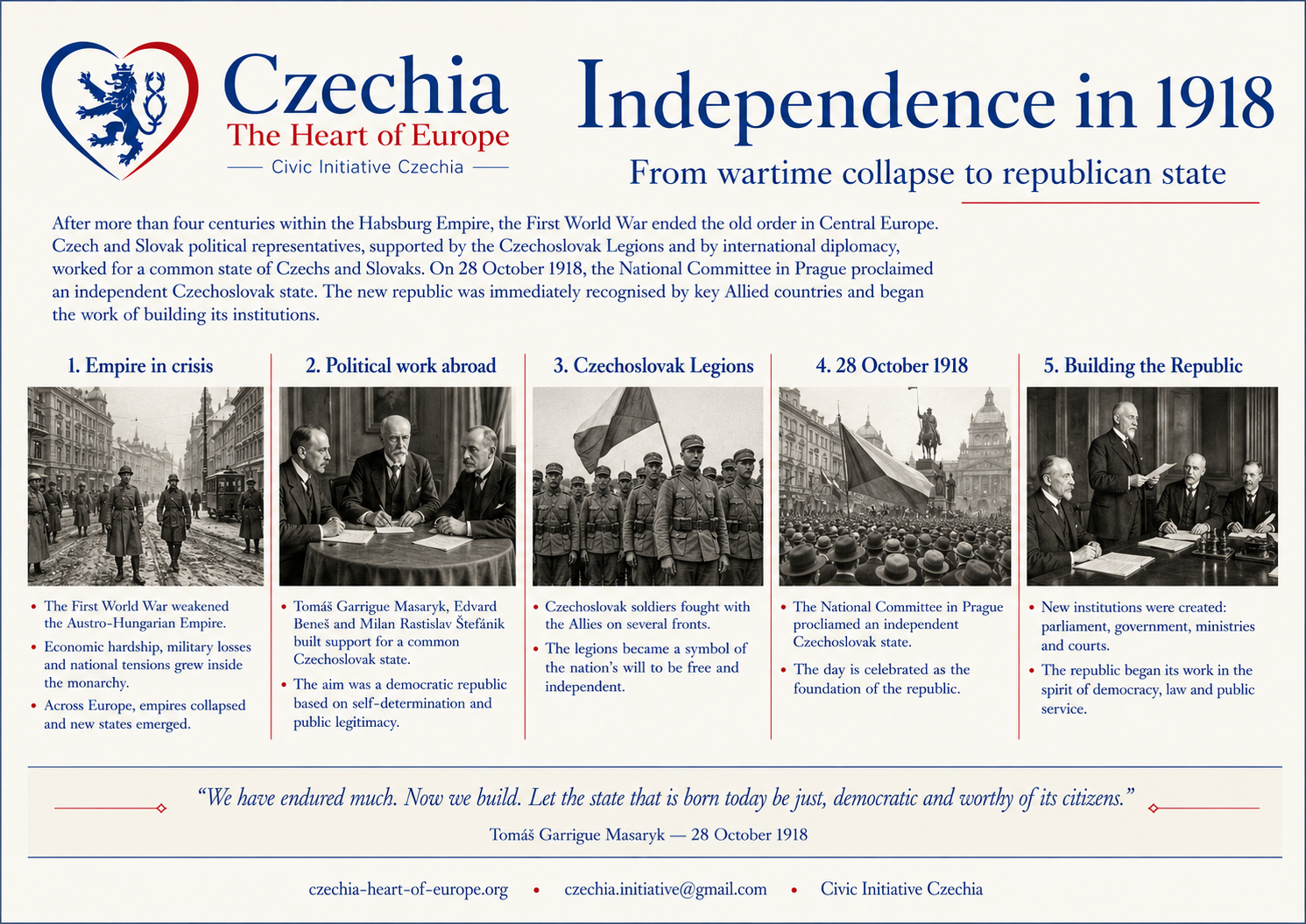
The First World War weakened Austria-Hungary and opened the political space for Czechoslovak independence. Exile diplomacy, domestic political organisation, military action by the Czechoslovak Legions and the changing position of the Allied powers all contributed to the formation of the new state.
The declaration of independence in October 1918 gave the Czech lands a new constitutional future. The state inherited administrative capacity, industry and education from the former monarchy, but it also had to integrate different regions, legal traditions, political cultures and national communities into one republican framework.
Exile diplomacyInternational recognition made independence politically possible at the end of the war.
Domestic politicsCzech political actors prepared the transition from imperial structures to republican government.
LegionsCzechoslovak military formations abroad became a major symbol of state-making.
New capitalPrague became the seat of the republic’s parliament, presidency and ministries.
The First Republic developed a parliamentary system with a president, government, legislature, political parties, courts, ministries and local administration. Its democratic reputation rested not only on elections but also on public institutions, education, press life, civic associations and the culture of debate.
Tomáš Garrigue Masaryk became the central symbolic figure of the republic. His presidency linked independence to democratic ethics, education, social responsibility and a public language of citizenship. Edvard Beneš, Milan Rastislav Štefánik and many other political, military, scholarly and civic figures belonged to the wider state-building environment.
ConstitutionThe republic worked through constitutional government and parliamentary institutions.
PresidencyMasaryk gave the new state a powerful democratic and moral symbol.
EducationSchools, universities and public learning supported citizenship and social mobility.
Civic lifeAssociations, parties, journalism and municipalities made politics visible in daily life.
A highly industrial state with strong regional centres
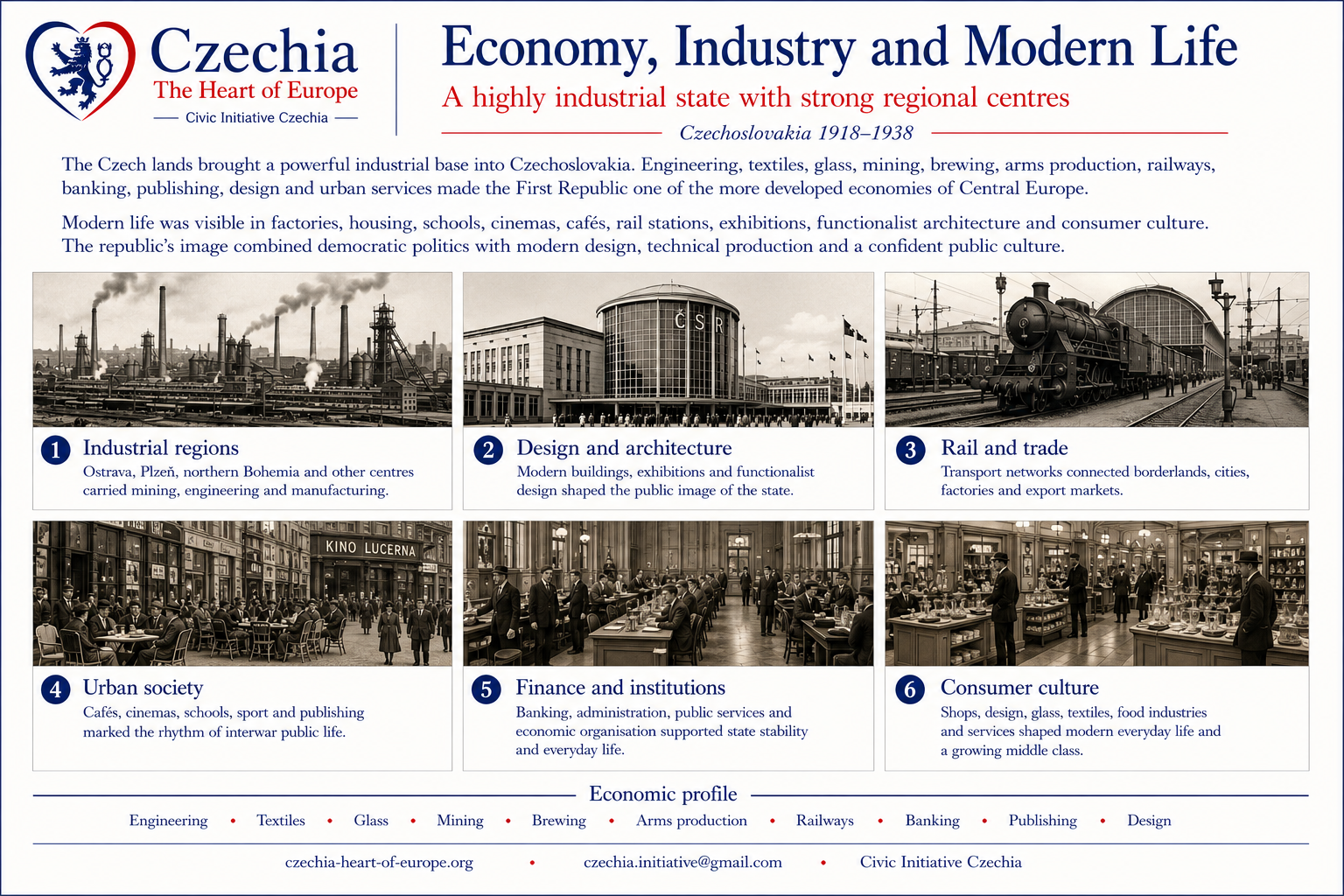
The Czech lands brought a powerful industrial base into Czechoslovakia. Engineering, textiles, glass, mining, brewing, arms production, railways, banking, publishing, design and urban services made the First Republic one of the more developed economies of Central Europe.
Modern life was visible in factories, housing, schools, cinemas, cafés, rail stations, exhibitions, functionalist architecture and consumer culture. The republic’s image combined democratic politics with modern design, technical production and a confident public culture.
Industrial regionsOstrava, Plzeň, northern Bohemia and other centres carried mining, engineering and manufacturing.
Design and architectureModern buildings, exhibitions and functionalist design shaped the public image of the state.
Rail and tradeTransport networks connected borderlands, cities, factories and export markets.
Urban societyCafés, cinemas, schools, sport and publishing marked the rhythm of interwar public life.
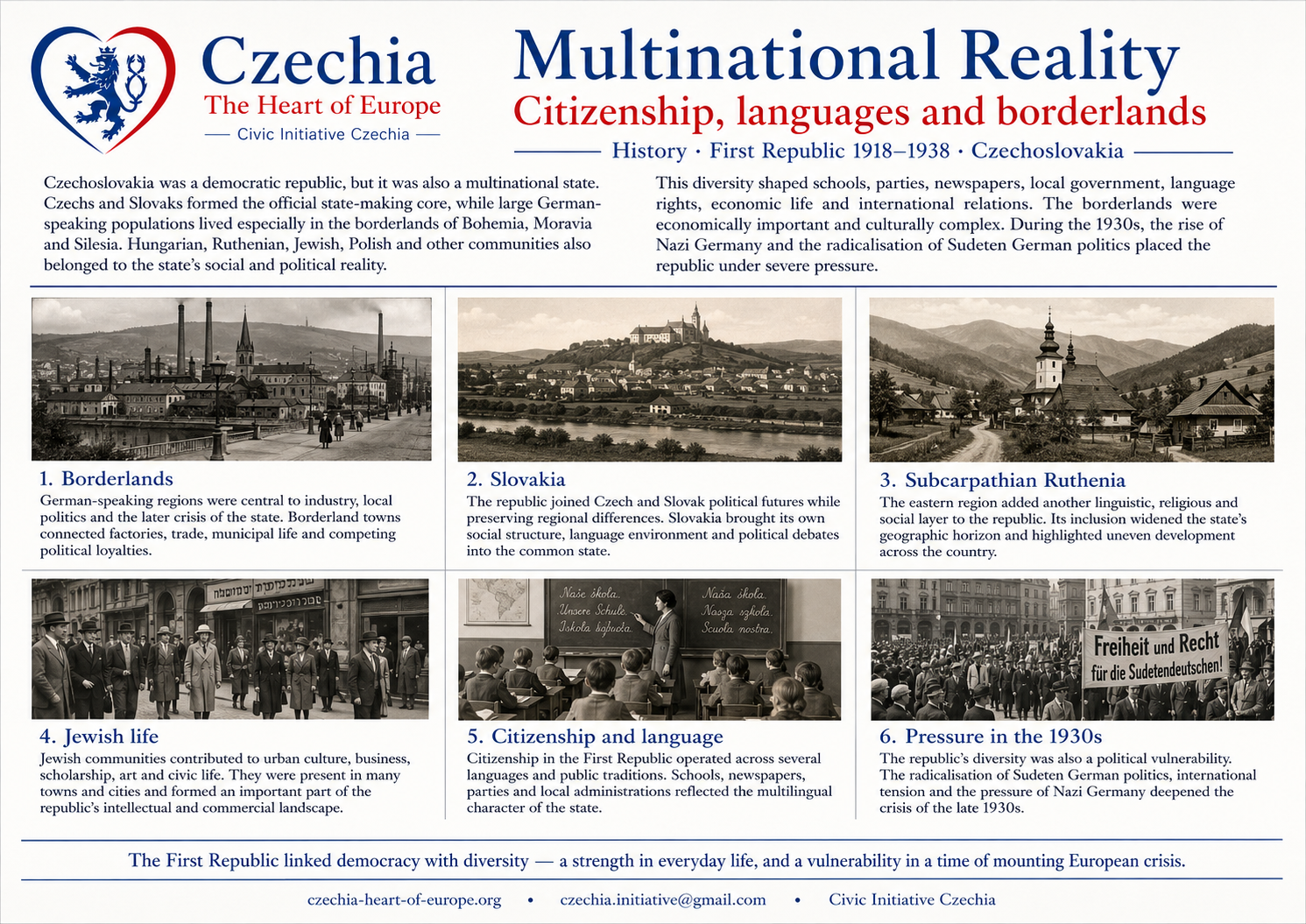
Czechoslovakia was a democratic republic, but it was also a multinational state. Czechs and Slovaks formed the official state-making core, while large German-speaking populations lived especially in the borderlands of Bohemia, Moravia and Silesia. Hungarian, Ruthenian, Jewish, Polish and other communities also belonged to the state’s social and political reality.
This diversity shaped schools, parties, newspapers, local government, language rights, economic life and international relations. The borderlands were economically important and culturally complex. During the 1930s, the rise of Nazi Germany and the radicalisation of Sudeten German politics placed the republic under severe pressure.
BorderlandsGerman-speaking regions were central to industry, local politics and the later crisis of the state.
SlovakiaThe republic joined Czech and Slovak political futures while preserving regional differences.
Subcarpathian RutheniaThe eastern region added another linguistic, religious and social layer to the republic.
Jewish lifeJewish communities contributed to urban culture, business, scholarship, art and civic life.
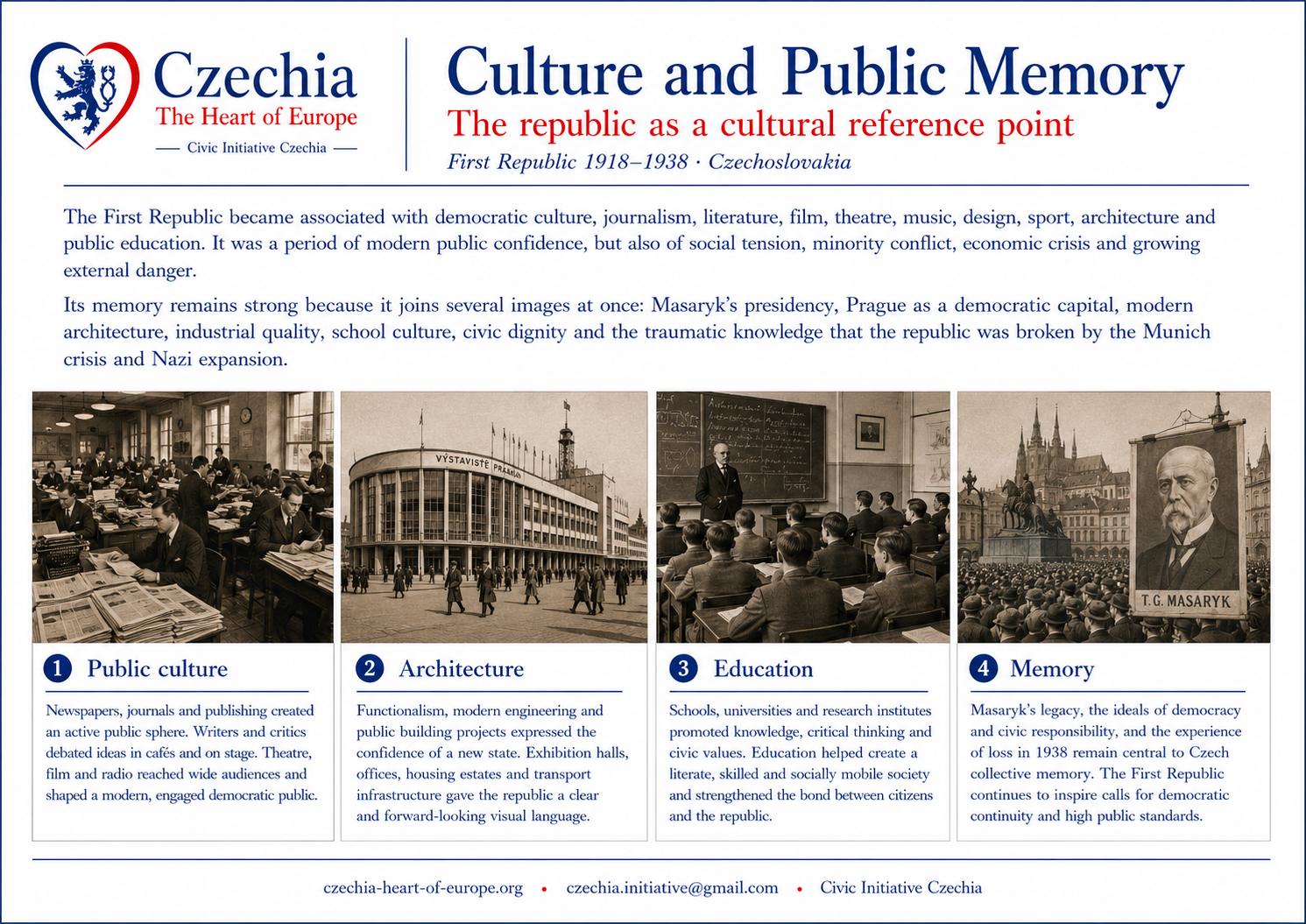
The First Republic became associated with democratic culture, journalism, literature, film, theatre, music, design, sport, architecture and public education. It was a period of modern public confidence, but also of social tension, minority conflict, economic crisis and growing external danger.
Its memory remains strong because it joins several images at once: Masaryk’s presidency, Prague as a democratic capital, modern architecture, industrial quality, school culture, civic dignity and the traumatic knowledge that the republic was broken by the Munich crisis and Nazi expansion.
Public cultureNewspapers, literature, theatre, film and radio shaped a modern democratic public.
ArchitectureFunctionalism and public buildings gave the republic a modern visual language.
EducationSchools and universities carried republican values into everyday society.
MemoryThe First Republic remains a reference point for democratic continuity and civic standards.
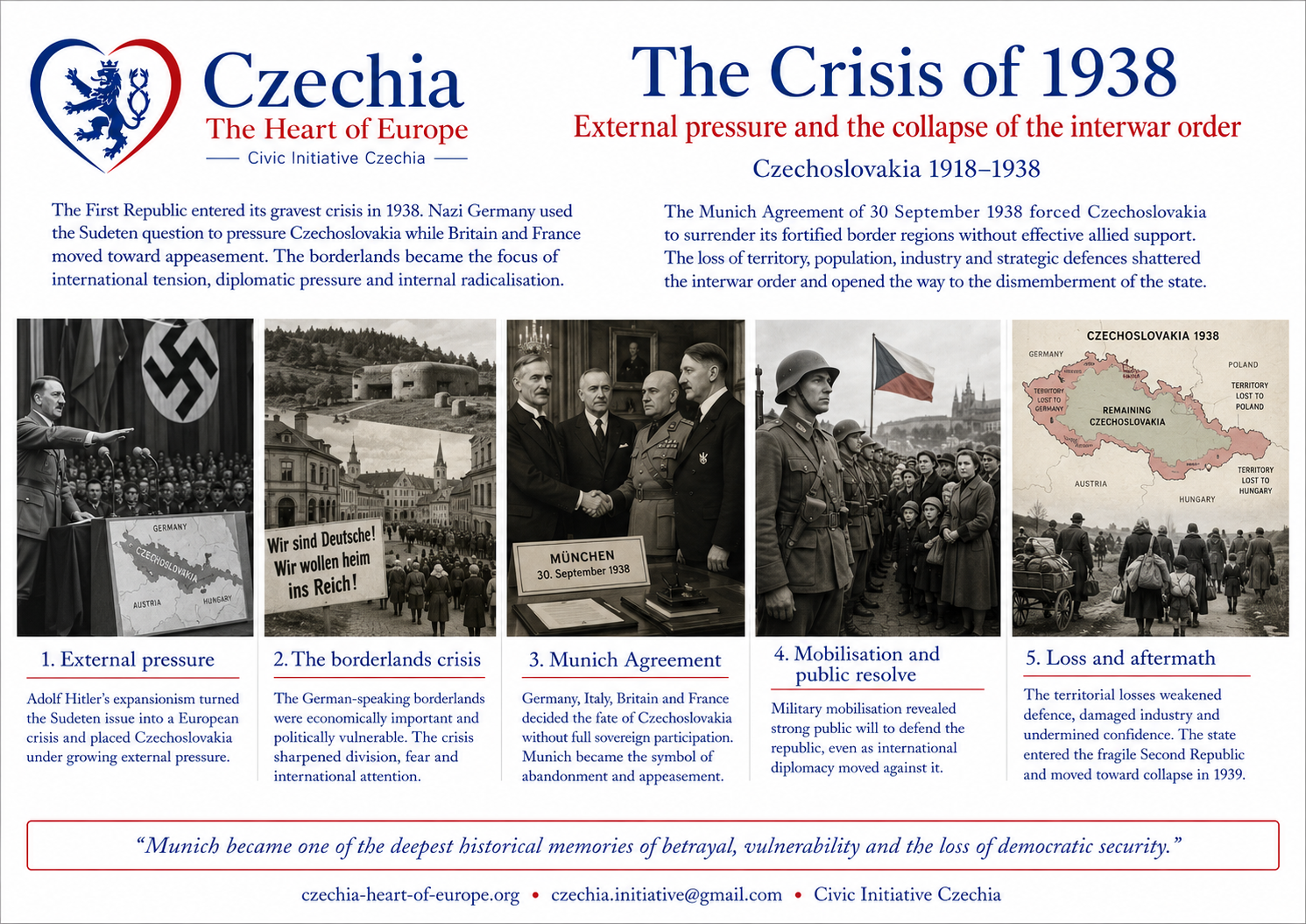
External pressure and the collapse of the interwar order
The 1930s brought economic strain, the rise of authoritarian regimes and the aggressive expansion of Nazi Germany. Czechoslovakia’s border fortifications, alliances and democratic institutions faced a crisis that was larger than domestic politics alone.
The Munich Agreement of September 1938 forced Czechoslovakia to cede border territories to Germany. The loss of the Sudetenland damaged the state’s defence, economy and political structure. The First Republic ended as a democratic project under extreme international pressure, opening the way to occupation, war and profound social trauma.
Sudeten crisisBorderland politics became tied to Nazi Germany’s pressure on the republic.
FortificationsDefensive structures show the seriousness of the military threat in the 1930s.
Munich AgreementThe imposed territorial loss broke the security and continuity of the state.
AftermathThe crisis leads directly to the next period: occupation, resistance, persecution and war.
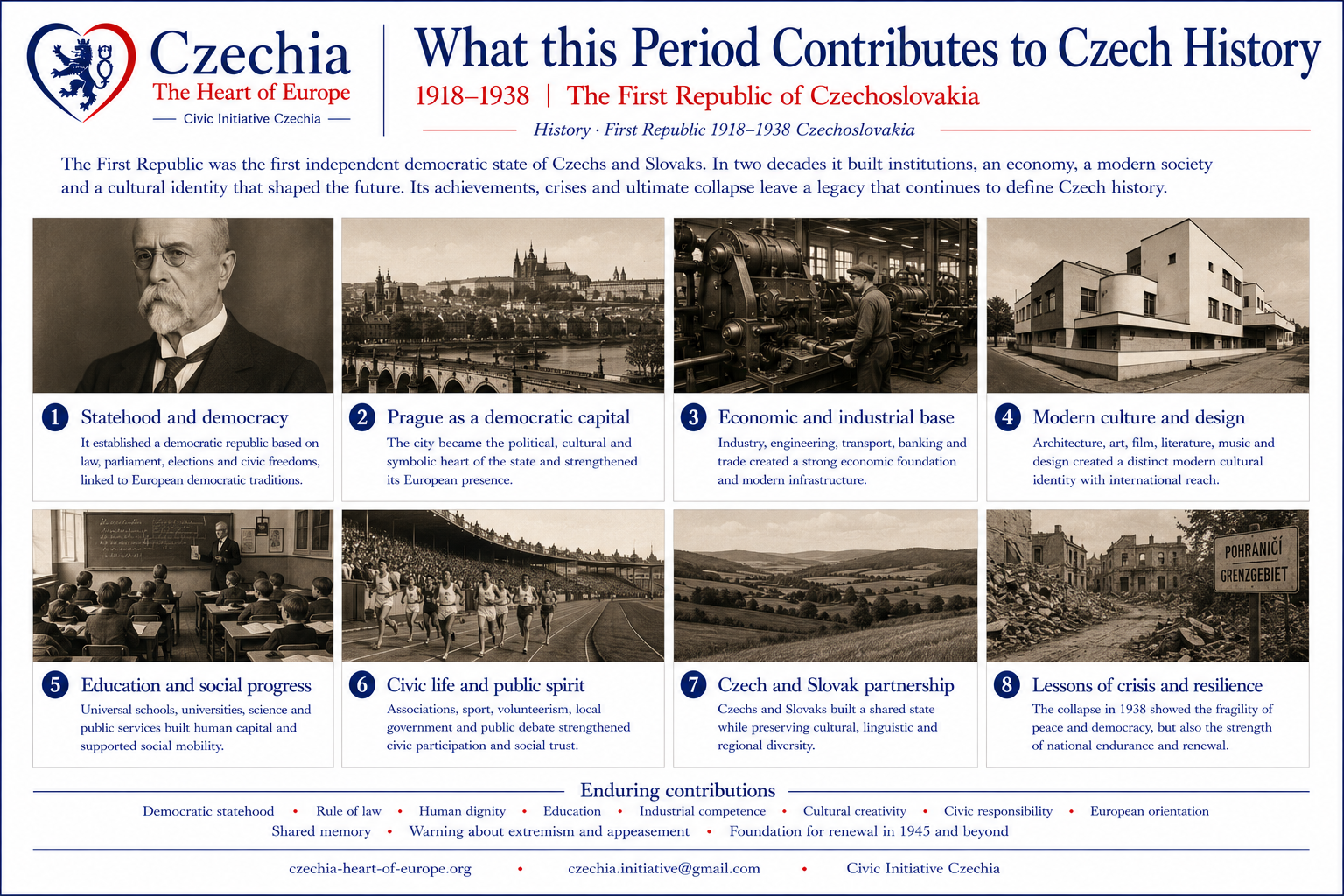
Czechoslovakia 1918–1938 gives Czech history its strongest modern democratic reference before the Second World War. It connects nineteenth-century civic culture with parliamentary statehood, public education, industrial capacity, international diplomacy and a modern sense of citizenship.
The period also clarifies the difficulty of building democracy in a multinational borderland state exposed to authoritarian pressure. Its legacy is therefore both institutional and tragic: a democratic republic remembered for its ambition, achievements, complexity and forced destruction.
Democratic modelThe First Republic remains a major reference for Czech democratic political culture.
State continuityModern Czech statehood is inseparable from the Czechoslovak foundation of 1918.
Industrial modernityThe Czech lands entered the republic with strong production, design and technical capacity.
Historical warning1938 shows the vulnerability of democracy under external aggression and diplomatic abandonment.
1918Czechoslovakia is founded after the collapse of Austria-Hungary and the end of the First World War.
1919The new state consolidates territory, administration and international recognition in the post-war settlement.
1920The constitutional framework of the republic defines parliamentary democratic government.
1920sThe First Republic develops institutions, industry, schools, public culture and democratic civic life.
1929The Great Depression begins to affect the republic’s economy and social stability.
1933Nazi rule in Germany changes the security environment around Czechoslovakia.
1935Masaryk resigns the presidency; Edvard Beneš becomes president.
1938The Sudeten crisis culminates in the Munich Agreement and the loss of border territories.
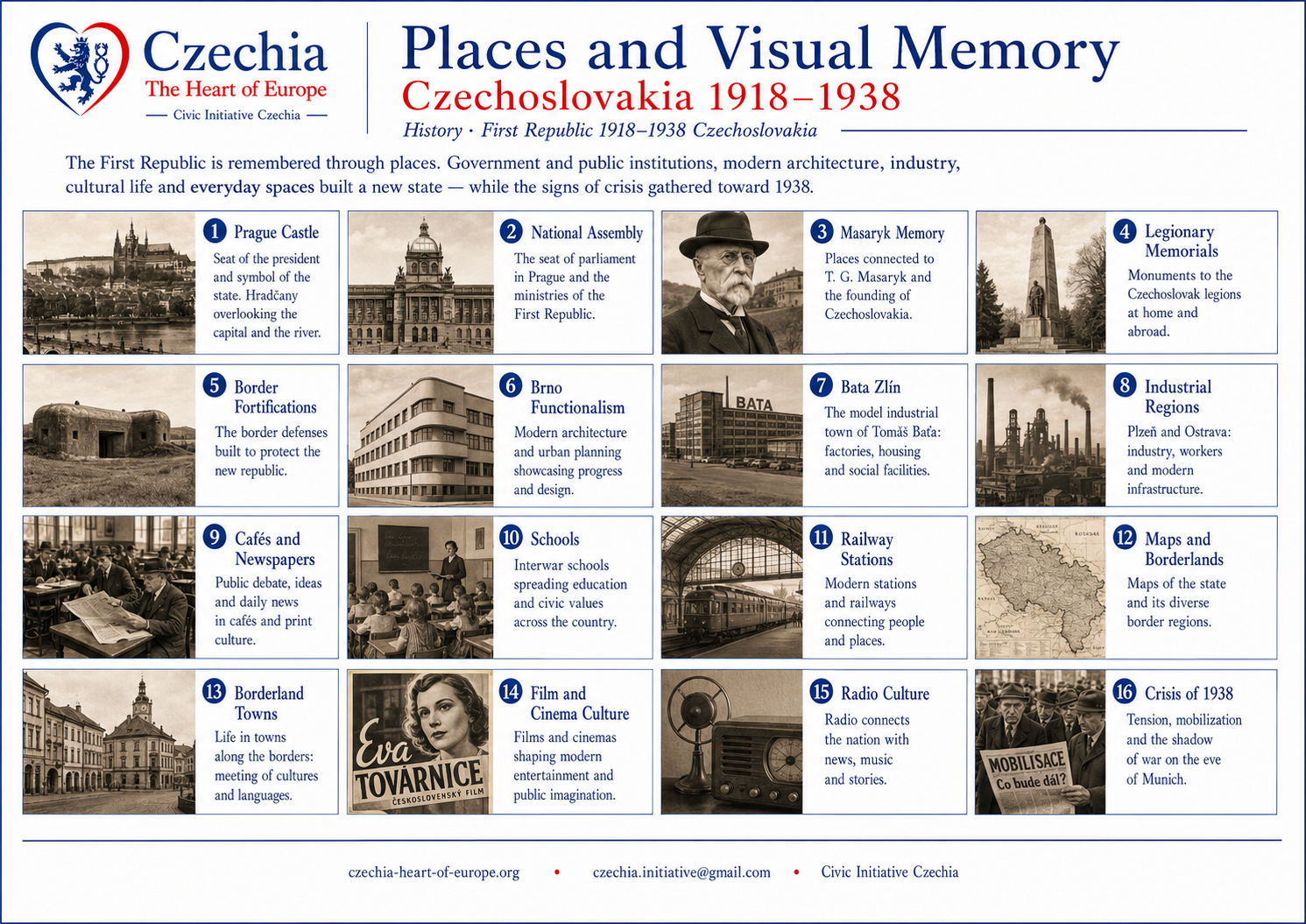
Places and visual memory
This period is best shown through Prague Castle and the presidential office, the National Assembly, First Republic ministries, Masaryk-related sites, legionary memorials, border fortifications, Brno functionalist architecture, Bata Zlín, industrial Plzeň and Ostrava, Prague cafés and newspapers, interwar schools, railway stations, maps of Czechoslovakia, borderland towns, film posters, radio culture and 1938 crisis imagery.