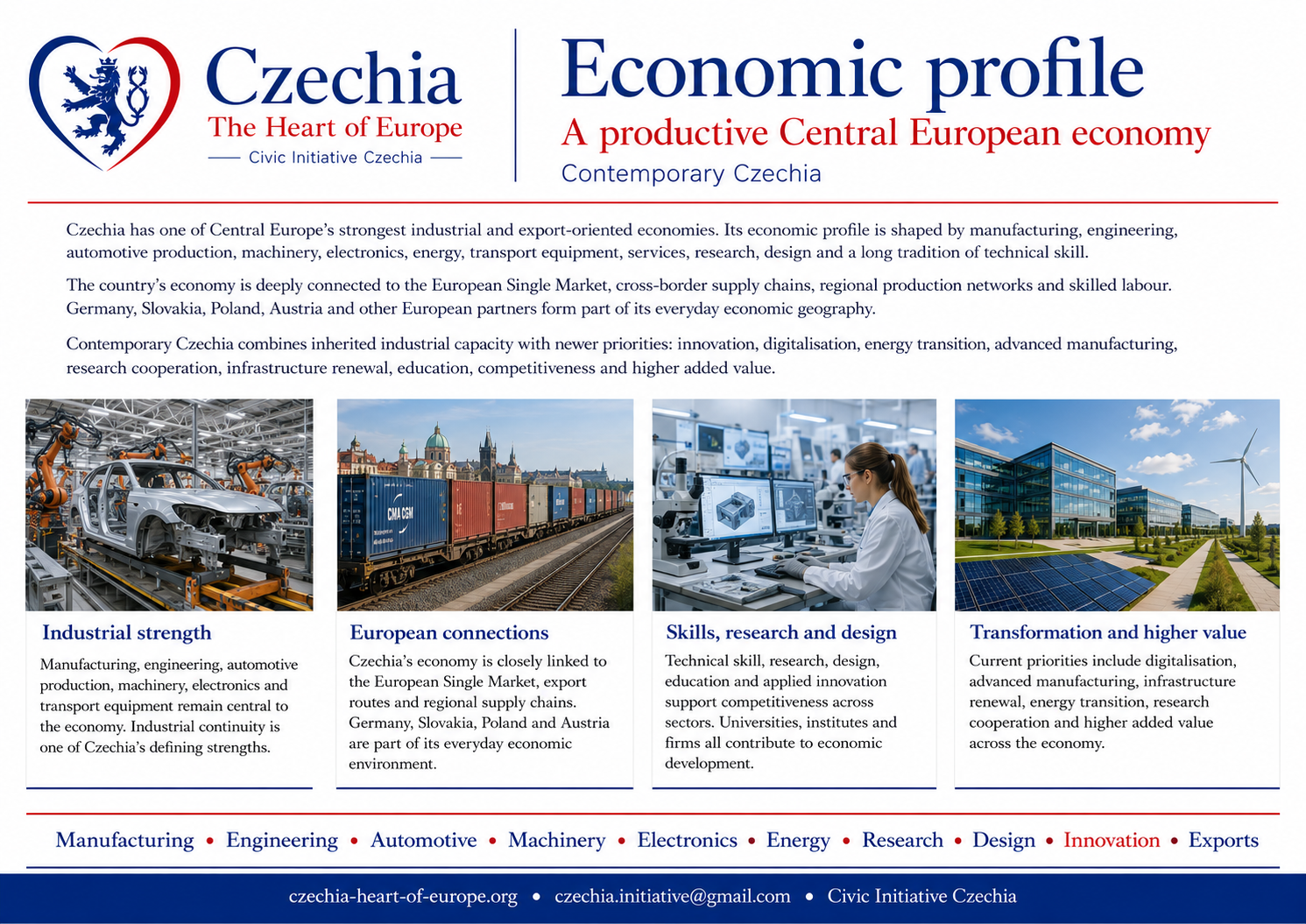
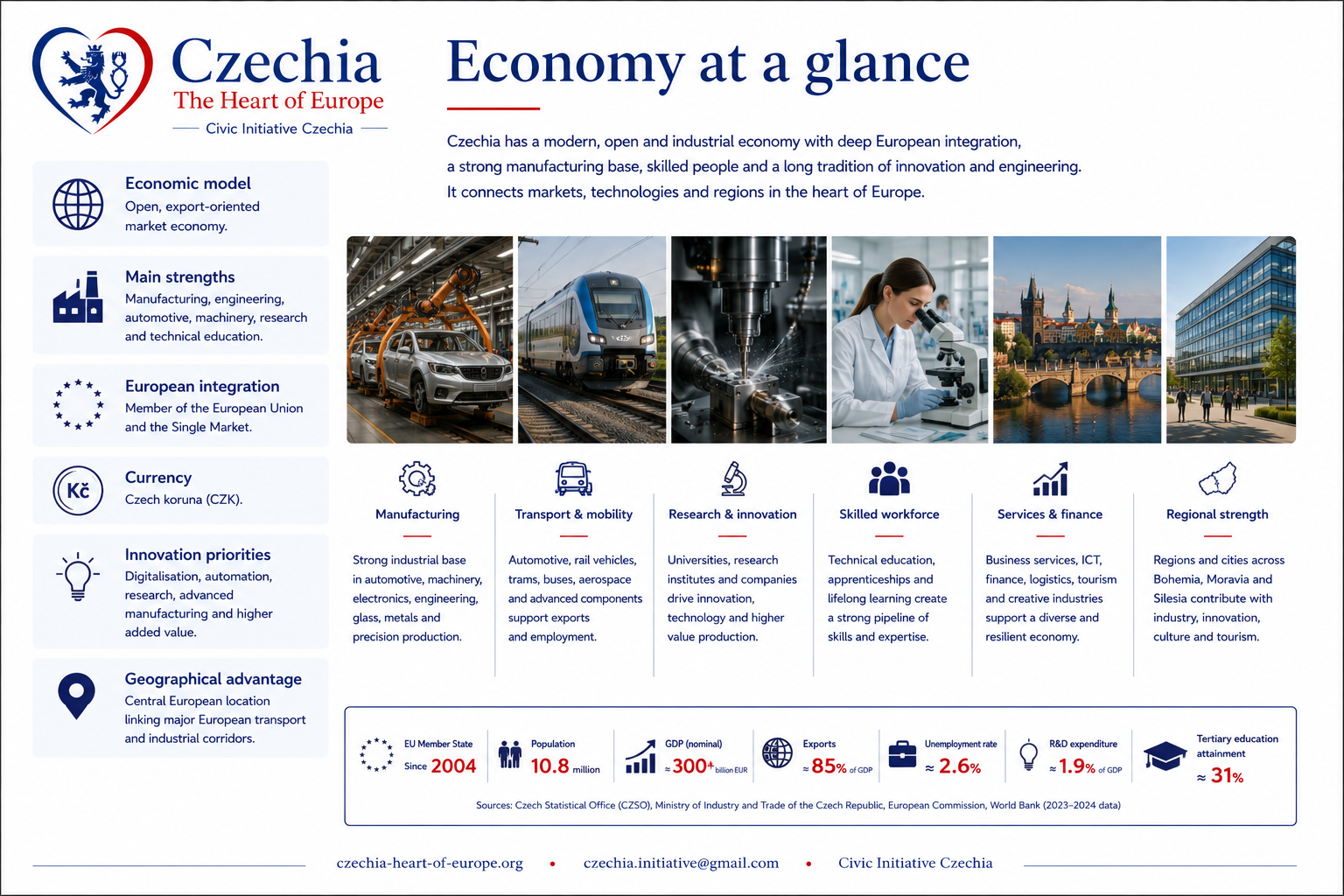
Czechia has one of Central Europe’s strongest industrial and export-oriented economies. Its economic profile is shaped by manufacturing, engineering, automotive production, machinery, electronics, energy, transport equipment, services, research, design and a long tradition of technical skill.
The country’s economy is deeply connected to the European Single Market, cross-border supply chains, regional production networks and skilled labour. Germany, Slovakia, Poland, Austria and other European partners form part of its everyday economic geography.
Contemporary Czechia combines inherited industrial capacity with newer priorities: innovation, digitalisation, energy transition, advanced manufacturing, research cooperation, infrastructure renewal, education, competitiveness and higher added value.
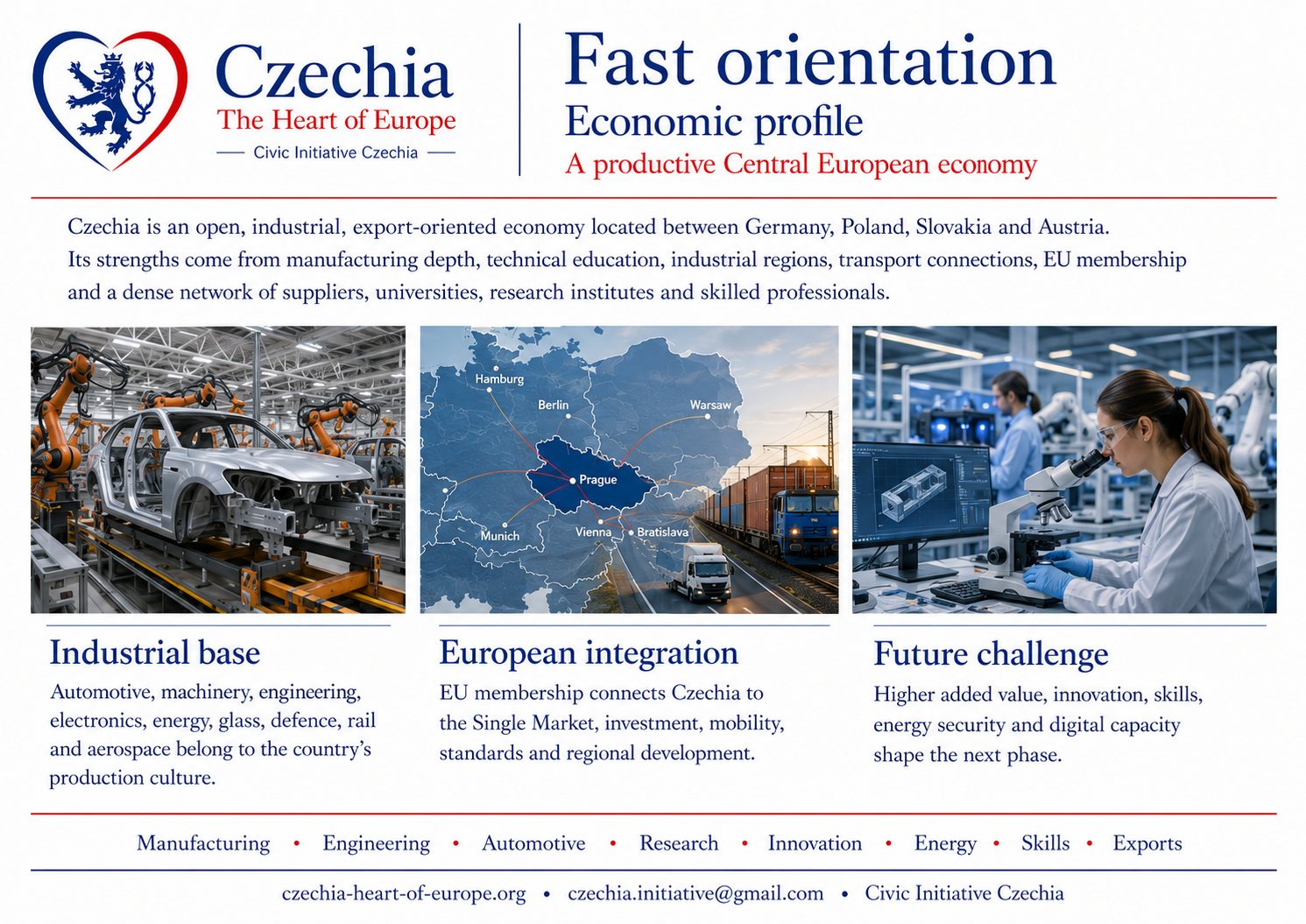
Czechia is an open, industrial, export-oriented economy located between Germany, Poland, Slovakia and Austria. Its strengths come from manufacturing depth, technical education, industrial regions, transport connections, EU membership and a dense network of suppliers, universities, research institutes and skilled professionals.
Industrial baseAutomotive, machinery, engineering, electronics, energy, glass, defence, rail and aerospace belong to the country’s production culture.
European integrationEU membership connects Czechia to the Single Market, investment, mobility, standards and regional development.
Future challengeHigher added value, innovation, skills, energy security and digital capacity shape the next phase.
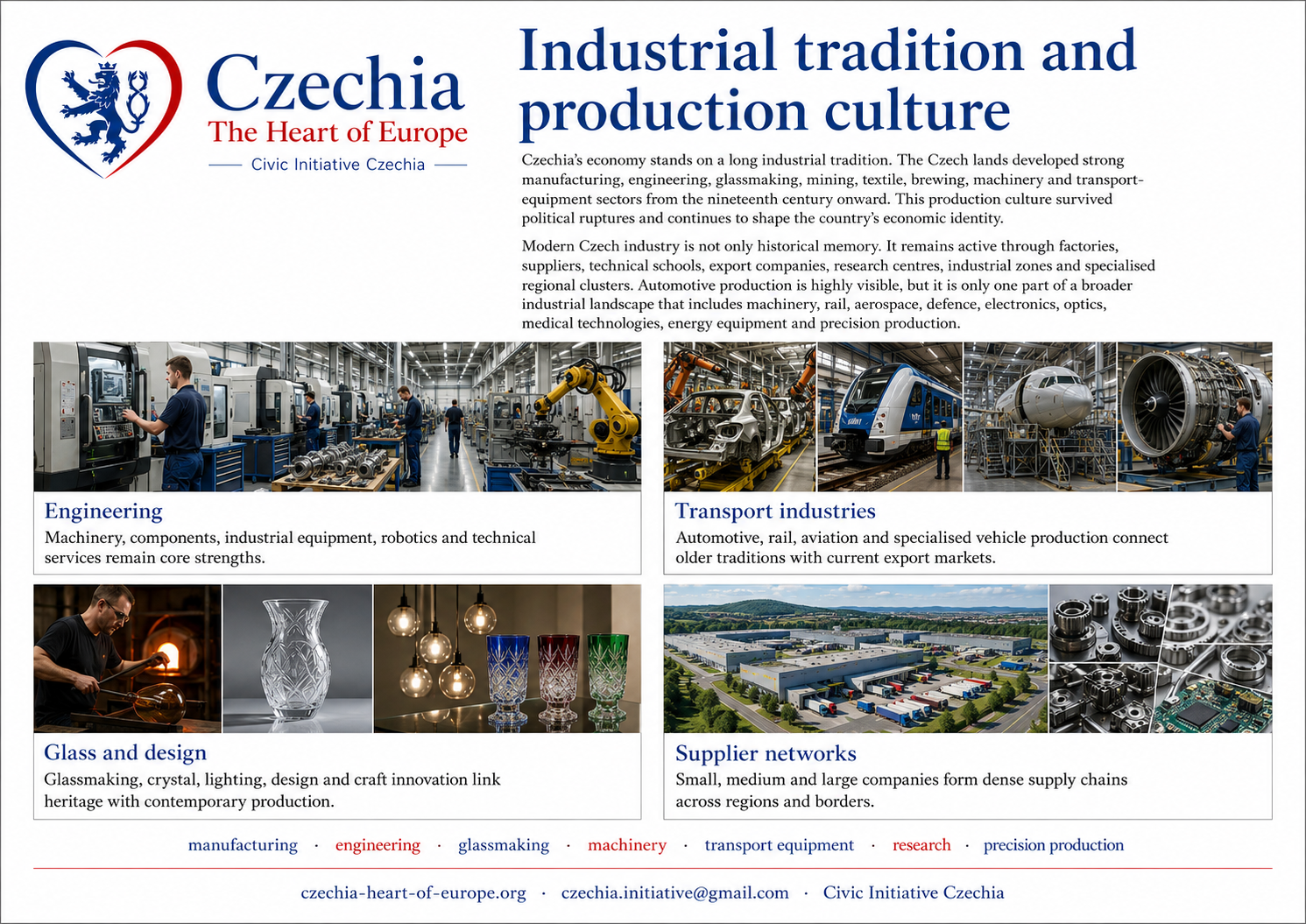
Czechia’s economy stands on a long industrial tradition. The Czech lands developed strong manufacturing, engineering, glassmaking, mining, textile, brewing, machinery and transport-equipment sectors from the nineteenth century onward. This production culture survived political ruptures and continues to shape the country’s economic identity.
Modern Czech industry is not only historical memory. It remains active through factories, suppliers, technical schools, export companies, research centres, industrial zones and specialised regional clusters. Automotive production is highly visible, but it is only one part of a broader industrial landscape that includes machinery, rail, aerospace, defence, electronics, optics, medical technologies, energy equipment and precision production.
Czechia is strongly integrated into European and global trade. Its exports are shaped by vehicles, machinery, electrical equipment, components, chemicals, plastics, metal products, precision manufacturing, services and knowledge-based sectors. Imports connect the country to energy, raw materials, components, technology and consumer markets.
Germany is the country’s largest trading partner, while Slovakia, Poland, Austria and other EU countries form a dense economic environment around Czechia. The country’s landlocked Central European position makes transport infrastructure, logistics, rail corridors, roads, airports and border cooperation essential to competitiveness.
Single MarketEU membership supports trade, services, standards, investment and cross-border production.
Germany linkGerman demand, suppliers and industrial networks are especially important for Czech exports.
Regional neighboursSlovakia, Poland and Austria create close economic, labour and logistics connections.
LogisticsRoad, rail, airports and warehouse networks support exports, tourism, services and industry.
Automotive, mobility and transport equipment
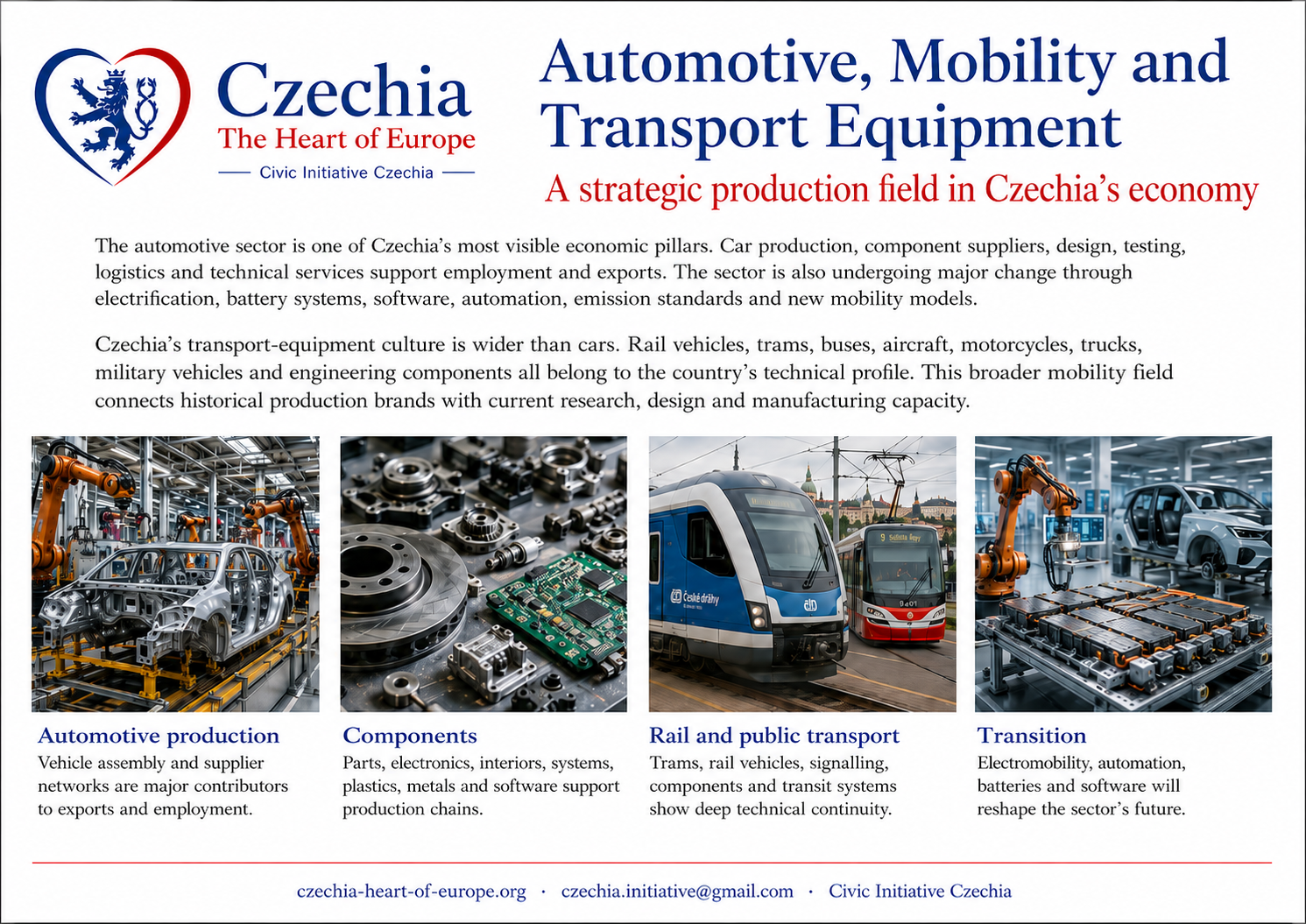
The automotive sector is one of Czechia’s most visible economic pillars. Car production, component suppliers, design, testing, logistics and technical services support employment and exports. The sector is also undergoing major change through electrification, battery systems, software, automation, emission standards and new mobility models.
Czechia’s transport-equipment culture is wider than cars. Rail vehicles, trams, buses, aircraft, motorcycles, trucks, military vehicles and engineering components all belong to the country’s technical profile. This broader mobility field connects historical production brands with current research, design and manufacturing capacity.
Automotive productionVehicle assembly and supplier networks are major contributors to exports and employment.
ComponentsParts, electronics, interiors, systems, plastics, metals and software support production chains.
Rail and public transportTrams, rail vehicles, signalling, components and transit systems show deep technical continuity.
TransitionElectromobility, automation, batteries and software will reshape the sector’s future.
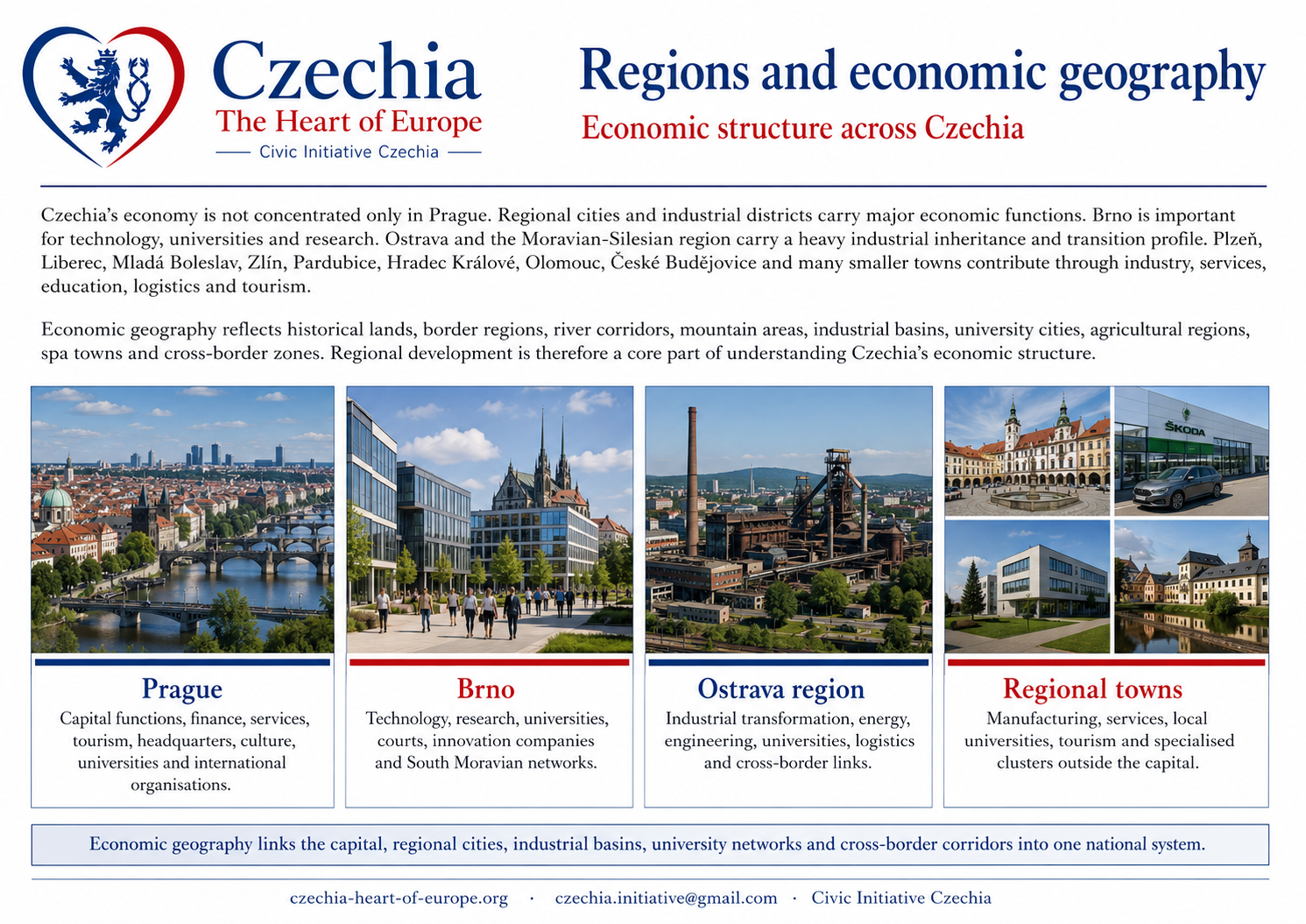
Czechia’s economy is not concentrated only in Prague. Regional cities and industrial districts carry major economic functions. Brno is important for technology, universities and research. Ostrava and the Moravian-Silesian region carry a heavy industrial inheritance and transition profile. Plzeň, Liberec, Mladá Boleslav, Zlín, Pardubice, Hradec Králové, Olomouc, České Budějovice and many smaller towns contribute through industry, services, education, logistics and tourism.
Economic geography reflects historical lands, border regions, river corridors, mountain areas, industrial basins, university cities, agricultural regions, spa towns and cross-border zones. Regional development is therefore a core part of understanding Czechia’s economic structure.
PragueCapital functions, finance, services, tourism, headquarters, culture, universities and international organisations.
BrnoTechnology, research, universities, courts, innovation companies and South Moravian networks.
Ostrava regionIndustrial transformation, energy, engineering, universities, logistics and cross-border links.
Regional townsManufacturing, services, local universities, tourism and specialised clusters outside the capital.
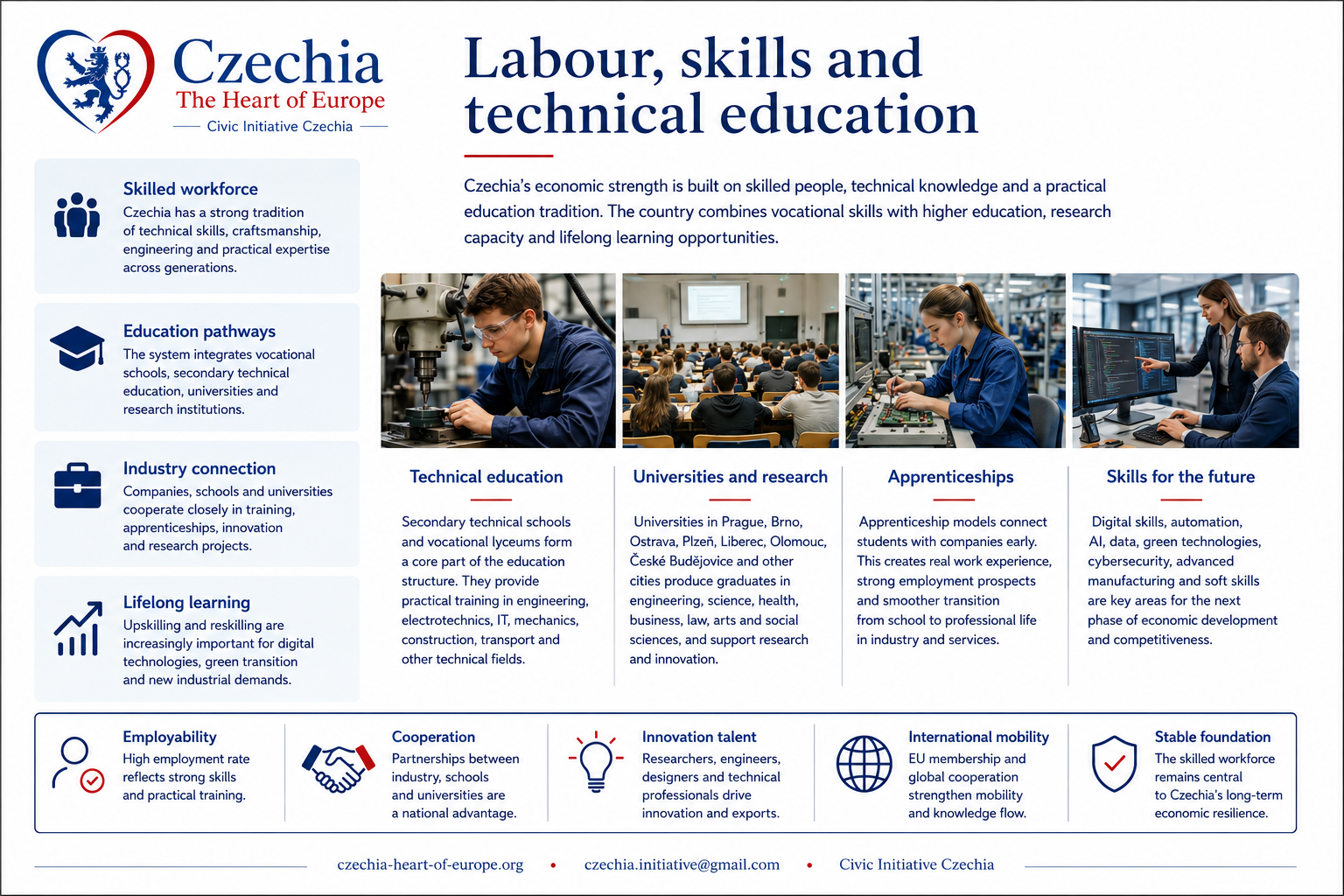
The Czech economy depends on skilled labour, technical education and professional competence. Industrial production requires engineers, technicians, machine operators, software specialists, logistics workers, designers, researchers, managers, electricians, welders, mechanics, language-capable staff and public-sector professionals.
Technical schools, vocational training, universities and company-based learning connect the economy to education. The future competitiveness of Czechia depends on whether skills can keep pace with automation, digital systems, energy transition, advanced manufacturing and international cooperation.
Vocational educationPractical training supports industry, services, construction, logistics, healthcare, hospitality and skilled trades.
UniversitiesTechnical, economic, scientific and humanities education supply specialists for public and private sectors.
Digital skillsSoftware, data, automation, cybersecurity and AI are increasingly important across sectors.
LanguagesEnglish, German, Slovak and other languages support business, tourism, science and cross-border cooperation.
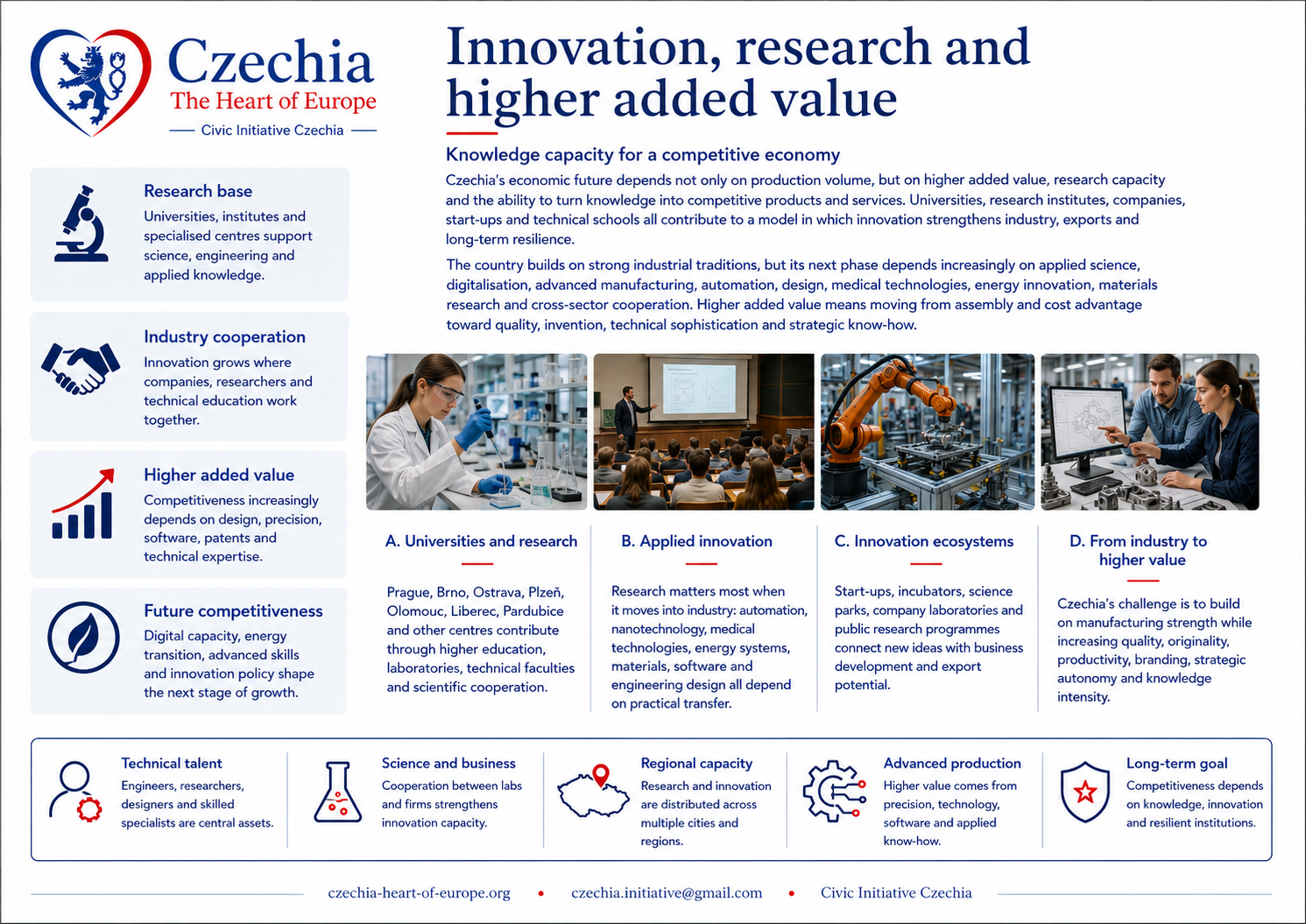
Czechia’s future economic position depends on the move from assembly and cost-based competitiveness toward higher added value. This means stronger research, design, software, patents, specialised production, advanced services, university-industry cooperation, strategic investment and the ability to keep knowledge in the country.
Innovation is not limited to start-ups. It also includes modernised factories, automated production, materials science, medical technologies, aerospace, defence systems, energy technologies, transport systems, nanotechnology, industrial design, cultural industries and digital public services.
Applied researchUniversities, institutes and companies develop practical technologies, materials and systems.
Advanced manufacturingAutomation, robotics, sensors, precision production and digital twins reshape industrial capacity.
Start-upsDigital companies and technology ventures add new layers to the traditional industrial economy.
Design and IPBrands, patents, product design and engineering know-how increase added value.
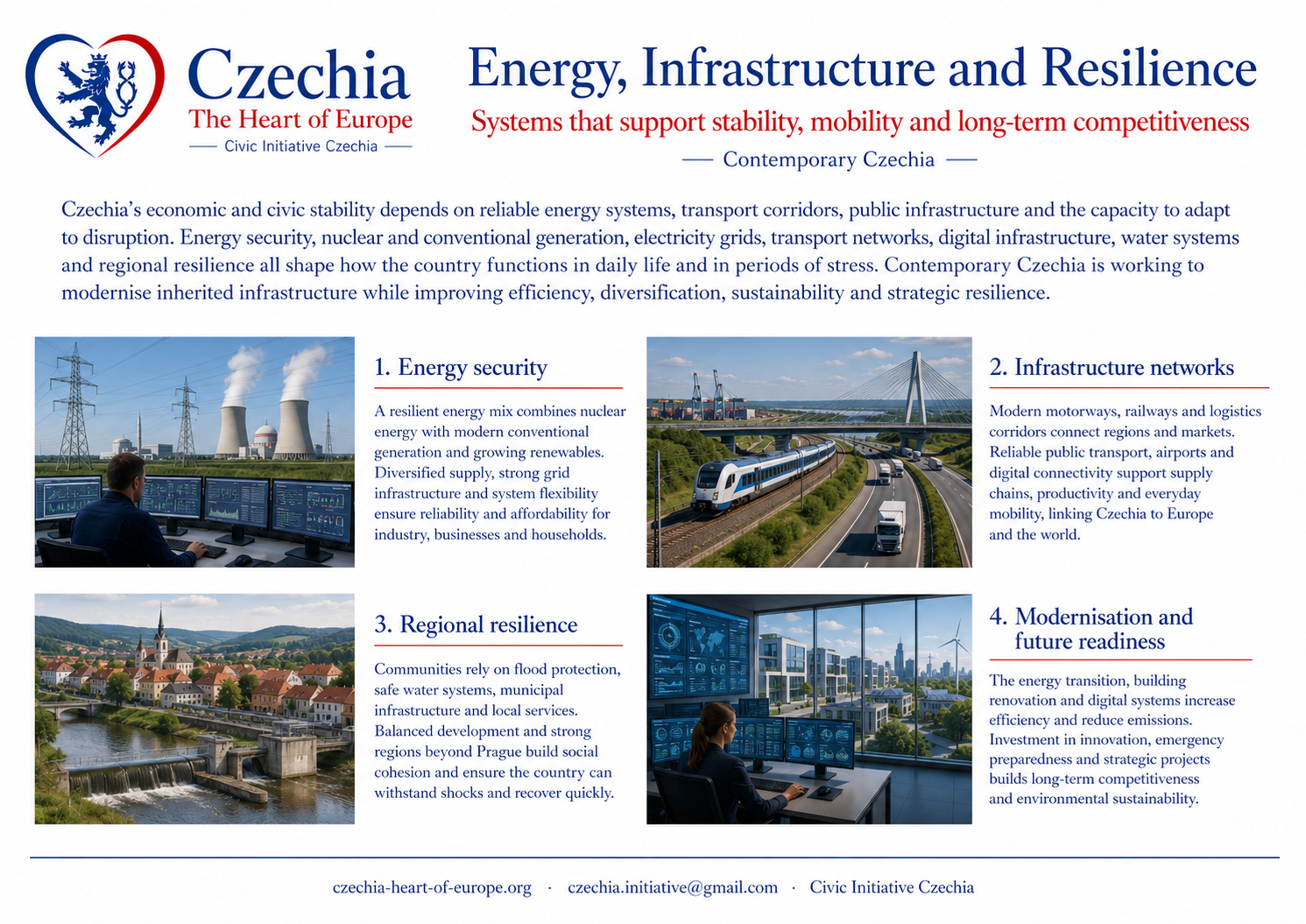
Energy security, infrastructure quality and resilience are central to Czech economic planning. Industry requires reliable electricity, heat, transport, water, logistics, digital networks and skilled maintenance. The energy transition brings questions of nuclear power, renewables, grids, storage, efficiency, industrial decarbonisation and affordability.
Transport infrastructure connects regions to markets. Rail corridors, highways, airports, urban public transport, freight terminals and cross-border routes support exports, tourism, commuting and logistics. Digital infrastructure is equally important for cybersecurity, data services, remote work, research and public administration.
Energy mixNuclear, renewables, grids, efficiency and industrial needs shape long-term energy strategy.
TransportRoad, rail, public transport, airports and freight logistics connect production regions to Europe.
Digital networksConnectivity, cybersecurity, cloud services and public digital systems support modern competitiveness.
ResilienceSupply chains, energy security, climate adaptation and strategic sectors require long-term planning.
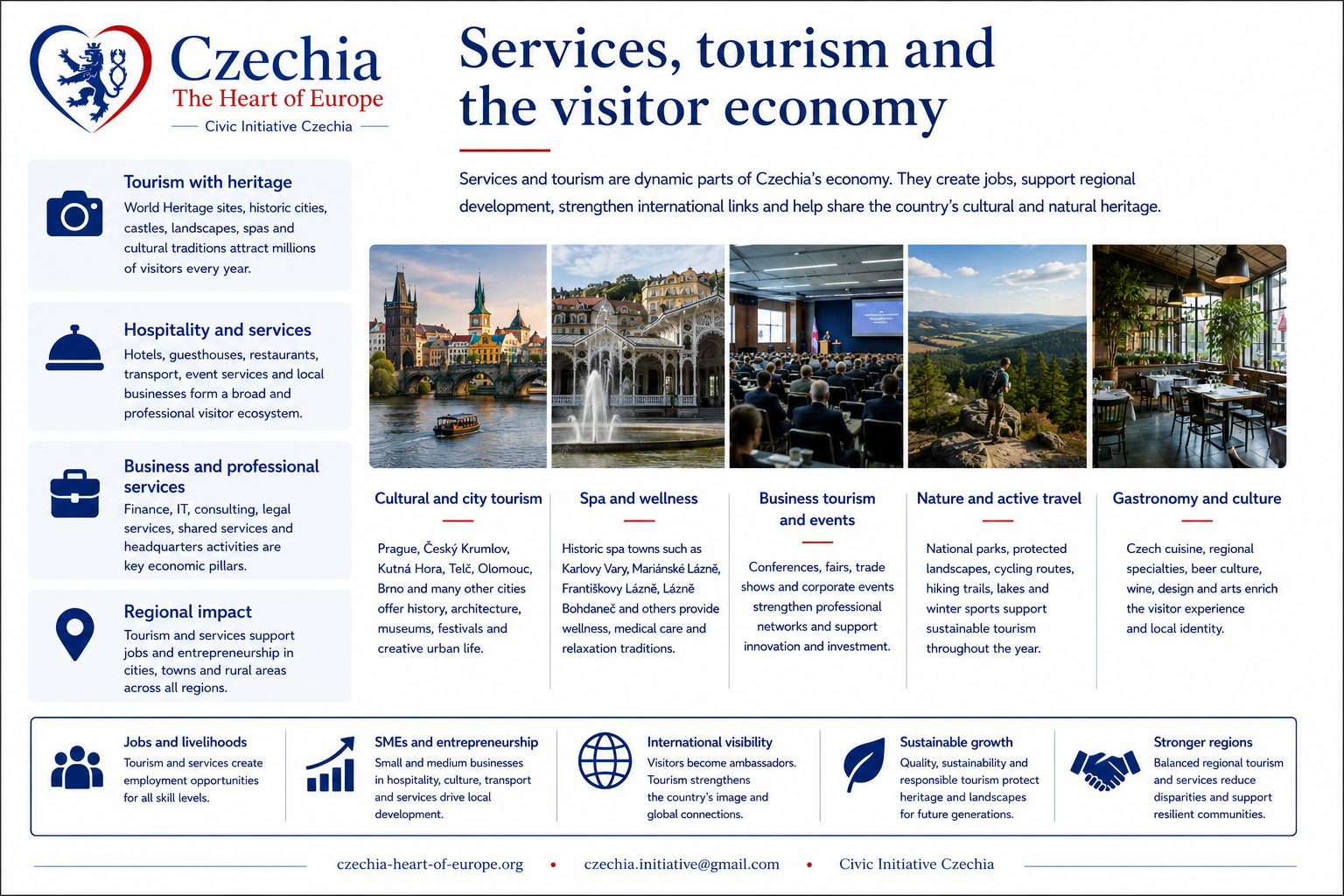
Services form a major part of the contemporary Czech economy. Finance, information technology, professional services, retail, logistics, healthcare, education, culture, hospitality, media, tourism and public administration all support employment and everyday economic life.
Tourism connects Prague, spa towns, castles, UNESCO sites, historic cities, landscapes, beer culture, music, festivals, Jewish heritage, industrial heritage and regional traditions. The visitor economy requires transport, accommodation, guides, language services, museums, restaurants, cultural institutions, digital information and local coordination.
Business servicesFinance, IT, consulting, design, legal services, administration and shared-service centres support the economy.
TourismPrague and the regions attract visitors through heritage, culture, landscapes, food, music and architecture.
Culture economyFilm, music, festivals, museums, publishing, design and creative industries generate both value and visibility.
Public servicesEducation, healthcare, transport and administration are economic sectors as well as civic infrastructure.
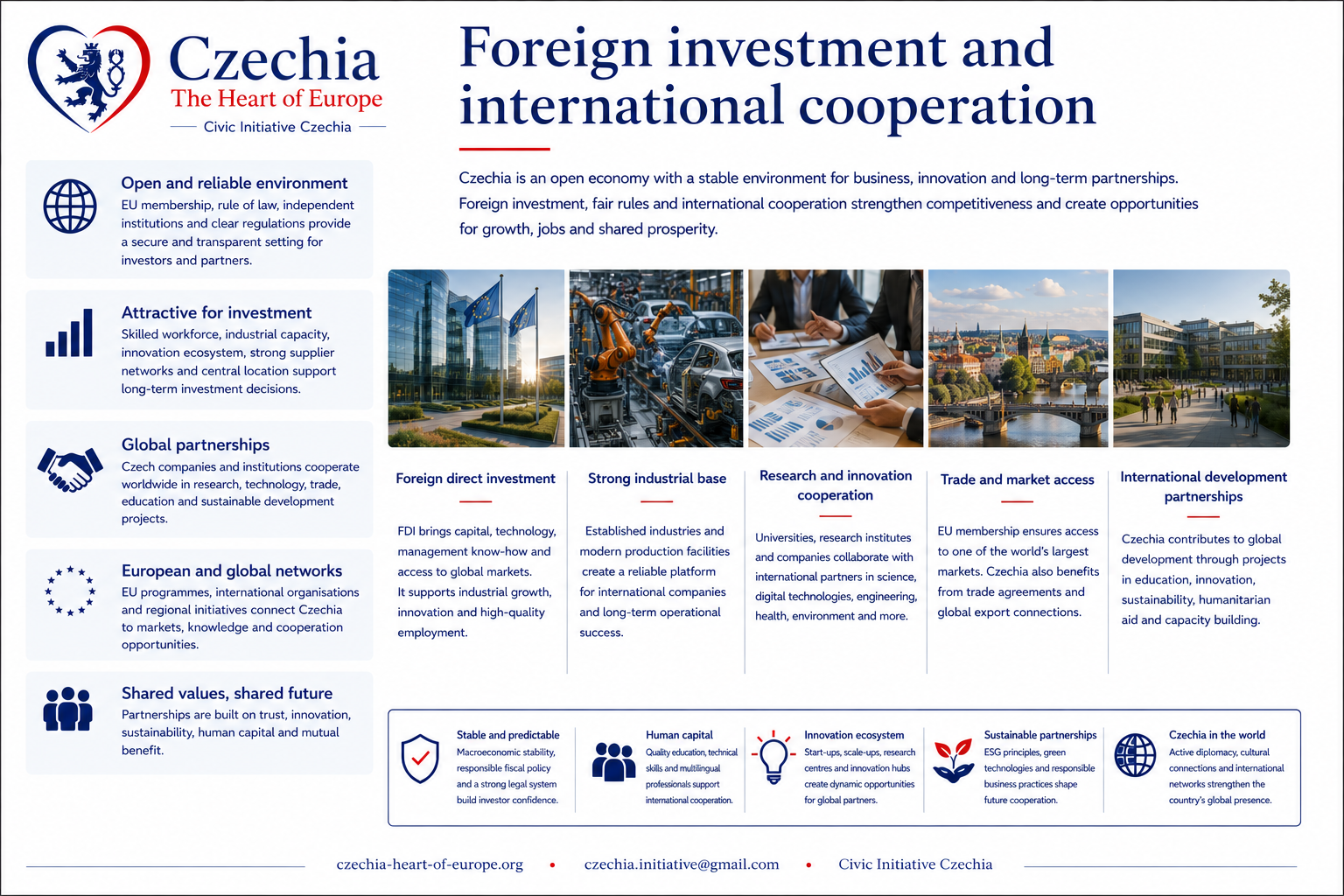
Czechia attracts international investment because of its central European location, industrial tradition, skilled workforce, transport links, political stability and integration into the European Single Market. Foreign companies operate alongside Czech-owned businesses, creating production networks that connect local suppliers with global markets.
Investment reaches manufacturing, technology, logistics, pharmaceuticals, engineering, finance, research, shared-service centres, digital industries and renewable-energy projects. At the same time, Czech companies increasingly expand abroad through exports, acquisitions, engineering services and specialised technologies.
InvestmentDomestic and international investment supports industrial modernisation, innovation and employment.
ExportsCzech products and services reach markets throughout Europe and beyond.
International partnershipsResearch, education and industrial cooperation strengthen competitiveness.
Regional integrationCross-border economic cooperation connects Czechia closely with neighbouring countries.
Like other advanced economies, Czechia faces structural challenges. Population ageing, labour shortages, housing affordability, energy transition, automation, digital transformation, infrastructure investment and global competition require long-term strategic planning.
Manufacturing must continue moving towards higher added value while maintaining industrial competitiveness. Universities, technical education, research institutions and companies increasingly cooperate to address these challenges through innovation, digital technologies and specialised expertise.
Contemporary economic policy increasingly focuses on productivity, innovation, resilience, energy security, skilled labour and sustainable long-term competitiveness rather than production volume alone.